FedEx is sounding the alarm about the global economy, with the shipping giant's weak quarter ricocheting across markets, and hinting at a broader — and potentially deep — downturn.
Why it matters: The diversity of goods flowing through FedEx's network serves as a barometer of the broader economy's health.
Driving the news: FedEx said revenue and profit in its first quarter ending Aug. 31 fell short of its expectations. The shipping giant "expects business conditions to further weaken in the second quarter," it said.
“Global volumes declined as macroeconomic trends significantly worsened later in the quarter, both internationally and in the U.S," CEO Raj Subramaniam said in a statement.
Subramaniam later told CNBC's Jim Cramer that he believes the world is headed toward a recession.
The impact: FedEx's stock swooned by over 21%, driving down the broader market. FedEx projected earnings per share of $3.44, well below the FactSet consensus of $5.05.
Threat level: FedEx outlined a slew of cost cuts designed to offset diving revenue, including:
Temporarily parking some aircraft and reducing flights.
Cutting labor hours, deferring hiring and reducing Sunday operations at some locations.
Closing more than 90 FedEx Office locations and five corporate offices.
Reality check: It's no secret that spending is shifting from physical goods to services like travel and entertainment, while inflation is undermining consumer confidence and spending power. It's surprising that FedEx didn't see that coming, and adjust accordingly.
"We are disappointed that FDX was not able to flex costs down quicker," Goldman Sachs analyst Jordan Alliger wrote in a research note.
What we're watching: Whether FedEx's troubles are truly reflective of wider troubles.
Consumers are still spending. Yet shipping companies had been "over-earning on pandemic-driven volume," Morgan Stanley analyst Ravi Shanker wrote in a research note.
FedEx's warning signals "the start of the post pandemic unwind" for FedEx and UPS, Shanker added.
Gautam Adani, founder and chairperson of the Indian conglomerate Adani Group. surpassed Jeff Bezos as the world's second richest person on Friday, according to the Bloomberg Billionaires Index.
Why it matters: Adani started the year at the 14th spot on the index before accumulating a $146.9 billion fortune that only lags behind Elon Musk's current worth of about $260 billion.
With monetary policy, what matters most is the destination, not the journey. What ultimately shapes the economy and markets is not a central bank's tactical moves, but how much it eventually raises interest rates.
Driving the news: Now, a seismic shift is underway in the outlook for the so-called terminal rate of this tightening cycle.
Celsius Network is charting its futurewhile mired in a bankruptcy proceeding that just got more interesting. Eager to resume business operations, the crypto lender is now asking the court for permission to sell its stash of stablecoins to fund operations, according to a filing submitted Thursday.
Why it matters: The company has yet to settle up with customers whose assets have been frozen on the platform since June. Yet it appears to be targeting a fresh crop of crypto newbies.
More homebuyers are paying cash and avoiding taking out mortgages, in what could be a longer-term structural change for the real estate market.
What's happening: About a third of all homebuyers in July paid cash.
That's down slightly from a peak earlier this year but still much higher than both pre-pandemic times and all of the 2021 buying frenzy, according to a Redfin analysis of county records across 41 of the biggest metro areas.
Elon Musk and Twitter are set to face off in court in October over whether Musk will be forced to go through with his offer to buy Twitter.
Why it matters: The richest man in the world, the most talked-about billionaire and the head of multiple companies shaping the future may soon also be the arbiter of free speech on the global public square.
The position of the U.S. Securities and Exchange Commission (SEC) with regard to cryptocurrencies — that existing regulations and guidances are adequate to cover this asset class — appears to be losing ground in Washington.
Driving the news: The White House released a series of reports this morning describing its Comprehensive Framework for Responsible Development of Digital Assets. In comments to reporters, the administration seemed to indicate it disagreed.
Dollars should be faster by now, and the White House wants to do its part to speed them up.
Driving the news: Based on a fact sheet summarizing several reports coming from the Biden administration today, stemming from the President's March executive order, the administration is prioritizing speeding up domestic and international payment.
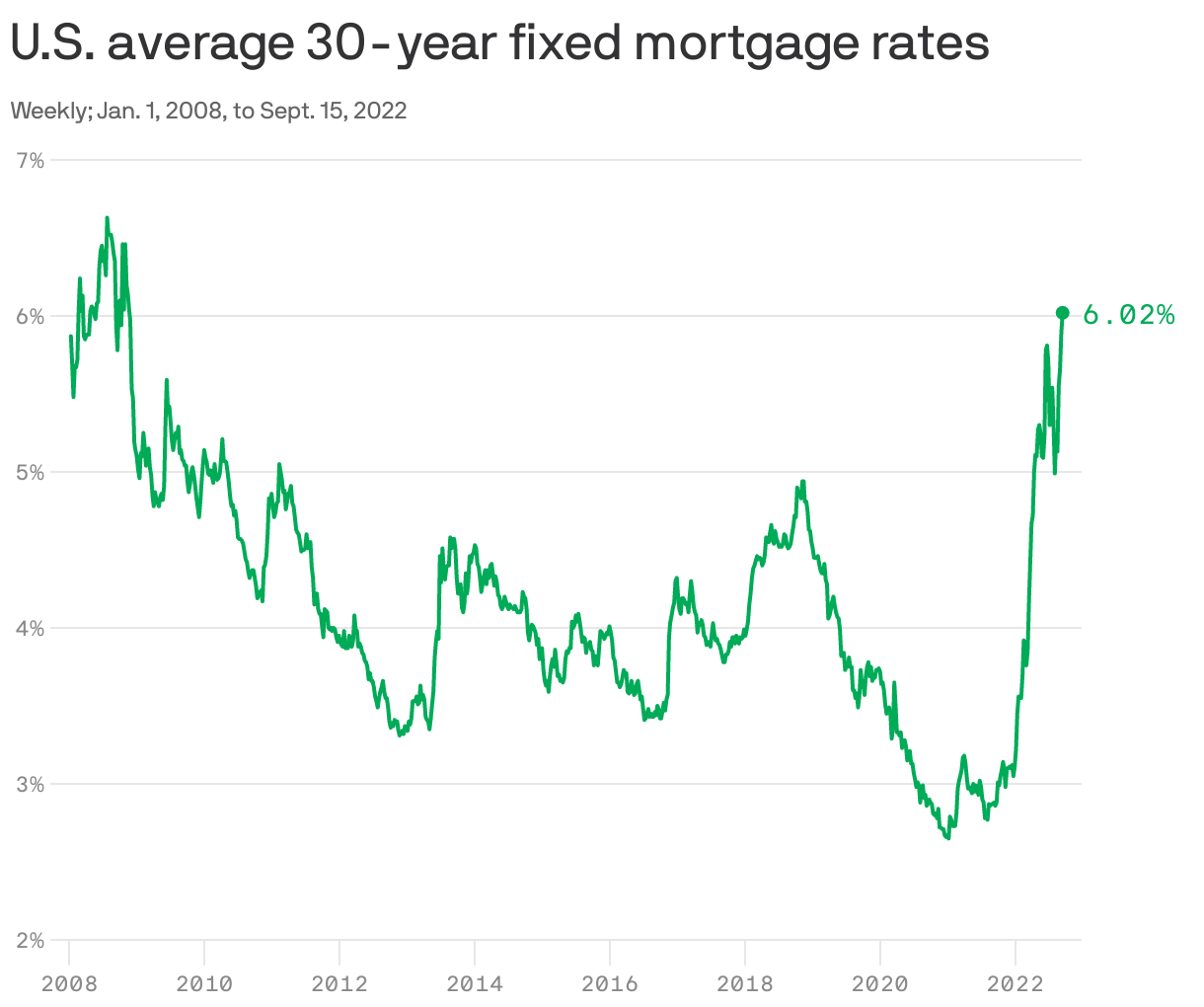
Mortgage rates have breached 6%, the latest avatar of an inflation-throttled economy that, even with its mounting challenges, is squeezing homeowners and leaving potential buyers with few affordable options.
Why it matters: There's little relief in sight for renter or homeowner sticker-shock, as inflation puts the Federal Reserve squarely on the path toward higher interest rates, even as the economy loses momentum.
The Biden administration on Thursday announced the U.S. will provide another round of military aid to Ukraine, this time for $600 million, as Russia's invasion nears the seven-month mark.
The latest: Ukraine's President Volodymyr Zelensky, who this week urged Western allies to hasten weapons deliveries after a Ukrainian counteroffensive forced Russia's military to retreat from the Kharkiv region, welcomed the latest U.S. aid package in a tweet saying, "Together we'll win!"
The UN food chief said Thursday the war in Ukraine is worsening an "unprecedented" global emergency, with up to 345 million people in 82 countries "marching towards starvation."
Driving the news: Surging food, fuel and fertilizer costs related to the war have driven some 70 million people closer to starvation, UN World Food Program Director David Beasley told the United Nations Security Council.
I had one speed when we launched Politico 15 years ago: fast and furious.
That was terrific for muscling a new brand into existence — but terrible for retaining talent. Soon, we were haunted by a reputation for being a sweatshop with an untenable burnout rate.
Why it matters: One speed for all circumstances is a crazy, reckless way to drive through life. We all need to learn to swerve away from running too hot or too cold, too often.