Friday's economy & business stories

Mothers make their way back to work
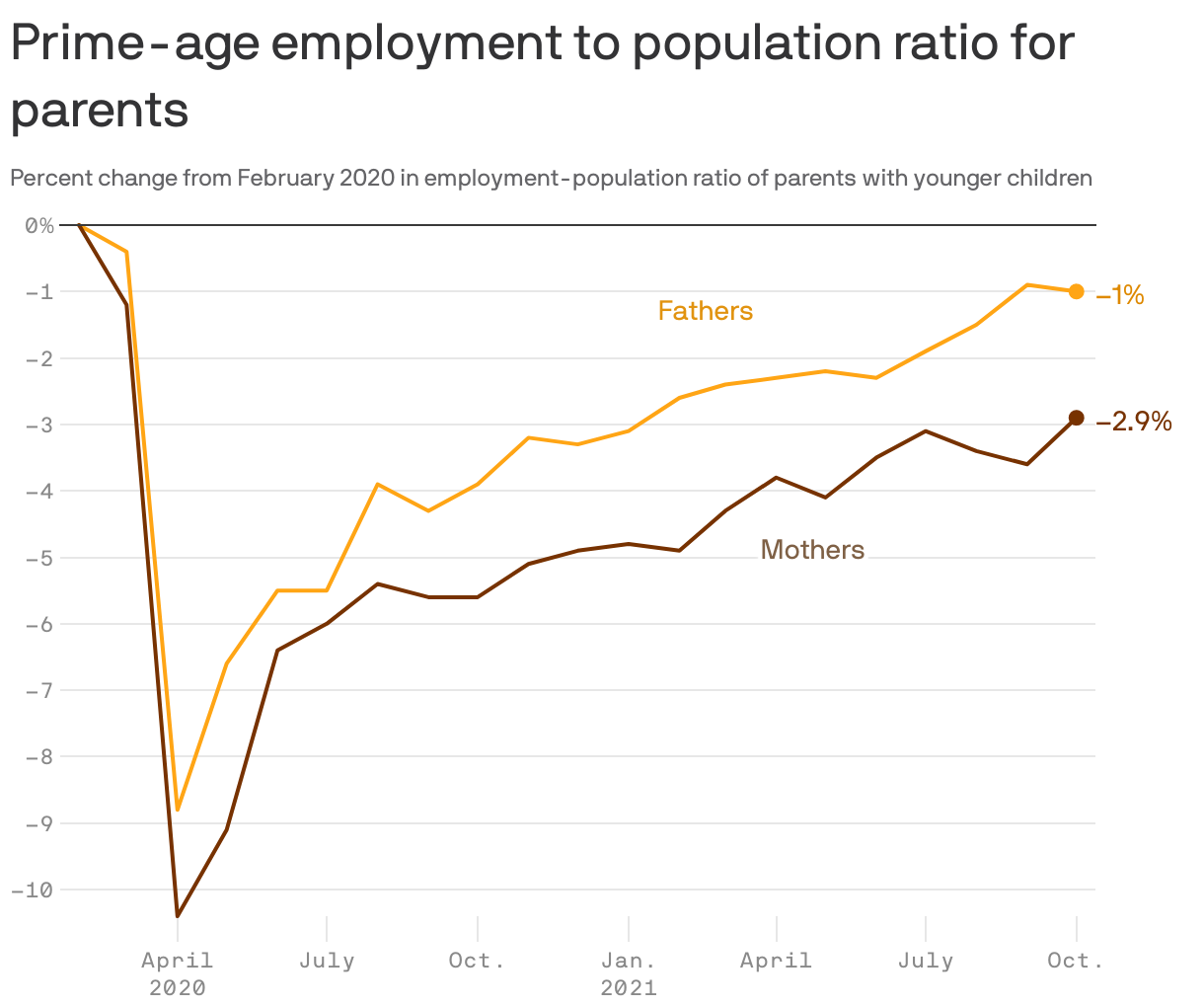
As the pandemic-era circumstances that drove a million American mothers out of work start to dissipate, that huge population of workers is coming back in greater numbers.
Why it matters: Employment for working-age moms rose at a faster rate than any other group of prime-age workers (those between the ages of 25 and 54) in October, according to new Current Population Survey data analyzed by Indeed Hiring Lab.

For investors, Rivian isn't the next Tesla

Electric vehicle maker Rivian closed trading Thursday valued at nearly $105 billion, two days after completing the largest U.S. IPO since Alibaba in 2014. In short, investors are betting that Rivian can become the next Tesla, whose own market cap stands above $1 trillion. It's a bad bet.
Our thought bubble: This isn't a commentary on Rivian's products, management or ability to deliver on its long list of preorders. Nor is this stock advice; as I once upbraided Google's venture investors for not taking money off the table at IPO.
- Instead, this is about ROI.

Early November was the perfect time to buy a barrel of cheese


If you’re in the market for a barrel of processed cheese, a short window in late October and early November would have been the time to buy.
The big picture: Schreiber Foods, a Wisconsin dairy, suffered a cyberattack that shut its operations for several days late last month, the Wisconsin State Farmer reported.

Johnson & Johnson says it will split into two companies

Johnson & Johnson announced Friday it will split off its $15-billion-a-year consumer health division to form two independent companies in 2022.
Why it matters: The move will create a slower-growing health care vendor that sells consumer brands like Band-Aid bandages, Tylenol medicines and Johnson’s Baby Powder and a high-margin but riskier advanced research pharmaceutical and medical device company.

A reality check on Glasgow net zero pledge by major financials

A slew of global financial institutions say they’re all tuning in to the same frequency on fighting climate change. The devil will be in the details — and it will take public and regulatory oversight to hold them to their voluntary pledges.
Why it matters: With scientists now warning that the effects of climate change are taking place faster and in more severe ways than expected, activists argue that pledges alone aren’t enough. Advocates, meanwhile, say a large-scale agreement is a step in the right direction.

Changes to Apple's App Store could come fast

While legislators and regulators around the world weigh big changes to Apple's and Google's app stores, some quick revisions could be coming within weeks, thanks to a U.S. judge's decision and a Korean law.
Why it matters: Control of app stores and their hefty commissions is what has made owning mobile operating systems so valuable for both companies, especially Apple.
The future of dressing rooms
One snag in shopping for clothes online is that there's no way to try before you buy. Virtual dressing rooms — if the tech gets good enough — could solve that problem.
Why it matters: E-commerce is taking more and more of brick-and-mortar's share of retail, growing up to five times faster during the pandemic than it was before, per McKinsey. The rise of virtual dressing rooms could propel that growth even further.
- The top reason why people shop for clothes in person is to try them on, per an NPD Group report from 2019 (cited by Morning Brew in a must-read deep dive into the tech behind virtual dressing rooms).
- Return rates have skyrocketed during the pandemic as people have been buying more online. Some 42% of U.S. consumers surveyed returned items between March 2020 and March 2021, per Coresight Research. And all those returns are costly for retailers to process.
But since 2010, apparel retailers — including Warby Parker, Walmart, Nike Amazon and Asos — have been experimenting with tech that lets people test stuff out at home, Morning Brew reports.
The options range from something as simple as a front-facing camera filter, which lets you see how a pair of sunglasses might look on your face, to Drapr, a startup acquired by Gap that lets you create a 3D avatar and see how you'd move in the new threads.
And the innovations in fitting rooms aren't just happening in the virtual world.
- More and more brick-and-mortar stores are sprucing up their dressing rooms — and leaving behind those drab closets with fluorescent lighting — to make the experience better for shoppers.
- As a result, people return a greater share of items they buy online than in person.
- Take Reformation, a women's clothing store, which has tech-infused fitting rooms with different light settings so that you can see how an outfit will transition from day to night. There are also screens inside the rooms that let you summon clothes to try on, or buy something you're loving, without ever having to speak to a salesperson.
What to watch: 50% of millennials and 45% of Gen Zers polled said they mostly shop online, per a Morning Brew–Harris Poll survey.
- But just 19% of millennials and 11% of Gen Zers surveyed had tried virtual dressing room tech.
- We'll see how quickly consumers become comfortable with it.

Lasting changes ahead for "Generation COVID"

The generation of kids and young adults who are coming of age in the midst of the pandemic will likely be shaped by COVID for the rest of their lives — and researchers are starting to offer a glimpse at how.
Why it matters: Massive news events — most recently the Great Recession and the Sept. 11, 2001 terrorist attacks for older millennials — can be drivers for changing how generations generally view the world, spend money and form relationships.
Driving the news: While there's no way to really know what will happen, behavioralists are trying to understand which changes might ultimately stick for Gen Z, as well as younger kids which some have started calling "Generation C."
State of play: Gen Z — roughly defined as those born between 1997 and 2012 — includes elementary-age kids up to young adulthood.
That means those on the older end of the spectrum are in their early 20s, in their college years, or their first jobs.
- Many of these young people were the last hired and the first fired during the pandemic, Jason Dorsey, president of the Center for Generational Kinetics, a research and strategy firm, tells Axios.
- That could be triggering higher desires to save money or spend it on quality items that have longevity like staple fashion pieces instead of fast fashion, the firm found in its research which is expected to be published later this year.
- Gen Z has reported greater symptoms of burnout to employers and expressed concerns about falling behind or missing out because the pandemic is impacting such as a formative period of their lives, Jessica Stollings-Holder, president of ReGenerations, which studies generational trends, told the Society for Human Resource Management.
- "They've seen a lot in a short amount of time, so this becomes a really intense moment for them," Stollings-Holder said, per SHRM.
- And in what has turned into a highly competitive market, Gen Zers have found themselves in the enviable position to ask more about workplace benefits early in their careers, Dorsey said. In some cases, perks have expanded to include pet insurance, manicures and even, free clothes, the Wall Street Journal reported.
Between the lines: When we get to younger children — between 8 and 14 — we see many in this generation may have developed a profound sense of mortality at a very young age, researchers say.
- More than 175,000 children in the U.S. have lost a parent or grandparent due to COVID-19.
- Many children have been simultaneously exposed to news of COVID case counts and death counts either by overhearing news coverage or adult conversations about COVID in a way that hasn't been seen since the Vietnam War, Dorsey said.
- "This is something they're now being conditioned to seeing on a regular basis," Dorsey added. "That's really heavy, what the generation is carrying with them."
The big picture: The dramatic increase in technology for education, socialization, and recreation during the pandemic likely vastly increased kids' already high trust and perceived reliance on technology and social media, especially under the age of 13, Dorsey said.
- "Even though the parents didn't necessarily want them to use their mobile devices all that much, the reality is they were on it because they weren't in school and weren't doing other activities," Dorsey said.
The intrigue: Researchers hypothesize small children growing up today may end up following different social norms.
- Several qualitative studies and surveys by Dorsey and Alice Fothergill, professor of sociology at the University of Vermont, show developmentally significant differences in kids' comfort with physical touch and worries they'll get loved ones like their grandparents sick.
- Young children growing up during the pandemic saw constant handwashing, virtual learning, mask-wearing, and social distancing. It's left researchers curious about whether social norms of personal space and hygiene will remain changed in the future with those who experienced the pandemic at a younger age.
The bottom line: We've never seen a crisis quite like this that impacts all demographics and groups of kids and it will likely change them in significant ways long into the future.
Your new apartment is someone's old office

Abandoned office buildings all over the U.S. are being converted into apartments.
By the numbers: In 2020 and 2021, a whopping 13,250 apartments across the country have come from repurposed offices, per a new report from RentCafe.
Exclusive: Blackstone hits goal of hiring 100,000 veterans

The Blackstone Group will announce Thursday that it has reached its goal of having its portfolio companies hire 100,000 military veterans and spouses over the past eight years.
Why it matters: U.S. military veterans have higher rates of unemployment and suicide than do nonveterans.

Elon Musk sells almost $5 billion of Tesla shares

Elon Musk has sold almost $5 billion in Tesla stock during a spate of transactions, CNBC first reported Wednesday evening.
Why it matters: The sale follows Musk's posting of an informal poll on Twitter Saturday, asking his followers whether he should sell about 10% of his shares in Tesla and after the company's stock fell 12% on Tuesday.