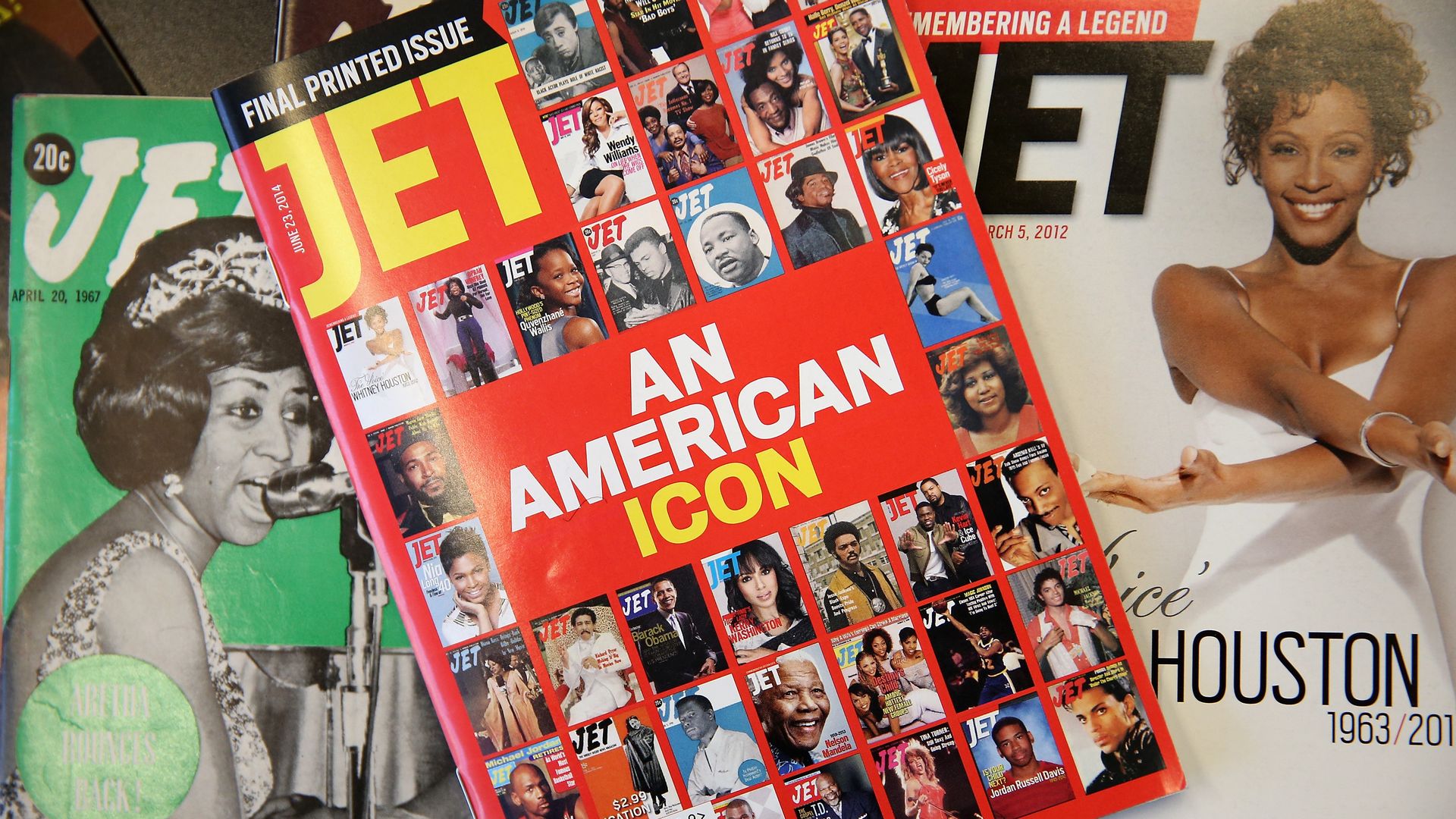
Johnson Publishing Co., the Chicago-based former owner of Ebony and Jet magazines, announced Tuesday it has filed for Chapter 7 bankruptcy protection and plans to sell its assets, adding that there’s "a confluence of adverse events and factors outside of the company’s control led to this decision."
"This decision was not easy, nor should it have been. Johnson Publishing Company is an iconic part of American and African American history since our founding in 1942, and the company’s impact on society cannot be overstated."
— Johnson Publishing Co., said in a statement.
Why it matters: The business was founded in 1942 by Johnson H. Johnson, who died in 2005, and became an iconic black-owned media organization. It currently has "an extensive archive of about 4 million images and 10,000 video assets from its former magazines and a cosmetics business, Fashion Fair Cosmetics," according to CNN. Johnson Publishing sold Ebony and Jet, its two hallmark magazines, to a private equity firm in 2016 to reduce its debt.
The International Monetary Fund cut its expectations for global growth from 3.5% to 3.3% — the third downgrade since October, as Reuters points out — and said major risks to the world economy like the U.S.-China trade war and Brexit are skewed to the downside.
Why it matters: The IMF's economic downgrade is broad based. Per its latest outlook, the group dialed down growth expectations across the eurozone, Latin America, the U.S., the U.K. and Australia. Its more optimistic projections for next year's economic growth — at 3.6%— "relies on an expected rebound in growth in Argentina and Turkey" as well as other "stressed developing economies, and is therefore subject to considerable uncertainty," the report says.
The Athletic, a subscription-based digital sports media company, is launching a multi-million dollar podcasting business. Over 20 exclusive, ad-free podcasts will debut behind the company's subscription paywall on its app and website on Tuesday. The podcasts will be produced in-house by a team of 12 new hires.
Why it matters: The sports podcasting space has become more crowded over the past few years, with digital upstarts like Barstool Sports, The Ringer and SB Nation, in addition to TV sports giants like Fox Sports and ESPN, all launching new podcasts. The Athletic is hoping to differentiate itself by focusing on quality, hyper-localized podcasts that live only behind a paywall.
The world’s biggest tech companies are spending billions of dollars on projects to get more people around the world connected to the internet.
Why it matters: Tech companies historically have specialized in services like social media or payments that ride on top of internet connections, rather than building the networks themselves. But their businesses can't grow without quick expansion of the web, and owning the broadband pipes is becoming just as important as owning the content that runs through them.
Chuck E. Cheese, the restaurant chain where kids eat pizza with their bare hands after swimming around in a plastic ball pit, is going public via a reverse merger with Leo Holdings (NYSE: LHC), a blank check acquisition company formed by private equity firm Lion Capital.
Why it matters: This would be the first restaurant company to enter the U.S. public markets in four years. Or, in this case, re-enter.
Endeavor continues to work toward an IPO later this year, but it no longer looks like the Hollywood talent agency that Ari Emanuel first built and later merged with William Morris.
The big picture: Endeavor, backed by such investors as Silver Lake and SoftBank, has arguably morphed into an events company. Not only through the purchases of Ultimate Fighting Championship and Professional Bull Riders, but also through a video streaming effort that's signed such event-centered clients as World Wrestling Entertainment.
The latest report from the CFTC shows net shorts on bitcoin Cboe futures rose to 1,343 contracts, from 1,244 the previous week, after the cryptocurrency's recent surge.
Driving the news: Bitcoin jumped 20% to its highest level since November last week, moving briefly above the $5,000 mark. A Reuters report credited the surge largely to "an order worth about $100 million spread across U.S.-based exchanges Coinbase and Kraken and Luxembourg’s Bitstamp."
The Dow gained nearly 500 points last week to close at 26,424. It's now just "1.5% shy of its all-time high of 26,828.39, set on Oct. 3, 2018," Barron's notes. The S&P 500 is just 1.3% from its record close, and the Nasdaq is just 2.1% away from a record high.
Why it matters: U.S. stocks have shaken off almost all of their December sell-off, yet banks continue to report that investors are selling, not buying, equities.
The March jobs report showed that nationwide, wage growth is settling in right above 3%, but it has been growing much faster for retail workers. Unlike most segments of the economy, retail workers' wages are now growing faster than they were during the boom years of the early 2000s.
The big picture: The outperformance is being driven by a combination of state-by-state legislation and a shrinking talent pool.
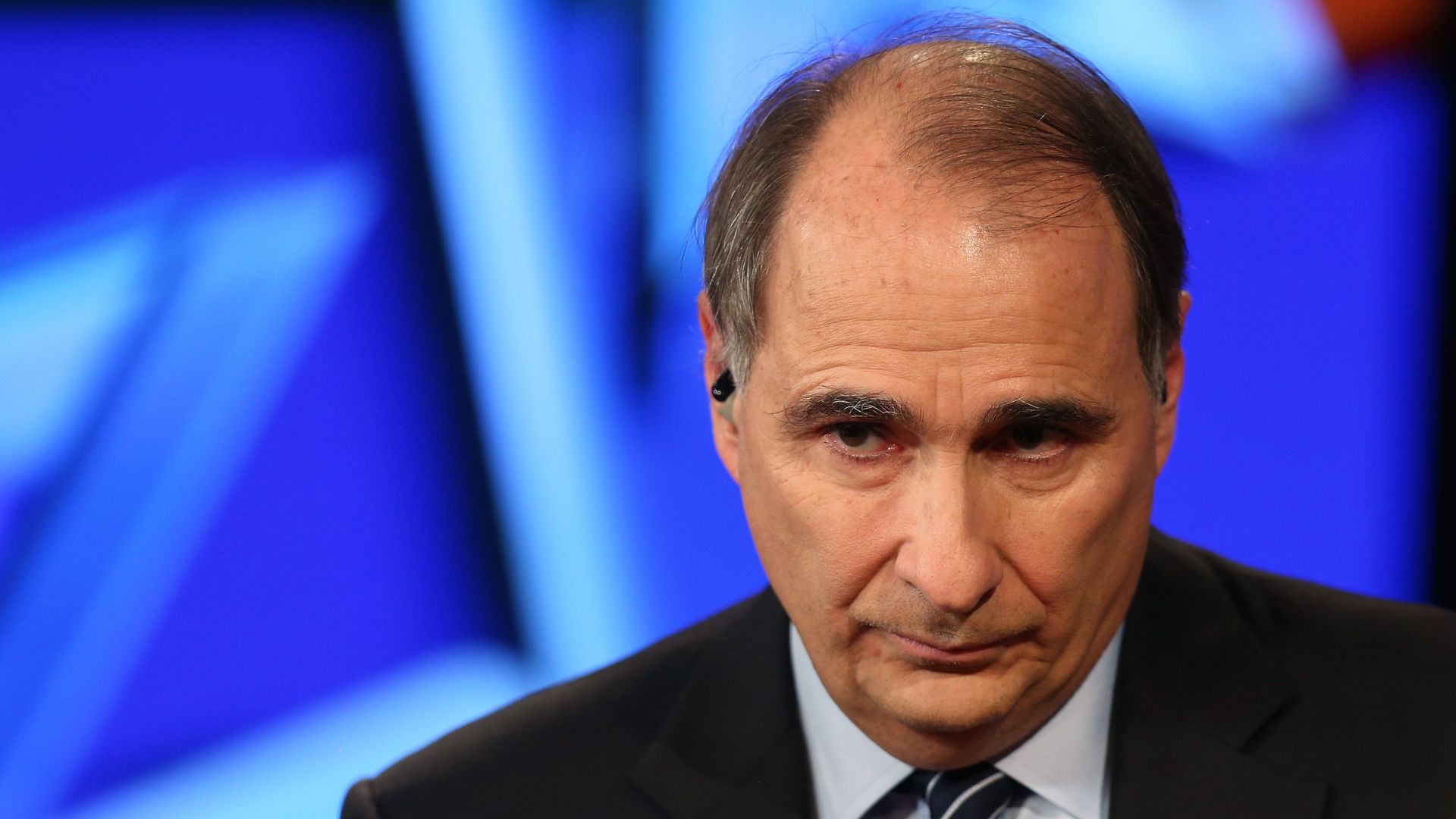
David Axelrod is making his popular podcast, "The Axe Files," exclusive to Luminary, which has raised $100 million and plans to launch a paid platform with ad-free podcasts, starting with 25 shows the week of April 23.
Details: Some of Axelrod's expected upcoming guests include Aaron Sorkin, Bryan Cranston, Jason Rezaian, Meghan McCain and Kal Penn.
Pinterest, the social bookmarking platform, on Monday set IPO terms with plans to begin trading late next week on the New York Stock Exchange.
The bottom line: The proposed price range of $15–$17 per share would give Pinterest an initial market cap of around $8.5 billion, were it to price in the middle, and a fully diluted valuation of around $11 billion. Both are lower than Pinterest's most recent valuation from private market investors of $12.3 billion.