President Trump is reportedly poised to suspend restrictions on a type of diesel fuel that is currently exempt from taxes in a move intended to deliver temporary pricing relief.
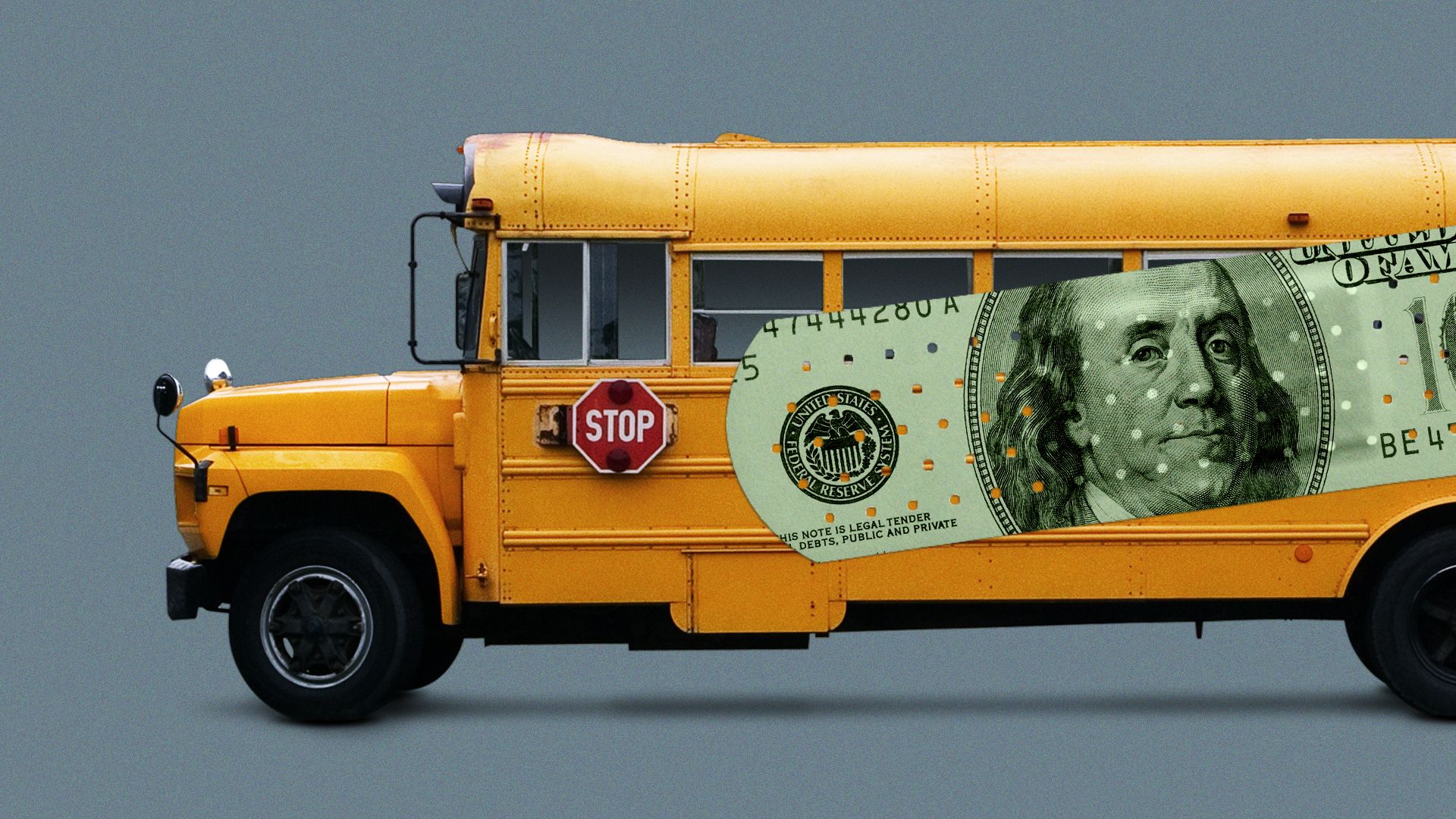
For millions of children, the school day starts on a diesel-powered bus with a driver behind the wheel. Now, school districts are struggling to afford both.
Why it matters: The Iran War is sending diesel costs higher just as districts are grappling with a yearslong bus driver shortage — a double whammy that can ripple into missed breakfasts, late classes and fewer school activities.
Paramount chair and CEO David Ellison and co-CEO Ynon Kreiz on Monday announced the new leadership team for Skydance, the name of the combined Paramount and Warner Bros. Discovery company when the merger closes.
Senior WBD leadership, including CEO David Zaslav, CFO Gunnar Wiedenfels, and revenue and strategy chief Bruce Campbell, were not mentioned in the announcement.
Why it matters: Skydance's new leadership will be tasked with executing Ellison's vision after a grueling, drawn-out merger process.
The National Association of Manufacturers on Monday unveiled its first ads urging Congress to approve the bipartisan Senate plan that would speed up permitting for energy projects and other infrastructure.
Why it matters: Faster and more certain permitting is the top priority for powerful business and industry groups in the waning months of this Congress.
September is historically a weaker-performing month for stocks, yet Charles Schwab's clients plowed into the market just the same, data from the brokerage giant shared exclusively with Axios shows.
Last month's buying activity was centered in large part on broader market exposure through exchange-traded funds, or ETFs, rather than in single stocks, Schwab says.
Why it matters: The data suggests that investors, while still bullish on stocks, have turned a bit more cautious, especially at a time of rising interest rates.
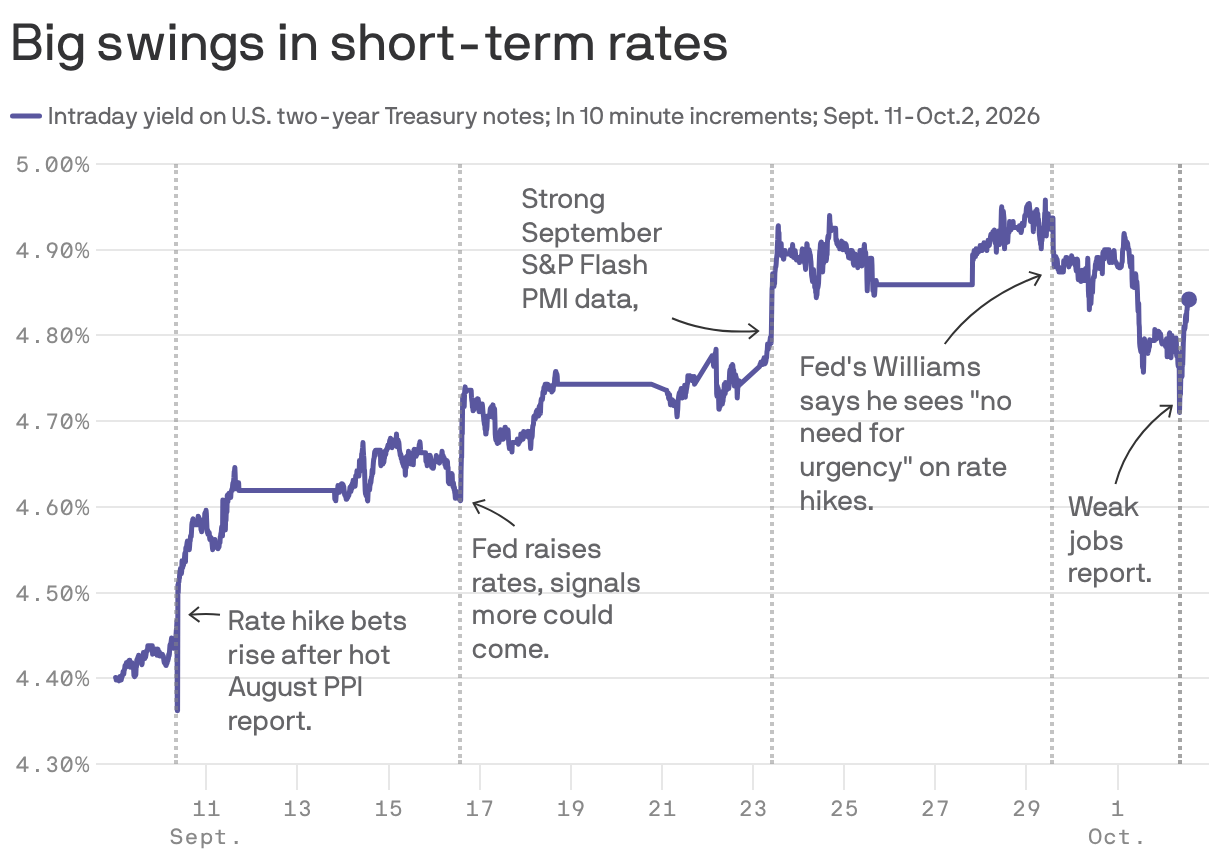
The yield on the 10-year note has gotten a lot of ink lately, but the yields on shorter-term government bonds have also been swinging.
Why it matters: Shorter-term U.S. government debt is heavily influenced by market expectations for what the Federal Reserve will do next on monetary policy.
France is dealing with a major debt crisis and social unrest ahead of its presidential election next year.
Why it matters: Worries are rising about contagion in Europe and beyond, and the situation is drawing comparisons with the sovereign debt crisis that rocked the European Union in the 2010s.
"Government bond yields in France are spiraling out of control. Contagion to the rest of high-debt Europe is unfolding rapidly," Brookings' Robin Brooks wrote recently.
BENTONVILLE, Ark. — Olivia Walton, who's leading a $100 million, bipartisan effort to cut the U.S. maternal mortality rate in half by 2031, tells me maternal health is a solvable problem, with state governments "in the driver's seat."
"We have the medicine," Walton, who's also chair of the Crystal Bridges Museum of American Art, told me last week on the sidelines of the annual Heartland Summit of the nonprofit Heartland Forward, which promotes economic development in America's geographic middle.
"We know what works. There are poorer and more rural countries around the world that are doing this better than we are. We also have pockets of what's working here in the United States."
We're getting a live look into the post-app, post-web world, for us as consumers and as business leaders.
Meta's new personal agent, Muse — the #1 free app on Apple's App Store in the U.S. — and Microsoft's new Copilot for Business are built on the same premise about where this is headed.
Why it matters: We won't use apps (life) or software (work) to get things done. We'll tell AI agents, each running on its own cloud computer, and they'll do it for us. This is happening now.
I met with faculty and the AI task force at Furman University and got a smart, provocative question: What do I wish liberal arts colleges taught students about AI to prep them to work for us?
In other words, what do CEOs want and need based on the known-knowns of AI capabilities today and our evolving expectations?
My dream: Every college student, from Day 1, takes a course every semester called "Living AI." It's constantly updated — how to use the newest models and how to grapple with their ethical, philosophical and practical consequences.
As CEOs, we love productivity: getting more done, faster, at less cost. Most normal people don't.
Why it matters: We need to reframe the benefits of AI for the people who work for us — fast. They crave a surge in purpose or satisfaction, not productivity.
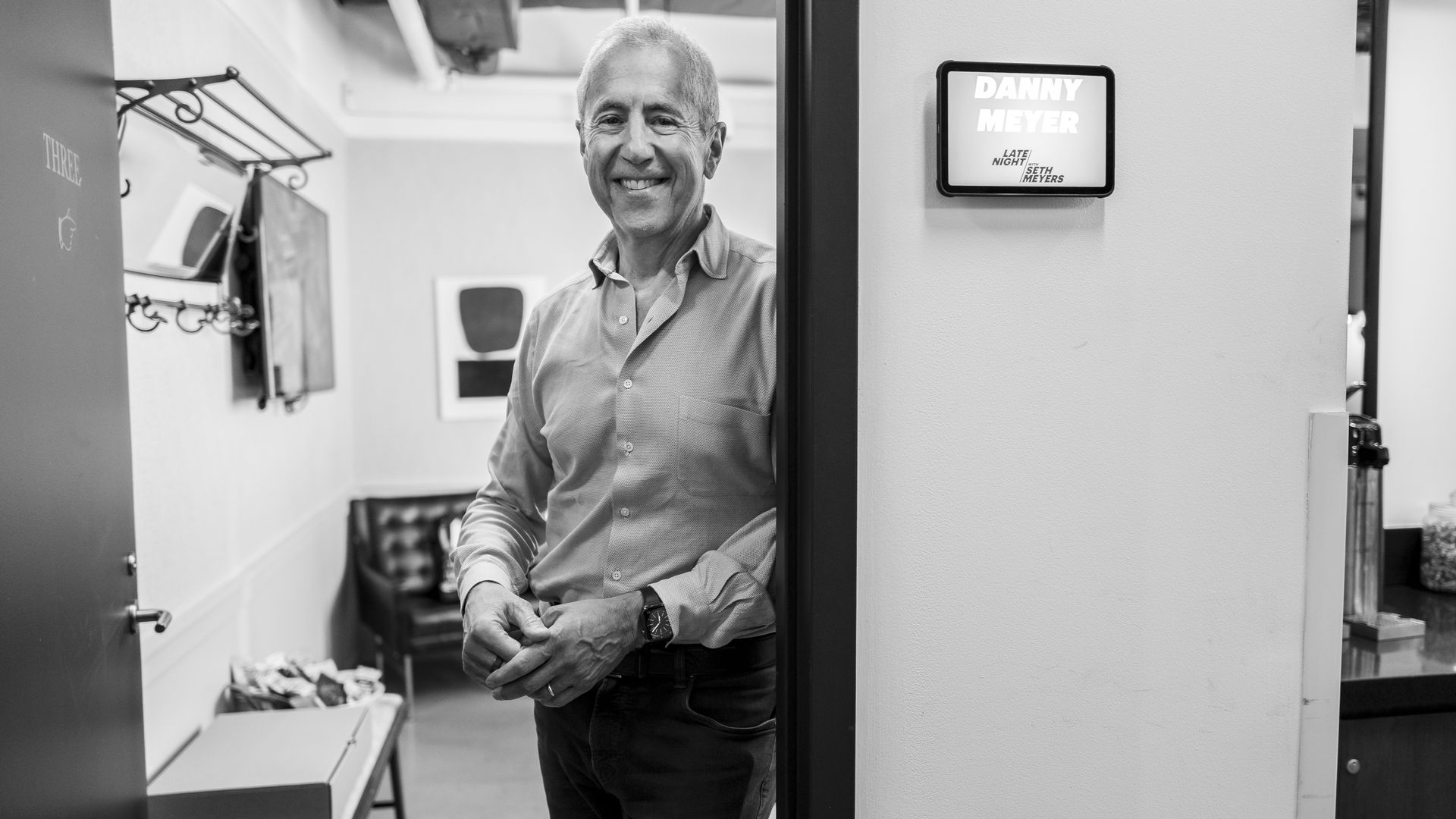
Danny Meyer, the legendary restaurateur behind Union Square Cafe and Shake Shack, is out with the rare biz book that's very much worthy of your time: "What Could Possibly Go Right?"
I asked him for a few non-obvious lessons he's learned that would be helpful to all CEOs and leaders:
Hire for HQ. EQ is emotional intelligence, the ability to read the room. HQ, or hospitality intelligence, is a step above: the ability to both read it and instinctively take action to make it better. Meyer screens for six traits: optimistic kindness, curious intelligence, work ethic, empathy, self-awareness and integrity. Integrity is the veto: "If you don't have integrity ... I don't really care about all the other stuff." When a hire flops, his team audits which trait they missed.
"Essentiality." Danny and I bonded over our obsession with cutting away anything that isn't vital. You need people and product that are truly essential. Otherwise, you'll get lost in the sea of endless choices. Growth pressure tempts you to add units and menu items. Scale the essential, not the footprint.
Don't f'ing settle. Meyer calls it D.F.S. Great companies rarely go bad overnight. They slip slowly: a lowered standard here, a tolerated miss there. Pretty soon, average feels normal. And normal is not essential. Restless improvement is vital.
Change your grip. What got you here won't get you there. As leaders, we need to push ourselves every day to offload things others can do better — and then evolve our swing. Hoarding the dopamine hit of being good at something is selfish and self-limiting.