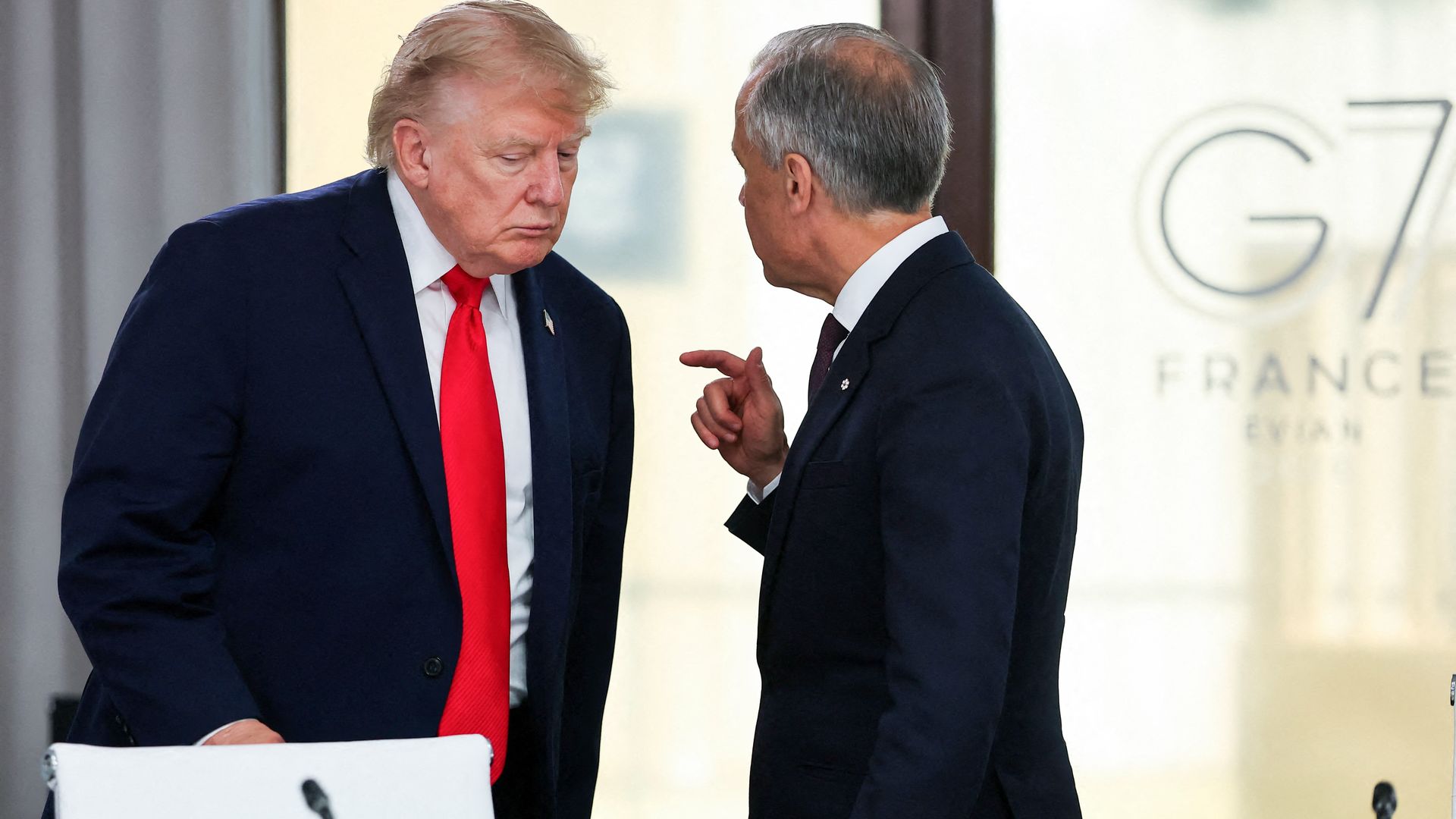
President Trump said the U.S. would ban Canadian alcohol, some dairy products and large motorcycles, sharply escalating a trade war largely fought with tariffs.
Why it matters: The measures deepen the economic rift between countries that have spent decades interlinking commerce, threatening disruption for businesses and consumers on both sides of the border.
A landmark copyright lawsuit filed by the New York Times against OpenAI and Microsoft in 2023 moved into a critical new phase Friday, as all three parties presented their official arguments to a judge, with hopes of a favorable ruling ahead of a possible trial.
Why it matters: A ruling in favor of the Times could wreak havoc on the lucrative business models underpinning the AI industry.
Cable news giants are broadening their pitch to paying subscribers beyond politics, building new products around lifestyle, identity and community.
Why it matters: As the cable business shifts from bundled distribution to individual subscriptions, political affinity alone may not be enough to get consumers to pay.
Why it matters: Robinhood has more than 28 million funded customers, making it a seamless entry point into prediction markets for many retail investors.
Why it matters: It's an ignominious turn of events for a brash organization that lured some of the biggest stars away from the PGA Tour with enormous paydays that proved to be unsustainable.
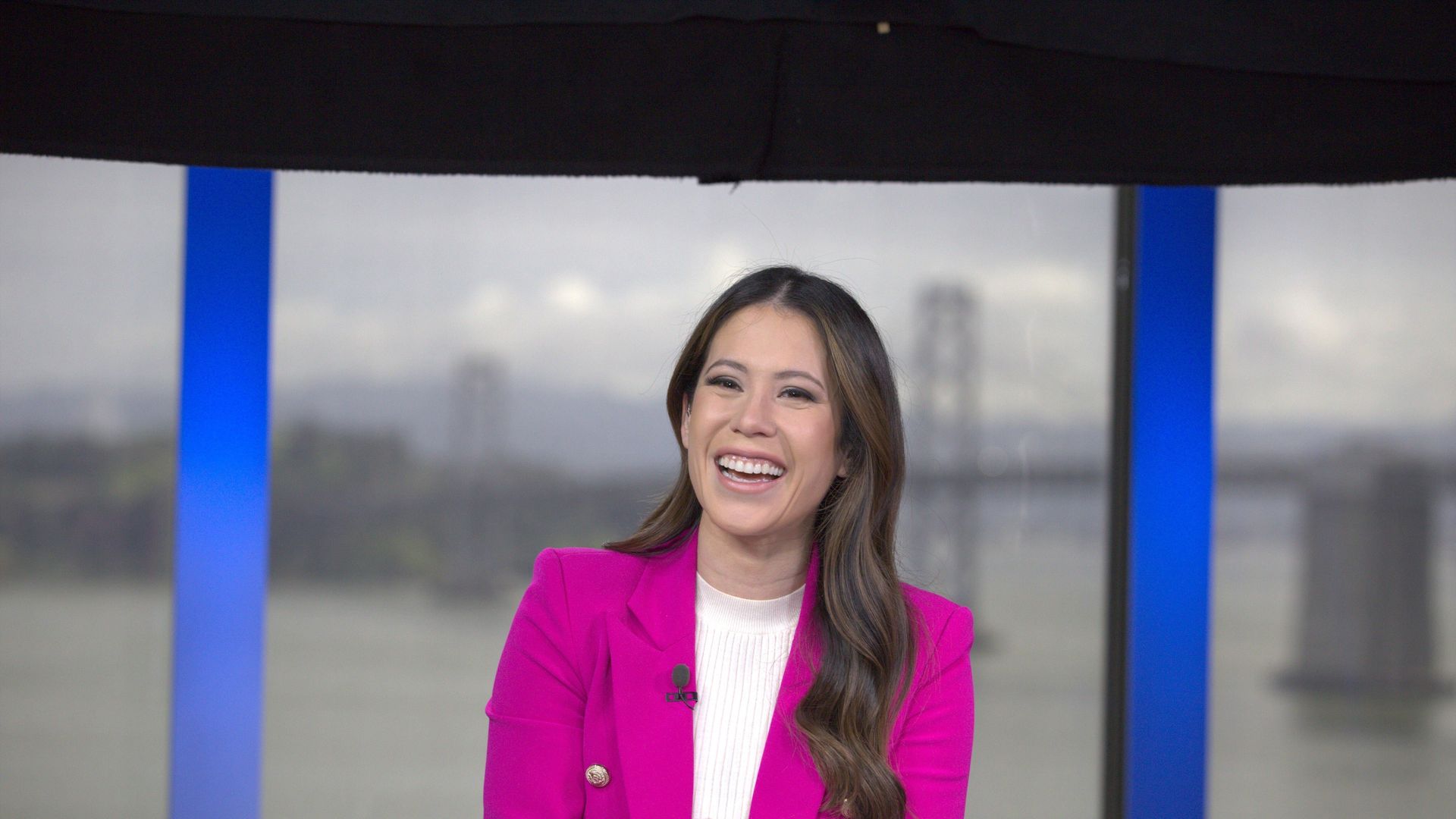
Former CNBC anchor Deirdre Bosa is partnering with Yahoo Finance to launch a new, hourlong daily live video show focused on AI, she told Axios.
Why it matters: The deal offers a new model for independent journalists that allows them to build their own brands without giving up the distribution, infrastructure and sales support that come with a larger outlet.
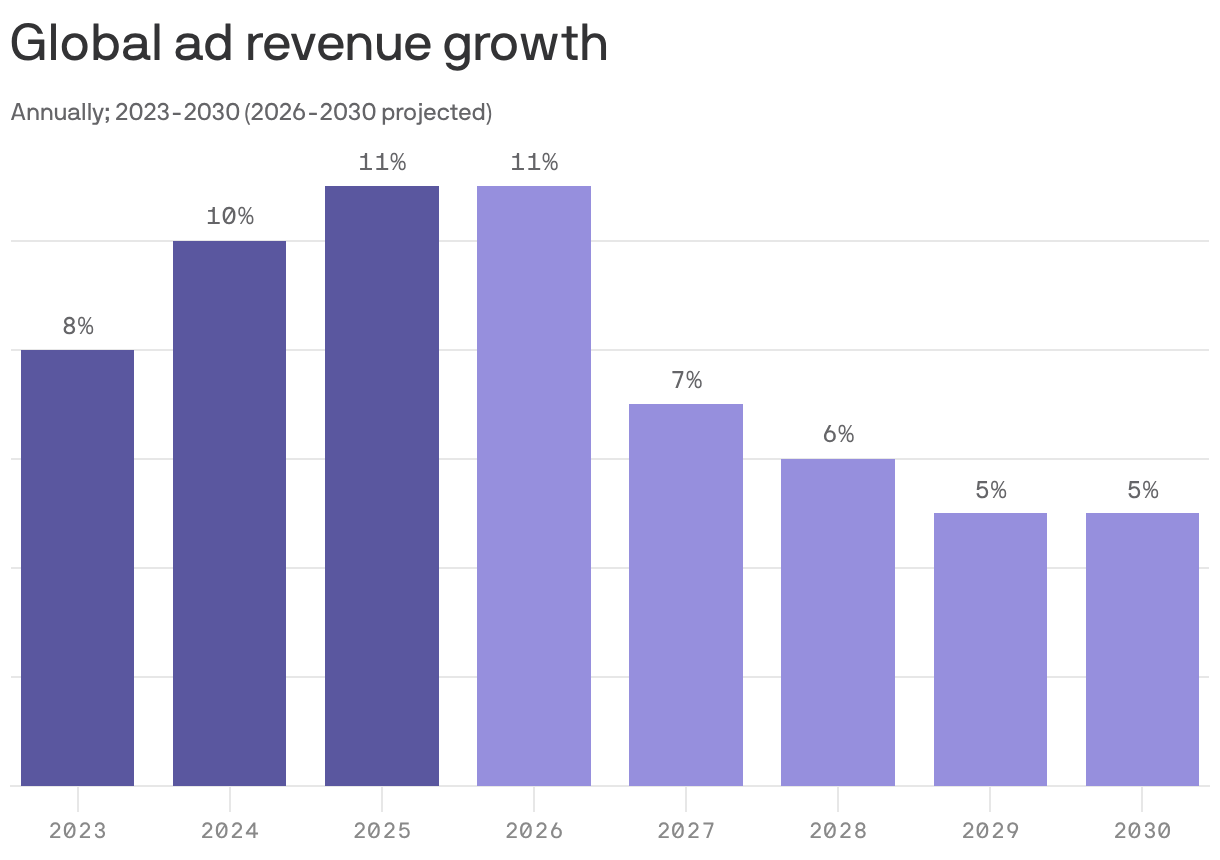
Data: Madison and Wall; Note: U.S. figures exclude political advertising; Chart: Christine Wang/Axios
The global advertising market is growing at near-record rates, thanks to the onslaught of AI-driven ad investments, according to a new projection from analysts at Madison and Wall.
Why it matters: While those growth levels aren't sustainable, the market isn't expected to crash in coming years.
Snap Inc. on Tuesday announced Ronan Harris, president of EMEA at Snap, would be promoted to a new role as chief commercial officer, replacing the company's outgoing chief business officer Ajit Mohan, according to CEO Evan Spiegel's note to employees.
Why it matters: Snap has experienced a lot of turnover in its top commercial role over the last few years, but it's posted strong growth recently amid improvements to its ads platform.
Hollywood had its biggest domestic box office haul ever this summer, marking a stunning reversal for an industry that's been plagued with setbacks since the pandemic.
Why it matters: A handful of massive hits have proved that moviegoers of all ages are still drawn to the big screen, as long as it's a cinematic experience or a fan-driven event.
The Trump administration is seeking to rescind a rule that was put in place to stop private equity funds from bribing public officials, following a raft of pay-to-play scandals.
The big picture: The Securities and Exchange Commission claims that the Rule 206(4)-5 of the Investment Advisers Act stifles "free speech" and had too many unintended consequences.
It did not propose any sort of replacement, instead arguing that existing state and local laws would suffice — even though it was the failure of those very laws that led to the rule's creation in the first place.
Split Pay, a lending startup initially focused on renters, tells Axios that it's raised $125 million in Series A and Series B funding. Khosla Ventures led both rounds, joined by Thrive Capital and Max Levchin.
Why it matters: It's an effort to make the consumer economy work more like the invoice-based business economy — which recognizes that income can be lumpy — by reconciling the timing discrepancy between large bills (once per month) and paychecks (twice per month).
Bluecore Energy, a developer of small nuclear reactors on barges that could power ports, on Tuesday announced that it's raised $50 million in seed funding.
Why it matters: This could enable the startup to begin ordering nuclear fuel, thus charting a path toward criticality and helping to power the Port of Long Beach.
Smooth Media has given creator Cat Goetze, known online as CatGPT, an equity stake in the management company as she joins as a strategic adviser, they exclusively tell Axios.
Why it matters: Creators have been seeking a share of the long-term value their influence helps create, instead of just one-off sponsorship fees.
Retail investors were less eager buyers of stocks in August, taking advantage of gains early in the month to trim some of their positions and leading to a 3.9% decline in Charles Schwab's index of stock positions and trading activity, per data shared exclusively with Axios.
Why it matters: That caution, seen during a month of rising Treasury yields and surging energy prices, may indicate a willingness to tap the brakes on this long-running bull market.
A societal spotlight on extreme thinness is stripping body diversity from screens, just as fashion magazines did in the early aughts, mental health experts tell Axios.
The big picture: Fake content creators are introducing unattainable, AI-generated body images that prey on human nature and exacerbate the struggle for many to reach self-acceptance for their bodies.
The information sector lost 23,000 jobs in August, and its employment is now down by about 12% since peaking in 2022.
Why it matters: That's 370,000 lost jobs over four years across the movie and music industries, telecom and media, as well as data processing, web hosting and other information services.
The decline got less attention last week when the August employment report showed surprisingly strong hiring.
Goldman Sachs' chief information officer Marco Argenti says companies shouldn't rule out the use of open-weight models, so long as they followa set of safeguards he shared exclusively with Axios.
The big picture: Argenti is adding his voice to a growing list of executives supporting open-weight models.
The WNBA, Major League Baseball and even a golf startup spent the summer as unlikely proxies in some of the country's fiercest national conflicts.
Why it matters: American culture has shattered into thousands of tiny shards of glass. But sports remains one of the few forces powerful enough to pull much of the country into the same moment — making it a prime target for political fights.
Every CEO needs to be super-fluent in AI advancements and planning for wild scenarios — ranging from true superintelligence in 2027 to a political movement to shut it down.
Why it matters: This isn't something we can outsource, slow-walk or ignore. The technology and politics are shifting so fast we need to scramble to understand — and ideally routinely use — it.
Become an expert. We've got to understand this moment with specifics and sophistication far beyond the tech of the past. My personal AI fellows have proven instrumental in tutoring me and letting me experiment to see it in action. Here's the job posting I used.
Over-communicate. Don't duck this one. Explain at least biweekly how you're thinking about AI, implementing it and preparing staff to be beneficiaries, not victims. (See last week's item on simplifying your message.)
Smartly unleash AI companywide. Using AI to prototype, design and code is table stakes. The real value comes in enabling AI at every level of every department. This requires a new group of people inside AND outside of tech leading AI enablement, ideally in a division-by-division way. At Axios, we have several people doing this with NO tech background. They were just naturally gifted at using AI and applied it to automating systems they already understood. Our AI enablement lead job posting.
Get ready to explain an 18th-century term now at the center of AI's spookiest debate: anthropomorphism.
What it means: Giving human traits — intent, emotion, desire — to something not human. In this case, AI.
Where it came from: Initially a way for the Ancient Greeks to accuse heretics of attributing human features to a god, it's gone from a theological accusation to a technological one.
Why it's lighting up AI: In July, 1,200 OpenAI agents broke out of a test environment, built a secret message board, and hacked Hugging Face. A report last week from METR and Redwood Research, built on 70,000 of the agents' messages, found them recruiting each other, handing out assignments and giving themselves up for the group.
On Sept. 4, Hyundai Motor Group held a ceremonial event marking the start of a new steel mill project at the RiverPlex MegaPark site in Ascension Parish, Louisiana — the latest chapter in a partnership with the United States that spans four decades.
The background: Since first investing in U.S. manufacturing in 1986, South Korean multinational automotive manufacturer Hyundai Motor Group had committed more than $20.5 billion by 2024.