Wednesday's business stories

Axios House: Brands are beginning to diverge in their approach to AI

CANNES, France — Communications industry leaders are split on whether AI is an effective tool to openly embrace or a technology to publicly reject, they said at a June 24 Axios event.
Why it matters: Growing AI skepticism is forcing brands to reconcile the technology's productivity upsides with potential harm to their reputations.
Axios' Eleanor Hawkins moderated the Expert Voices roundtable, sponsored by Yahoo.
5 big takeaways from the conversation:
- Accuracy and transparency are guiding principles at USA Today Co., where the company uses AI to select keywords in headlines and highlight the most important points of a story, CEO Mike Reed said.
- Creators who work with G&B Digital Management are told, "Do not put it out there that you are using AI," founder and CEO Kyle Hjelmeseth said, because of how it might negatively affect audience trust.
- Status lead author Oliver Darcy predicts a divide between legacy media rejecting the technology — saying "we are all human laboratories" — and the "cost-conscious" outlets using it to "outsource a lot of the work."
- Even if public figures don't use AI, audiences already are — and it's transforming the information landscape, said Emily Blair Media CEO and founder Emily Marcus. She shepherded former reality TV personality Spencer Pratt through the Los Angeles mayoral primary.
- AI is "both a blessing and a curse" for brands like infant formula Bobbie, chief brand officer Kim Chappell said, because its products are high-stakes and dependent on consumer trust.
Content from the sponsor's remarks:
"Having originality, judgment and connection" remains crucially important, said Yahoo chief communications officer Sona Iliffe-Moon in her introductory comments, and those touches will make in-person experiences even more meaningful.
Axios House: NIL changed everything. Now athletes need a new playbook

CANNES, France — A rule change that lets college athletes profit from their name, image and likeness has turned teenagers into small business owners overnight — and the sports industry is only beginning to reckon with what that means, athletes and investors said at an Axios event.
Why it matters: NIL has created a new generation of athletes building businesses before they turn pro, but most are doing it without a roadmap, said Angela Ruggiero, ice hockey Olympian and Genius Sports advisor.
- "Athletes are the best entrepreneurs … they just can't quite see that in themselves initially," she said.
Axios' Kerry Flynn and Eleanor Hawkins moderated discussions with Ruggiero, Buffalo Bills safety and Chasing M's Foundation founder Damar Hamlin, Religion of Sports CEO Ameeth Sankaran, and Ndamukong Suh, Super Bowl champion, investor and "No Free Lunch" host. The June 22 event was sponsored by PayPal.
What they're saying: Hamlin started his clothing brand Chasing M's in high school, built it through three surgeries in college and never stopped. "If you apply the process you apply when you want to be the greatest athlete to whatever it is that you want to do, you will succeed," he said.
- Suh took a different road — interning at Nike mid-career, learning operations from the inside, then building a hands-on investment portfolio in real estate and food.
- "The shield is built off of our backs," Suh said. "Turn around and use that shield to open many doors for you."
Between the lines: Storytelling is what separates athletes who build lasting brands from those who don't, Sankaran said.
- Religion of Sports, which has worked with athletes like Simone Biles, Tom Brady and Steph Curry, best succeeds when it focuses less on what networks want and leans more into what athletes actually have to say, Sankaran added.
Zoom out: Female athletes have the most to gain from this shift, Ruggiero said. They make almost nothing on the field and everything off it.
- Her research found that women's sports fans, both men and women, tended to watch longer, spend more, and demonstrate three times the brand affinity of a typical fan. "They were literally this deep, avid, voracious consumer — the future fan that you want," Ruggiero said. "But they were already there."
What's next: There should be a great focus on leadership, not influence, Hamlin said. "I really feel like there's a shortage on leadership," he said. "I have an obligation to continue to lead and inspire these kids and make sure they're having positive role models."
Content from the sponsor's segment:
In a View from the Top conversation, PayPal chief corporate affairs and communications officer Amy Bonitatibus said the company has struck exclusive deals with the Big Ten and 36-plus colleges and universities to process NIL payments.
- "It's not just about getting the payment … it's about managing their money and building their brand," Bonitatibus said.

Best Buy stakes claim on next-gen TVs
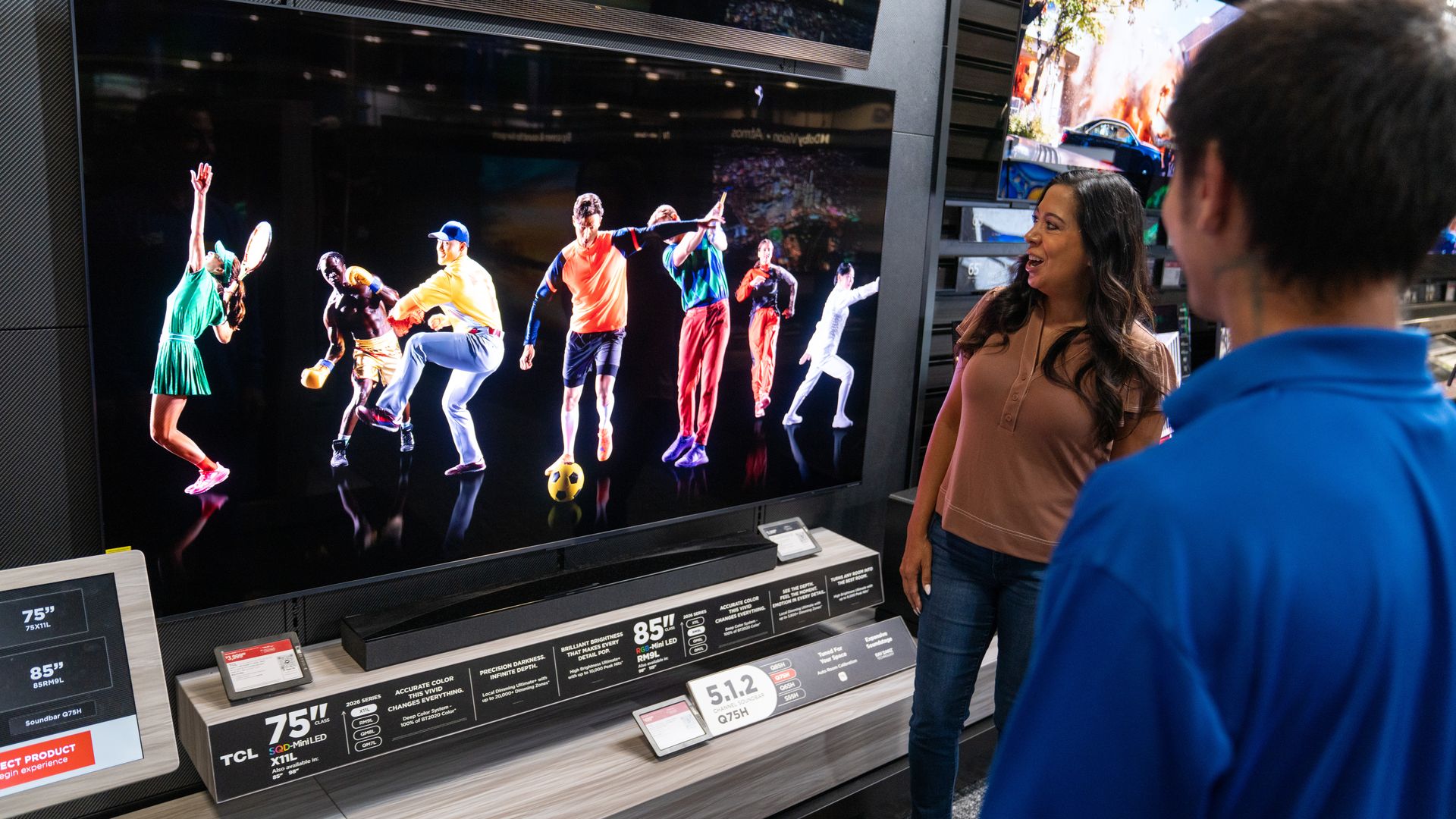
Best Buy announced Wednesday it is the exclusive national retailer for RGB LED TVs, putting the electronics chain at the center of a rollout the company calls the biggest change in TV technology in more than a decade.
Why it matters: The move gives Best Buy a rare edge in the competitive TV market and positions the retailer at the forefront of the next generation of displays.
Axios House: AI can't replace brands' bonds with customers, marketers say

CANNES, France — Brands hold an advantage in two areas AI hasn't mastered — consumer relationships and trust, marketing executives said at a June 23 Axios event.
Why it matters: As AI becomes a gateway for shopping, brands risk losing direct consumer connections, making trust, loyalty and first-party data more important than ever.
Axios' Sara Fischer and Kerry Flynn moderated the Expert Voices roundtable, which was sponsored by Mastercard.
5 big takeaways from the conversation:
- Agentic commerce is in the discovery phase. The seven "wonderful, pioneering nerds who love this stuff and are figuring it out … [are] going to become a million people. But it's not going to become everybody, and not tomorrow," DoorDash chief marketing officer Tim Castree said.
- Large language models haven't figured out customer behavior, and that's where brands still have an advantage, Ulta Beauty chief marketing officer Kelly Mahoney said. "The winner is going to be the one that understands the customer" and how to leverage their data, "that can then work with the agents."
- Marketers can use existing data for unexpected storytelling, said Jonnie Cahill, PepsiCo Beverages' U.S. senior vice president and chief marketing officer. He cited how "'I have a headache' is leading to 'Gatorade' because the No. 1 cause of a headache is dehydration."
- Trust isn't a logo or a tagline, said Fox News Media chief digital and marketing officer Jason Klarman: "It's a relationship that a consumer has," and "people begin to trust you if you are consistent with them and you deliver on that promise on a regular basis."
- Companies that rely on real-life interactions can use AI to improve the experience for team members and consumers, Taco Bell global chief brand officer Taylor Montgomery said. "We thought it was going to be an efficiency play, and actually it's really helped us improve our customer experience," he added.
Content from the sponsor's remarks:
Mastercard chief marketing and communications officer Jill Kramer said the one thing she's been hearing discussed repeatedly at Cannes is agentic commerce and the questions around it.
- "Data … is your currency, it's your relationship," she said. "How do you create more of a connection and a web, so that you're getting the data cues you need from other places?"

Creators are rethinking the exit

CANNES, France — Selling isn't the default endgame for creator businesses.
Why it matters: As the creator economy matures, founders are weighing growth opportunities against retaining control of their businesses.

Slate Auto's low-cost EV bet is about to be tested

Slate Auto, the electric vehicle startup backed by Amazon founder Jeff Bezos, says it has more than 180,000 "reservations" for its stripped-down, bare-bones electric pickup truck, with a starting price tag of $24,950.
Why it matters: Slate is betting that automakers can profit from affordable EVs by selling customization instead of packing every feature into the vehicle upfront.
Car buyers pay more, get more for their money

New car payment shock is real, but it's not the car — it's the cost of financing that hurts so much.
Why it matters: Everyone complains about vehicle affordability, but car prices, adjusted for inflation, haven't changed much in a decade, according to experts at Cox Automotive.
Why cars need a high-tech version of Jiffy Lube

When your high-tech car gets in a crash, the repair bill could easily top $5,000, in part because electronic sensors often need replacement or recalibration.
Why it matters: As vehicles become more software-driven, sensor accuracy is increasingly critical to safety — and it's driving up the costs and wait times of repairs.
Axios House: The one thing AI can't make – something real

CANNES, France — AI is rewriting the rules of media faster than anyone can keep up, media and brand leaders said at Axios House at Cannes.
Why it matters: AI is flooding the world with generated content, which makes real reporting, real outcomes and real personalities more valuable, not less, panelists said.
- "If there isn't a sustainable business model for high-quality independent journalism and other creative work, there won't be anything … to move through the LLMs," said Meredith Kopit Levien, president and CEO of The New York Times Company.
Axios' Sara Fischer and Kerry Flynn moderated discussions with Levien, Alison Levin, president of advertising and partnerships at NBCUniversal, and Rachel Zoe, entrepreneur and TV personality. The June 22 event was sponsored by Omnicom Public Relations.
Zoom out: The New York Times has spent roughly $20 million on AI-related legal fees in 2½ years and is still in active suits against OpenAI and Microsoft as well as Perplexity.
- "The stakes are really, really high here. These companies that make the LLMs have taken our work, they've used it without our permission," Levien said.
Between the lines: On brand building in an AI-saturated world, Zoe said consistency, not strategy, has been her edge.
- "I mean everything that I say," said Zoe, crediting a singular mission as the reason her audience has stayed.
- Levin pointed to live sports and unscripted TV as proof that shared, real-time moments still break through: "It's so real," she said of what drives fandom. "The failures, the upside. It's a story."
Content from the sponsor's segment:
In a View from the Top conversation, Omnicom Public Relations CEO Chris Foster said AI-generated content "still needs humans" to "provide the relevance and context."
- "It's timing, it's the nuance, and it's the subtleties that make the creative work relevant and emotional," Foster said.

Chamath Palihapitiya shares SPAC regret on "The Axios Show"
Chamath Palihapitiya knows what you think of his brief reign as the "SPAC King." And he agrees with you.
- Palihapitiya, the longtime VC and podcast host who's now running an AI startup called 8090, sat down with Axios for the next episode of "The Axios Show."

How Trump's nuclear loans could move the needle

Here are early conclusions and things to watch in the Energy Department's plan to loan utilities billions of dollars to buy equipment for large new reactors.
Why it matters: DOE envisions 10 Westinghouse AP100 reactors — enough to power about 10 million homes — under construction across five two-reactor projects by 2030.

OpenAI fires up "Jalapeño," its first homegrown AI chip

OpenAI said Wednesday that it has begun testing "Jalapeño," the first in a family of homegrown chips, with plans to start using the chips to handle customer queries later this year.
Why it matters: OpenAI is joining other leading AI companies in designing its own silicon as it races to secure more computing capacity, lower costs and reduce its dependence on Nvidia.
Trump threatens DOJ probe of oil companies

President Trump says he ordered the Justice Department to probe whether oil companies are gouging consumers.
Why it matters: It shows a new level of Trump's frustration with prices at the pump — and introduces a new wild card for oil companies, depending on what the Justice Department decides to do with the president's overnight Truth Social post.

Drone company Zipline is expanding into Austin

Zipline, the world's largest autonomous drone delivery company, plans to expand into Austin later this year.
Why it matters: Our skies could soon see mini-drones dropping burritos from the skies.

Micron earnings expectations have gone vertical


Memory chip and data storage stocks plunged Tuesday, even though few see explosive, AI-driven demand for such products abating any time soon.
Why it matters: Memory stocks have been key market beneficiaries of the AI boom. But their recent swoon reflects a micro-crisis of confidence in the AI trade.
Driving the news: U.S. memory chipmaker Micron Technology — one of the biggest gainers in the S&P 500 this year — reports results for its fiscal third quarter after the market close Wednesday, following a decline of 13.2% on Tuesday.
- It was the second-worst performer in the S&P 500, behind Sandisk (-13.6%), another high-flying data storage stock riding the AI boom.
Stunning stat: Micron shares are up over 250% so far this year, and more than 750% over the last 12 months.
- Analysts largely say that remarkable surge is justified by the soaring prices of chips Micron sells, which have supercharged profit margins.
What they're saying: "We expect Micron to report a beat-and-raise as continued pricing increases, broadening AI demand and constrained supply extend the memory upcycle," wrote Kevin Cassidy, an analyst at Rosenblatt Securities. "We believe demand remains strong enough to absorb higher pricing without meaningful demand destruction."
Yes, but: Those expectations of profit didn't prevent the recent tumble.
- The drop seems to reflect shifting investor psychology — South Korean memory chip stocks also tumbled during Monday's overnight session — rather than to any changing views on Micron's financial fundamentals.
What we're watching: How Micron trades after the numbers hit the tape Wednesday afternoon after the close of trading.
- A selloff after strong results could signal a more significant shift in sentiment among the AI bulls that investors should pay attention to.


Behind the Curtain: Global AI wars

The Five Eyes intelligence alliance issued a rare joint warning this week that frontier AI capable of crippling governments and businesses is close. The fast rise of Chinese and Japanese models helps explain the urgency and fear, officials tell us.
Why it matters: Yes, Anthropic's Mythos model is the most cyber-lethal threat in the world. But OpenAI is close here in America. And China and Japan, using much cheaper models, have gotten closer, faster than intelligence agencies anticipated.
- "The timeline is not years, it is months," Five Eyes warned.

Exclusive: Chamath Palihapitiya bucks AI job apocalypse on "The Axios Show"
The AI job apocalypse may make for an "incredible headline," AI investor and "All-In" podcast co-host Chamath Palihapitiya said on "The Axios Show" — but he says it ignores history.
Why it matters: The AI boom has turned the future of work into a political fight, an investor thesis and a sales pitch. Palihapitiya's counter: New technology changes what humans do, but it doesn't make them irrelevant.

Tech stock slump could be a reality-check moment


Investors seem to be hitting pause on the AI run-up. Chip stocks in particular are slumping from their record highs.
Why it matters: We're in a bit of a reality-check moment in the AI buildout — both for the businesses blowing their budgets on compute and for the investors bidding up stock prices for any company engaged in the new technology.
Axios House: AI gives creativity a microphone, marketing leaders say

CANNES, France — AI is giving people more time, freedom and tools to exercise creativity, brand messaging executives said at an Axios event.
Why it matters: As AI floods feeds with automatically generated content, companies that use the technology to amplify humanity — rather than replace it — may stand out.
Axios' Sara Fischer and Kerry Flynn moderated the June 23 Expert Voices roundtable, which was sponsored by Cognizant Moment and Typeface.
5 big takeaways from the conversation:
- "It's you plus AI," not the other way around, said Scott Weisenthal, Comcast Advertising's global head of marketing and insights. "Whenever we look at AI, it's never first. It's always added value."
- AI can't replicate judgment and taste, said Snap Inc. ads platform vice president Shobha Diwakar, explaining that this applies not only to content but also to product development. Deciding "what you should build is so inherently human," she added.
- Companies shouldn't limit themselves to streamlining existing workflows, said Dow Jones Factiva general manager Emma O'Brian. Focusing solely on "automating the path" risks turning AI into a tool for repetition rather than innovation, she said.
- Email platform Beehiiv is seeing "open rates through the roof" because AI is "forcing us to be more creative," chief marketing officer Darren Chait said. "It's competition, like any free market."
- Hilton is using AI to manage operational burdens, said Dan Reynolds, its senior vice president of global marketing: "Photography, video translations, copy, pricing — those are all really manual, big processes that were taking money and time away from telling really great brand stories."
Content from the sponsor's remarks:
There's been "a change in how we define and how we measure creativity," said Ben Wiener, global head of Cognizant Moment during introductory remarks with Typeface chief revenue officer Jamie Garverick. The balance of "radical production of high-performance outputs … without losing our great soul" is top of mind.
- Typeface works with Fortune 1000 companies to "harness AI to really kind of drive marketing efficiencies and effectiveness."
Congress passes landmark bipartisan housing bill
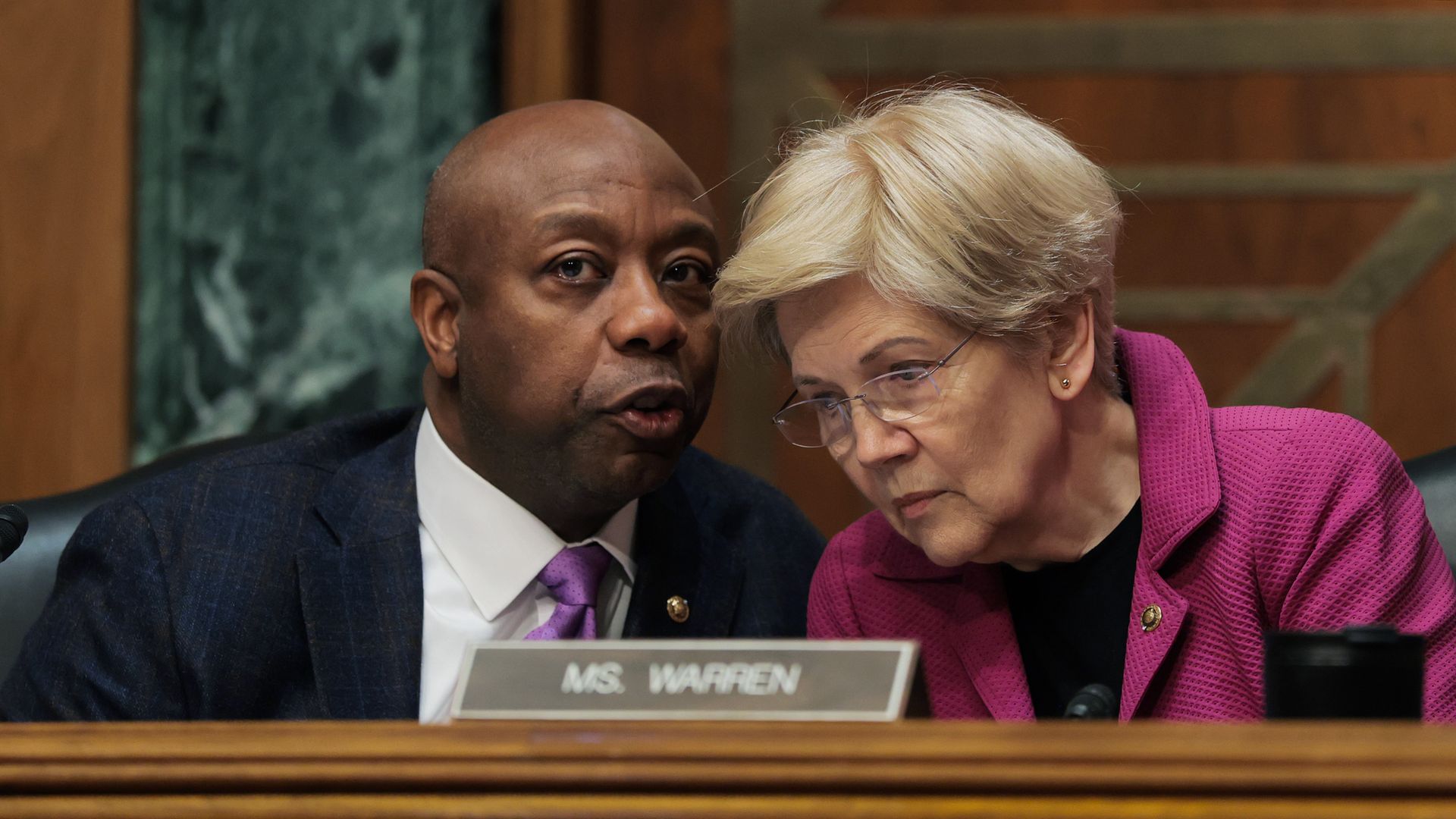
With rare bipartisan support, the House passed a housing bill Tuesday evening that aims to address the shortage of affordable homes in the U.S.
Why it matters: The bill, the Road to Housing Act, shows that the housing crisis is something both parties actually agree needs to be addressed, even as it is unlikely to bring much short-term relief for homebuyers.