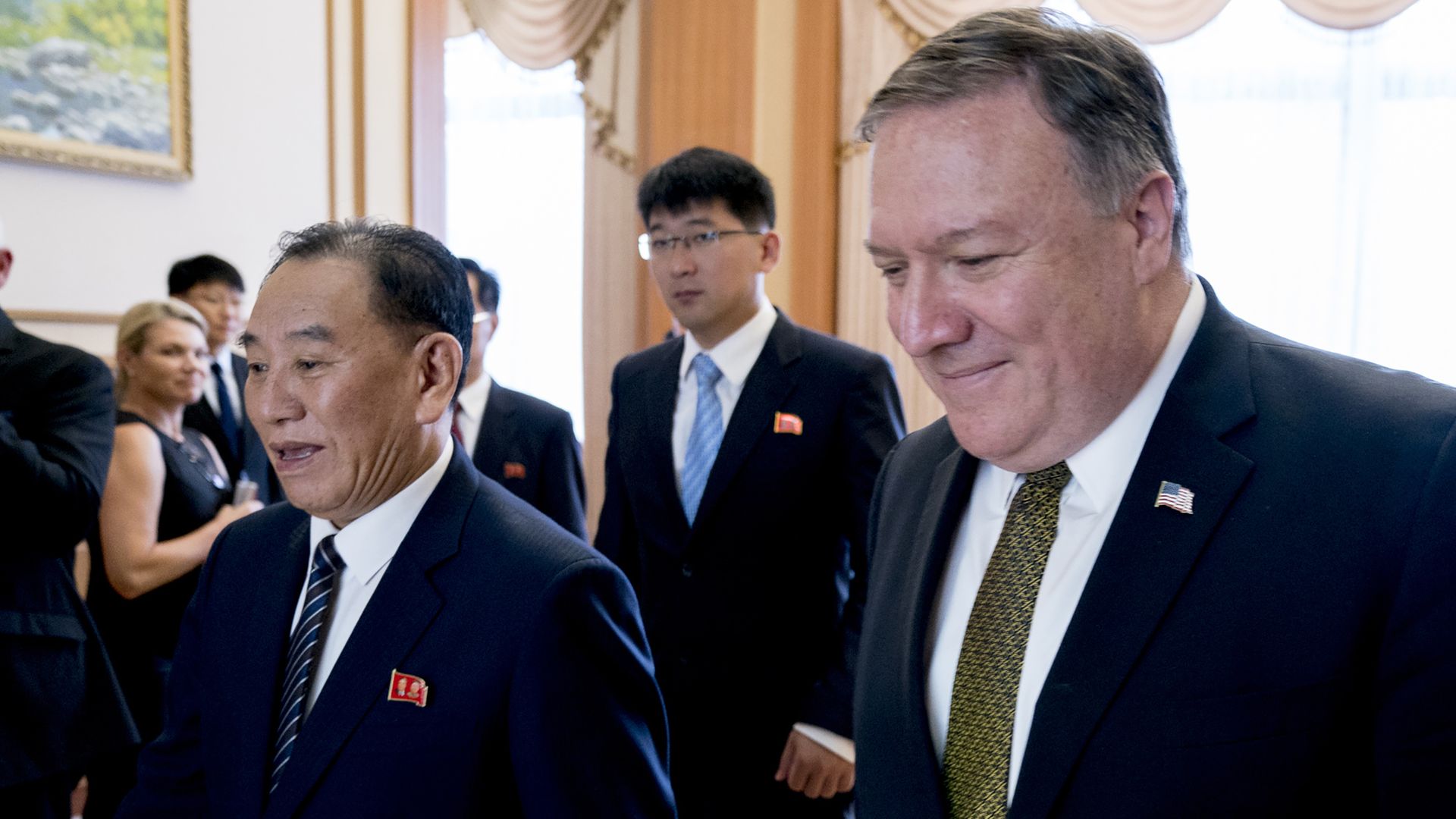
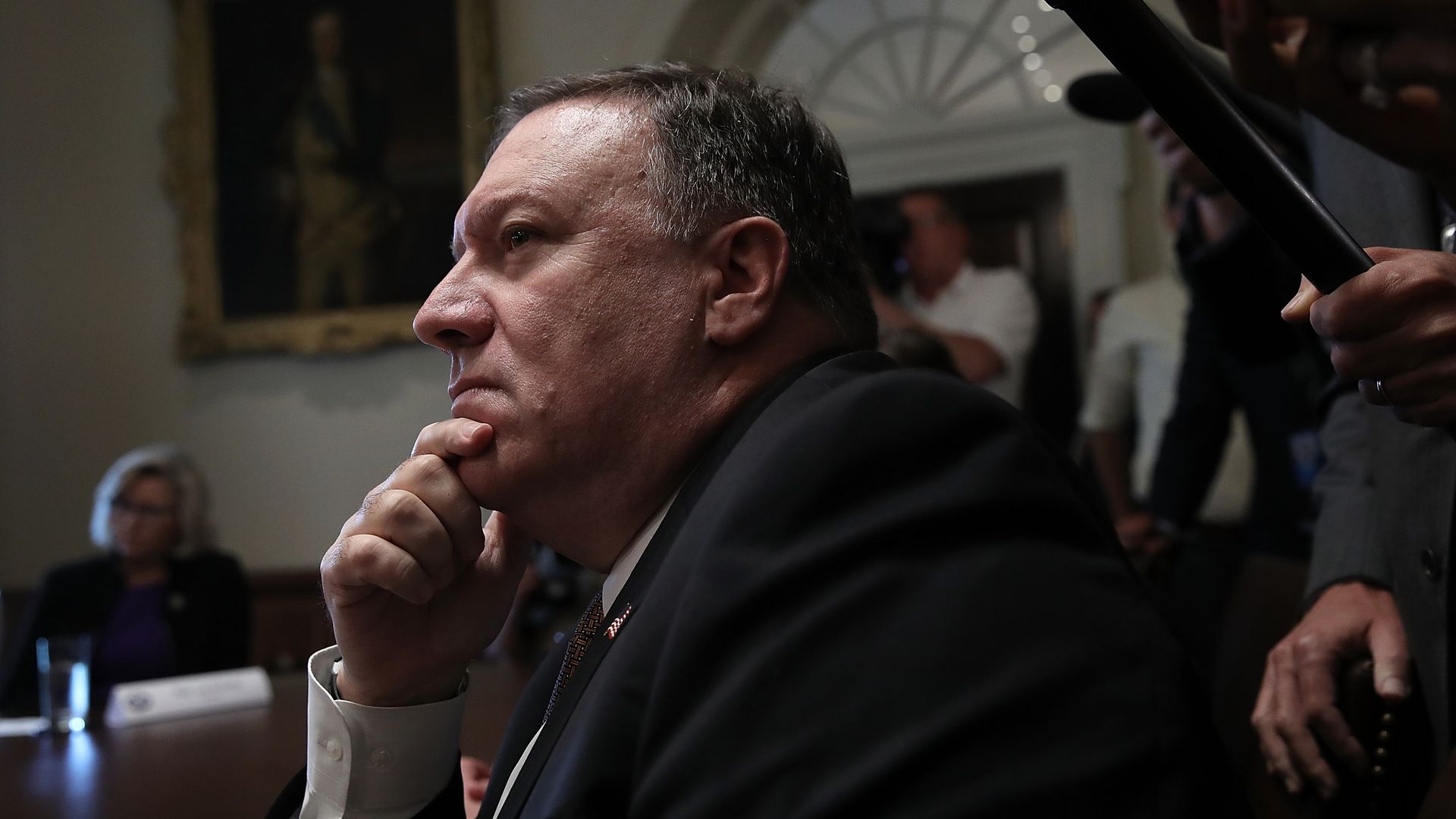
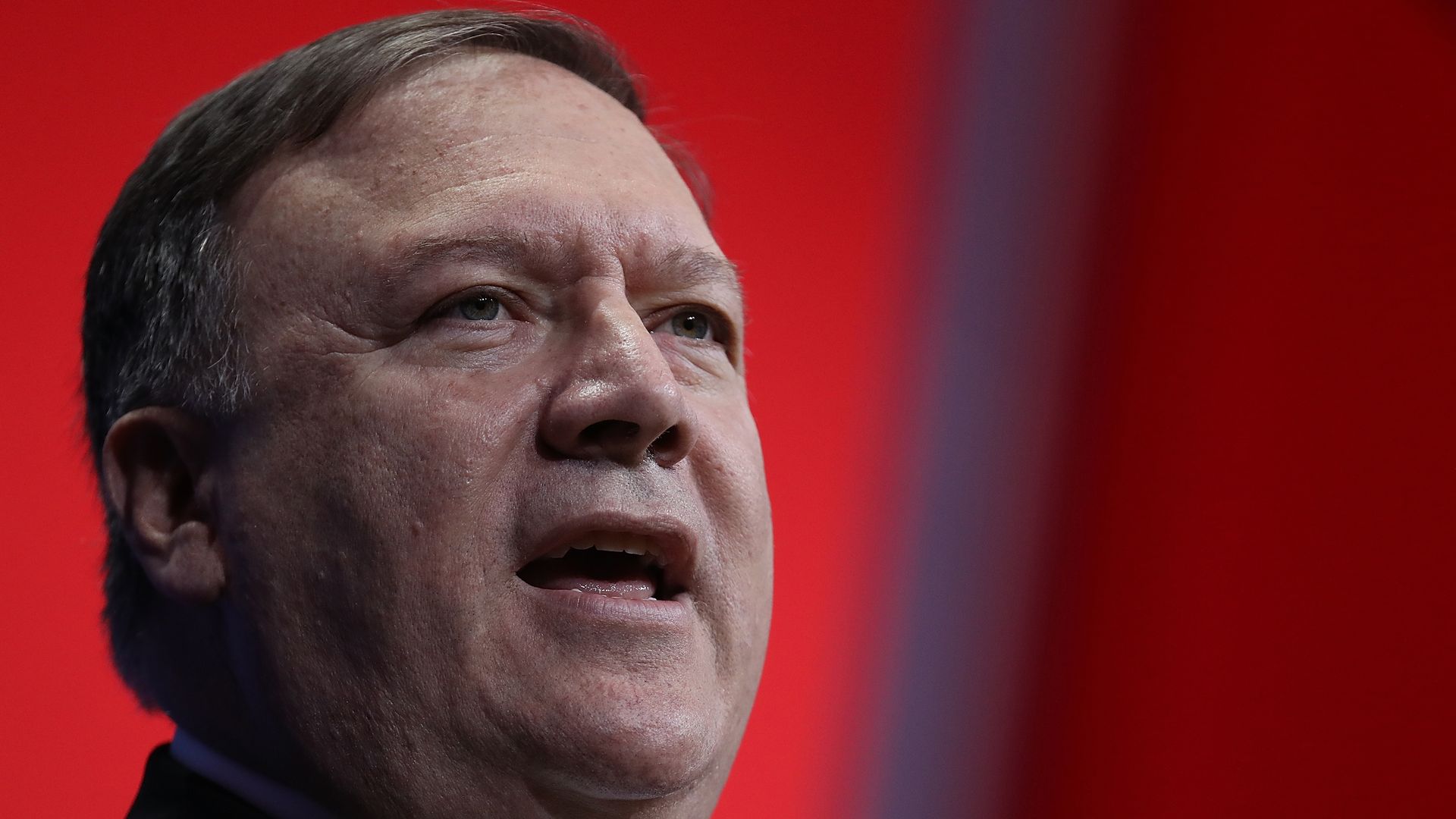
Would you travel 7,000 miles to confirm what your boss believes? That's partly what Secretary of State Mike Pompeo was doing with his two-day mission to North Korea.
The bottom line: According to sources, it's not going to happen overnight, or even in a year. Sources tell Jonathan Swan and me that the secretary was trying to validate for President Trump, who's anything but patient, that some patience will increase the chances of denuking North Korea.
The North Korean Foreign Ministry said on Saturday that talks with Secretary of State Mike Pompeo were "regrettable," the Associated Press reports, accusing the U.S. "of unilateral demands for denuclearization."
The big picture: Pompeo has been in North Korea for two days speaking with officials, but did not meet with the country's leader, Kim Jong-un. Per the AP, Pompeo said on Saturday before leaving Pyongyang that his talks with North Korean officials had been conducted "in good faith," and that "a great deal of progress" was made on some issues.
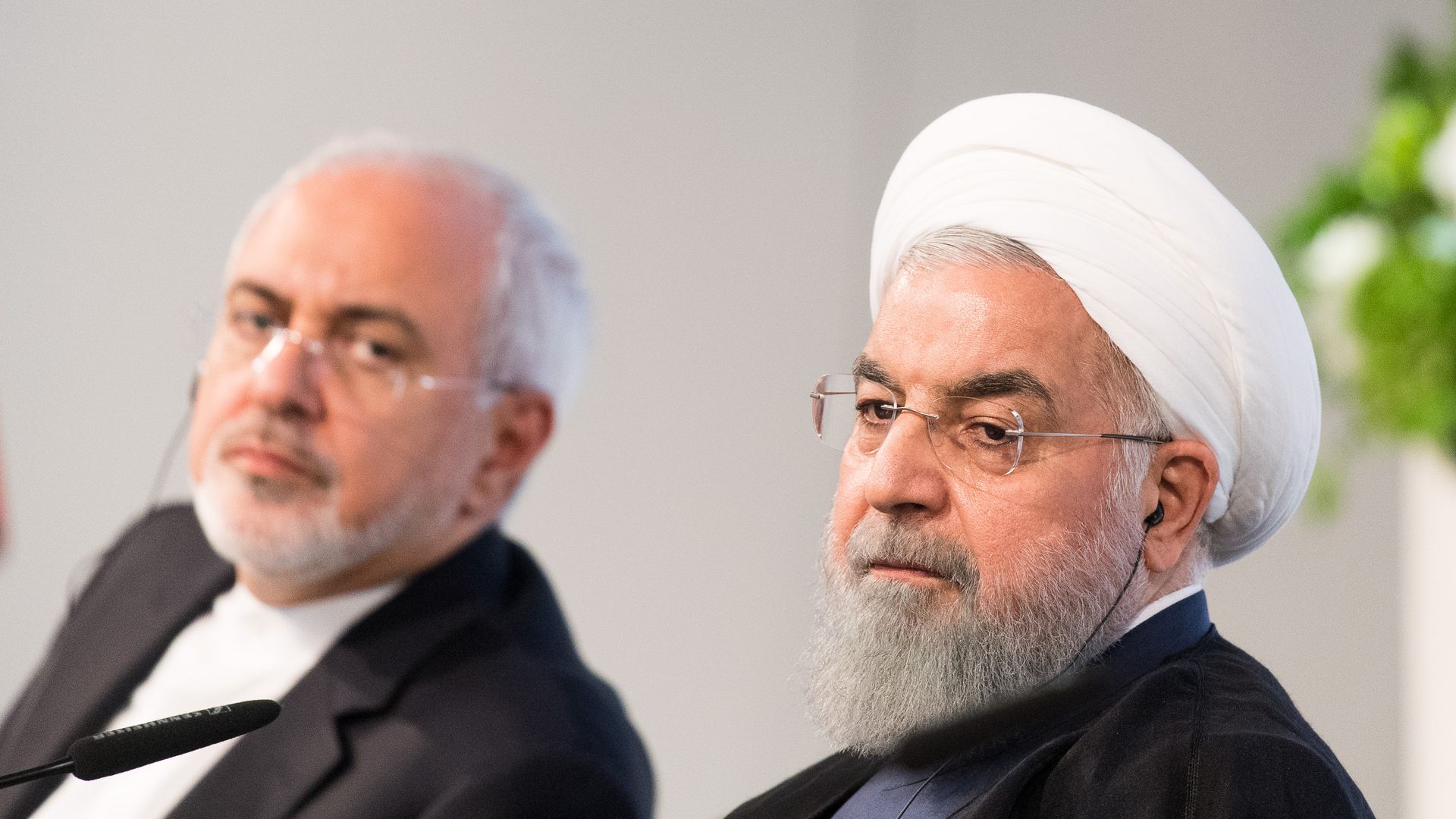
Convening for the first time since the United States' withdrawal, foreign ministers of the remaining parties to the 2015 Iran nuclear deal failed to announce new measures to compensate Iran for the re-imposition of U.S. sanctions.
Where it stands: Britain, France, Germany, Russia and China, meeting with Iran in Vienna under EU auspices, issued a bland communiqué that “reconfirmed their commitment to the full and effective implementation” of the deal. But there was no there there, apart from naming Britain to replace the U.S. as co-chair of a panel, alongside China, on reconfiguring a heavy-water reactor in Arak.
Secretary of State Mike Pompeo traveled to North Korea on Friday and met with Kim Yong-chol, the Vice Chairman of North Korea's worker's party, to fill in details on denuclearization, reports Reuters.
The details: Kim Jong-un broadly declared North Korea would commit to denuclearize at his summit with President Trump in June, but Pompeo hopes to get more information on a concrete plan moving forward. He's also hoping to discuss recovering the remains of American soldiers from the Korean war after Jong-un promised he would send them back to the U.S.
China on Friday hit the U.S. with $34 billion in retaliatory tariffs on 545 products, and they are expected to take particular aim at states that voted for President Trump in the 2016 election.
Bottom line: Trump had promised that such actions would be met with additional U.S. tariffs, which means the two countries may be staring down the black hole of a tit-for-tat trade war.