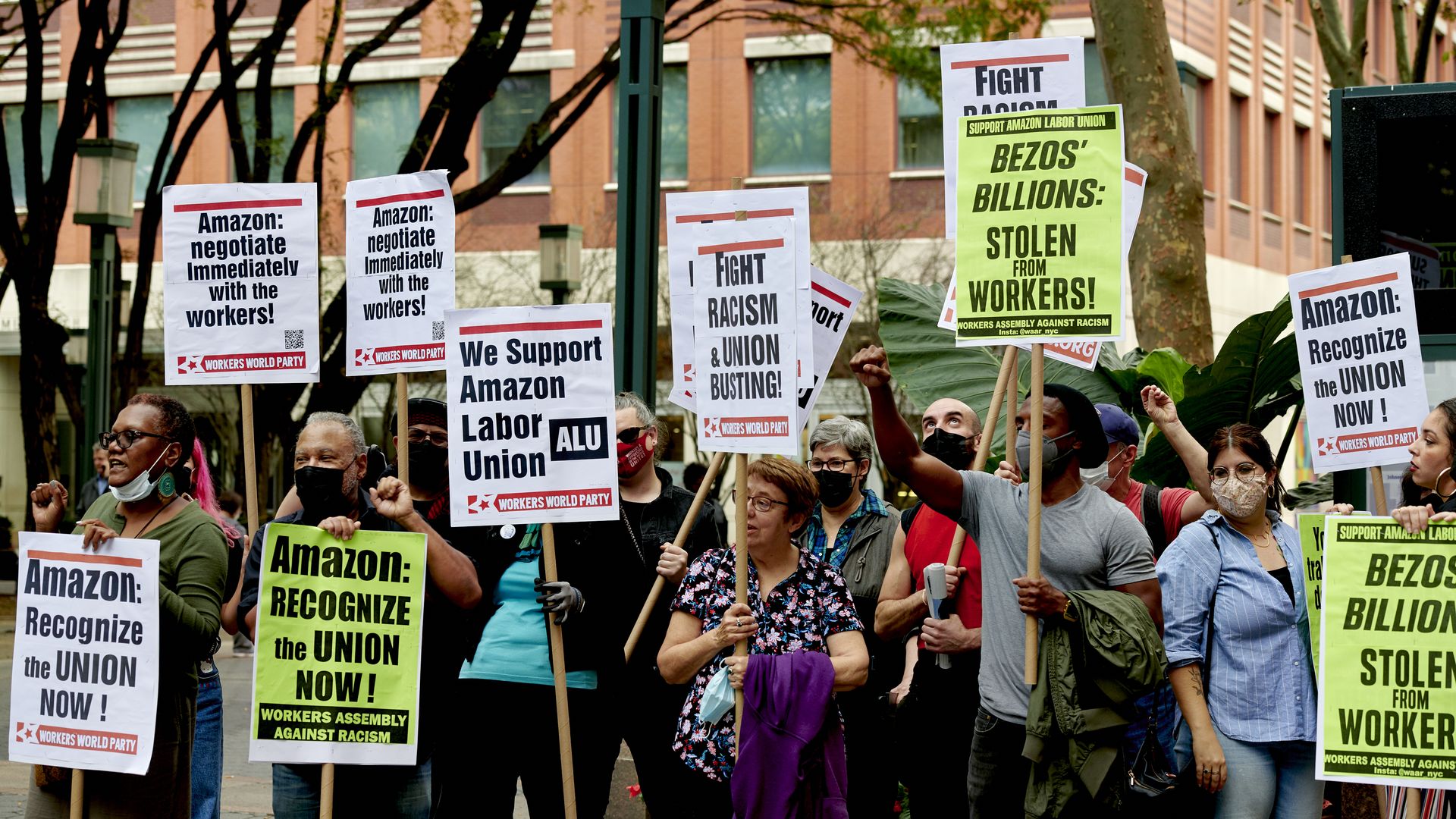
Why it matters: The election is part of a wave of labor organizing at Amazon facilities across the U.S. Another Staten Island warehouse is already set to hold an in-person union vote from March 25 to 30.
The creators of Destiny 2 are learning to manage their ever-evolving hit sci-fi game as they go, the game's general manager Justin Truman tells Axios.
Why it matters: Bungie is now in its fifth year running Destiny 2, making the Bellevue, Washington-based studio one of the foremost experts in the kind of service-oriented “live games” that so many other studios are now trying to make.
"Saturday Night Live" comedian Pete Davidson will no longer head to space on Blue Origin's next flight, the company announced late Thursday.
The latest: Blue Origin delayed the launch date six days to March 29 and said in a tweet that "Pete Davidson is no longer able to join the NS-20 crew on this mission."
Optimism, a New York-based Ethereum scaling startup, raised $150m in Series B funding at a $1.65b valuation co-led by Paradigm and Andreessen Horowitz.
Why it matters: Web3 evangelists see a decentralized future that sprints cheaply along the Ethereum network, but the current architecture can't handle more than a jogger's pace at a luxury gym. Optimism, and a handful of peers, wants to build a second layer that adds speed and reduces costs.
Forget toxic pesticides: The next generation of urban rodent control relies on internet-connected traps that shock or impale a rat or mouse before isolating it in a chamber for disposal.
Why it matters: Rat complaints have surged in the aftermath of pandemic lockdowns, and cities are cracking down with renewed vociferousness, appointing "rat czars" and prioritizing citizen complaints about rodents.
Finance on blockchains keeps getting more refined, with an eye to really taking on the banks. Prime Protocol, a decentralized prime brokerage that will work on multiple blockchains at once, has raised $2.75 million in a round co-led by Arrington, Jump and Framework, with multiple angels also participating.
Why it matters: As crypto-powered credit services get more sophisticated, that should eventually put pressure on the traditional banking system to lower fees for users.
A company called Staxxon in Montclair, New Jersey, is planning to sell a newfangled shipping container that's "designed to fold in an accordion-style fashion, and shrink to 1/5 the size of a regular container."
Why it matters: Most standard shipping containers return home empty, so if cargo ships can fit more of them on a return journey by collapsing them, it could help ease today's notorious supply chain woes.
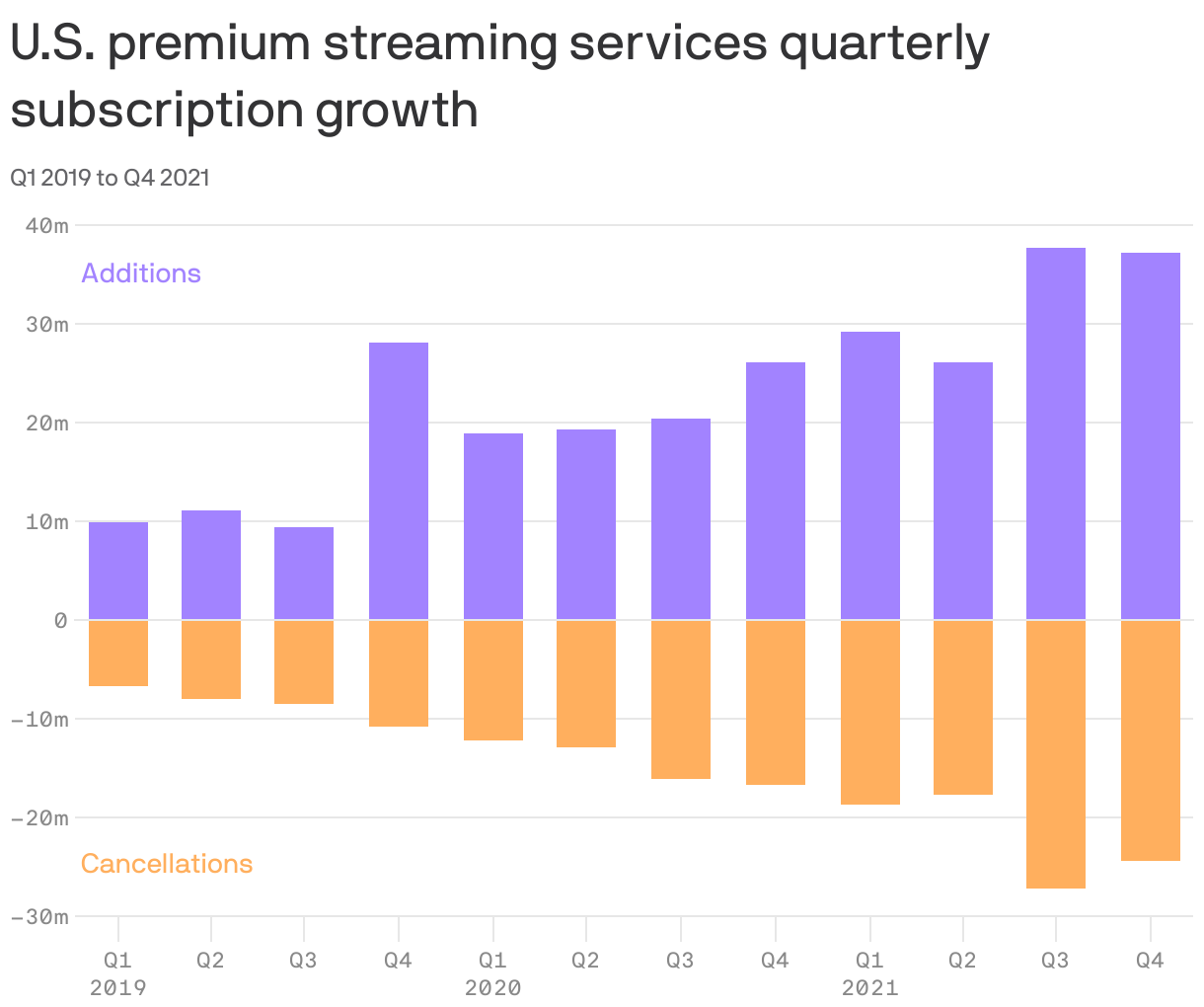
Data: Antenna; Note: Services include Apple TV+, Discovery+, Disney+, HBO Max, Hulu (SVOD-only), Netflix, Paramount+, Peacock, Showtime and Starz; Chart: Jacque Schrag/Axios
Streaming companies are cracking down on password sharing, as the number of quarterly subscription cancellations in the U.S. grows.
Why it matters: Password-sharing used to be a feature of the video subscription economy, allowing consumers to easily sample content across different services. Now that there's so much competition, it's a bug.
U.S. adoption of facial recognition software hit a speed bump recently when the Internal Revenue Service dropped one controversial plan, but public and private institutions are charging ahead with deploying the technology anyway.
Why it matters: Facial recognition systems solve thorny identification problems for government agencies and businesses, but they also raise concerns over bias and privacy, particularly since the U.S. lacks strong data regulations.
Russian journalist Marina Ovsyannikova told Reuters Wednesday she's "extremely concerned" for her safety but hopes her anti-war protest live on state TV this week will help people "open their eyes" to the invasion of Ukraine.
Why it matters: The Channel One editor's on-air demonstration to "millions of viewers" that the Kremlin isn't telling the truth about the invasion "broke the state propaganda machine" and along with it a "long silence" among Russia's journalists — several of whom have since resigned or plan to, writes Russian journalist Denis Kataev in the Guardian.
Britain's government has introduced an online safety bill that aims to strike a balance between holding tech firms more accountable and preserving robust free speech.
Why it matters: The move comes as regulators and legislators around the world are seeking to tighten the rules that govern everything from online privacy to competition in the digital world.