Google parent company Alphabet posted better-than-expected Q4 2021 earnings, with revenues leaping 32% year-over-year, and YouTube advertising revenue beating out Netflix during the same quarter, at $8.6 billion compared with $7.7 billion.
Why it matters: Alphabet is doing better and better in most parts of its business, including in advertising, where there had been a COVID-related slump, even as the world continues to struggle with other disruptions to commerce due to the Omicron variant.
Game industry veterans at upstart publisher The 4 Winds Entertainment are tired of how the mainstream video game industry treats players in the Middle East and nearby countries, and they’re doing something about it.
Driving the news: 4 Winds is lending development support to the upcoming multiplayer military-themed shooter World War 3 to address chronic cultural and technical issues for gamers in a part of the world where the player population is rapidly growing.
The FBI is warning people and businesses to remain vigilant against malicious actors who could interfere with the Beijing Olympic Games through a "broad range" of cyber activities, including theft of sensitive data.
Why it matters: High-profile events like the Olympics give cyber actors the opportunity to "make money, sow confusion, increase their notoriety, discredit adversaries, and advance ideological goals," the FBI said in a statement Tuesday.
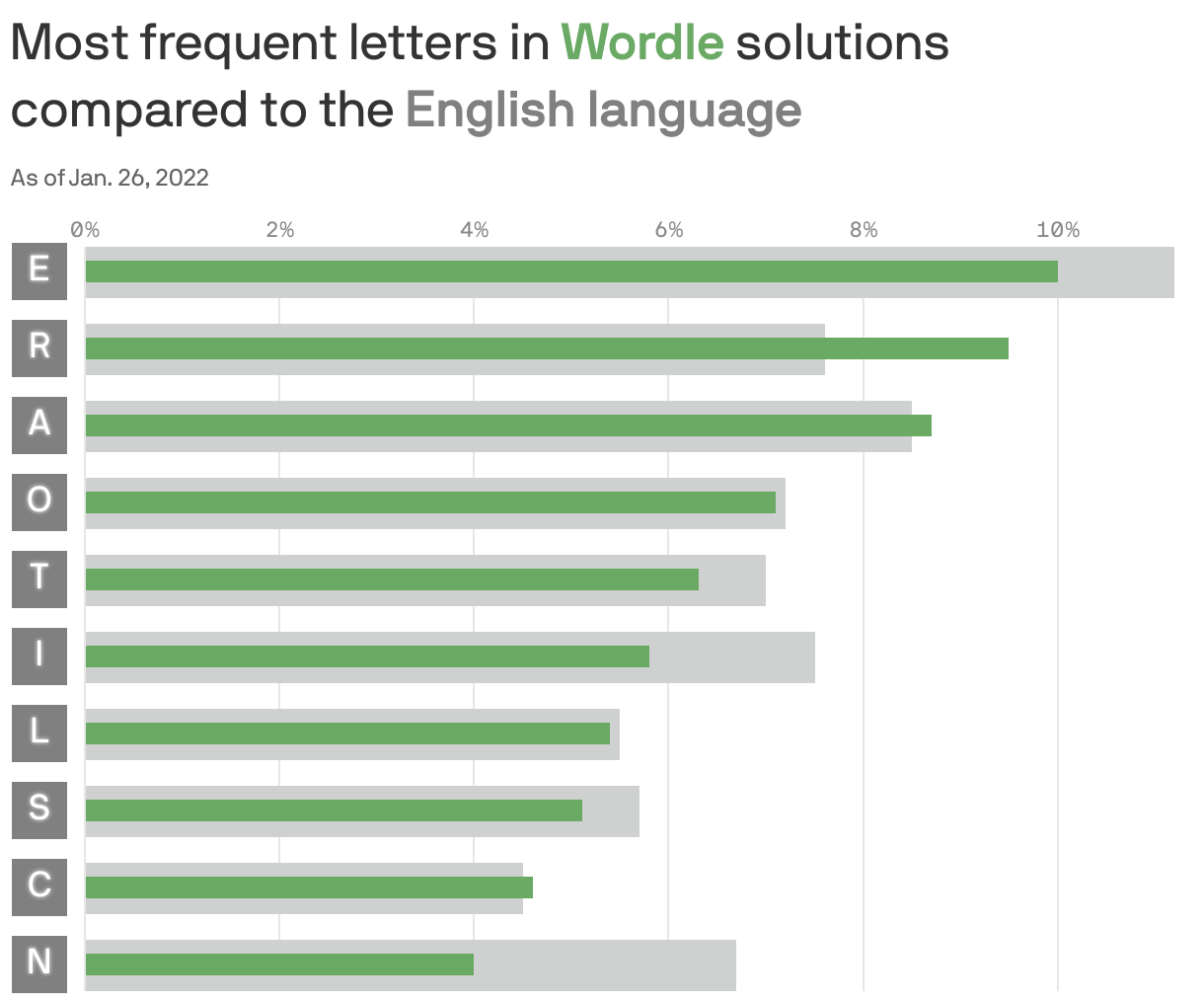
Reproduced from Christopher Ingraham, the Why Axis; Chart: Kavya Beheraj/Axios
Ta-da! The most common letters used in Wordle are E R A O T, according to an analysis of 221 games from Christopher Ingraham, a former Washington Post reporter.
Context: Invented byJosh Wardle, a software engineer in Brooklyn, to amuse his friends and partner, Wordle has become a daily obsession for many ( 🙋). The New York Times just paid in the "low-seven figures" to acquire the game.
AT&T on Tuesday said it would spin off WarnerMedia in a $43 billion deal that would combine the media asset with Discovery, rather than split it off.
How it works: A spin-off will give AT&T shareholders a proportionate number of shares in the new WarnerMedia/Discovery company, rather than giving shareholders the option to trade their AT&T shares for discounted stock in the new venture.
Launch House, which runs mostly in-person month-long programs for entrepreneurs and other techies, has raised $12 million in Series A funding led by Andreessen Horowitz, with several angel investors also participating.
Why it matters: Launch House is betting that the pandemic driven dispersion of techies across the country has created opportunities to create local communities for entrepreneurs and others looking for peers.
The National Highway Traffic Safety Administration said Tuesday that Tesla is recalling and updating the software for 53,822 of its cars using the Full Self-Driving (FSD) beta program because it may allow some models to conduct "rolling stops" at intersections, posing a safety risk.
Driving the news: The company said the update would disable the controversial feature, which allowed some cars to roll through intersections with stop signs instead of braking completely.
Spotify's weekend of boycott threats may have made headlines, but recent history suggests the controversy won't dent Spotify's business.
Why it matters: Boycotts of tech services have become more frequent amid growing political polarization and frustration over misinformation. But data shows that boycotts and the press attention around them are typically fleeting.
Zipline, a leading drone operator, will begin delivering prescription medicines to patients' homes in a suburb of Charlotte, North Carolina, this year, helping usher in the long-anticipated era of routine drone drops.
Why it matters: Battery-operated drones could satisfy our demand for "instant delivery" in less than 15 minutes, while easing traffic congestion, improving safety and helping the environment.
An online news outlet in Mexico announced Monday its reporter had been fatally shot — the fourth journalist to have been killed in Mexico this month, per AP.
Sony’s plan to buy Destiny developer Bungie is the latest move in an escalating arms race by video game industry leaders to outspend the competition for studios, franchises and players’ time.
The big picture: The games industry has grown immensely over the past decade, and so has competition for that revenue. Gaming’s heavy hitters are investing in popular developers and well-known titles to keep players on their side.