Misinformation is proliferating on Facebook about January's Senate election in Georgia despite the company's stated plans to keep conspiracy theories and falsehoods around the runoffs at bay, a new report from nonprofit human-rights group Avaaz finds.
Why it matters: The Georgia runoffs are a huge test for the fact-checking and labeling abilities of Facebook and other social media companies, as President Trump and his allies continue to spread false theories about voter fraud.
As the pandemic forces students out of school, broadband deployment programs aren't going to move fast enough to help families in immediate need of better internet access. But Democrats at the Federal Communications Commission say the incoming Biden administration could put a dent in that digital divide with one fast policy change.
State of play: An existing FCC program known as E-rate provides up to $4 billion for broadband at schools, but Republican FCC chairman Ajit Pai has resisted modifying the program during the pandemic to provide help connecting students at home.
A proposed executive order that could keep American cloud computing companies out of certain foreign countries is being circulated within the Trump administration and to tech industry players, Axios has learned, disconcerting the firms that could be affected.
Why it matters: The proposal would likely represent a chance to plant another tough-on-China flag before the president leaves office. The Trump administration has repeatedly sought to prove that it will stand up to countries that it believes want to supplant or infiltrate American tech.
The Justice Department is suing Facebook, alleging that the tech giant discriminated against American workers by intentionally reserving more than 2,600 jobs for immigrants on H-1B visas, the department announced Thursday.
Details: The department's two-year investigation found that Facebook gave jobs to visa holders whom the company sponsored for green cards, while failing to properly advertise the open positions or consider U.S.-born workers.
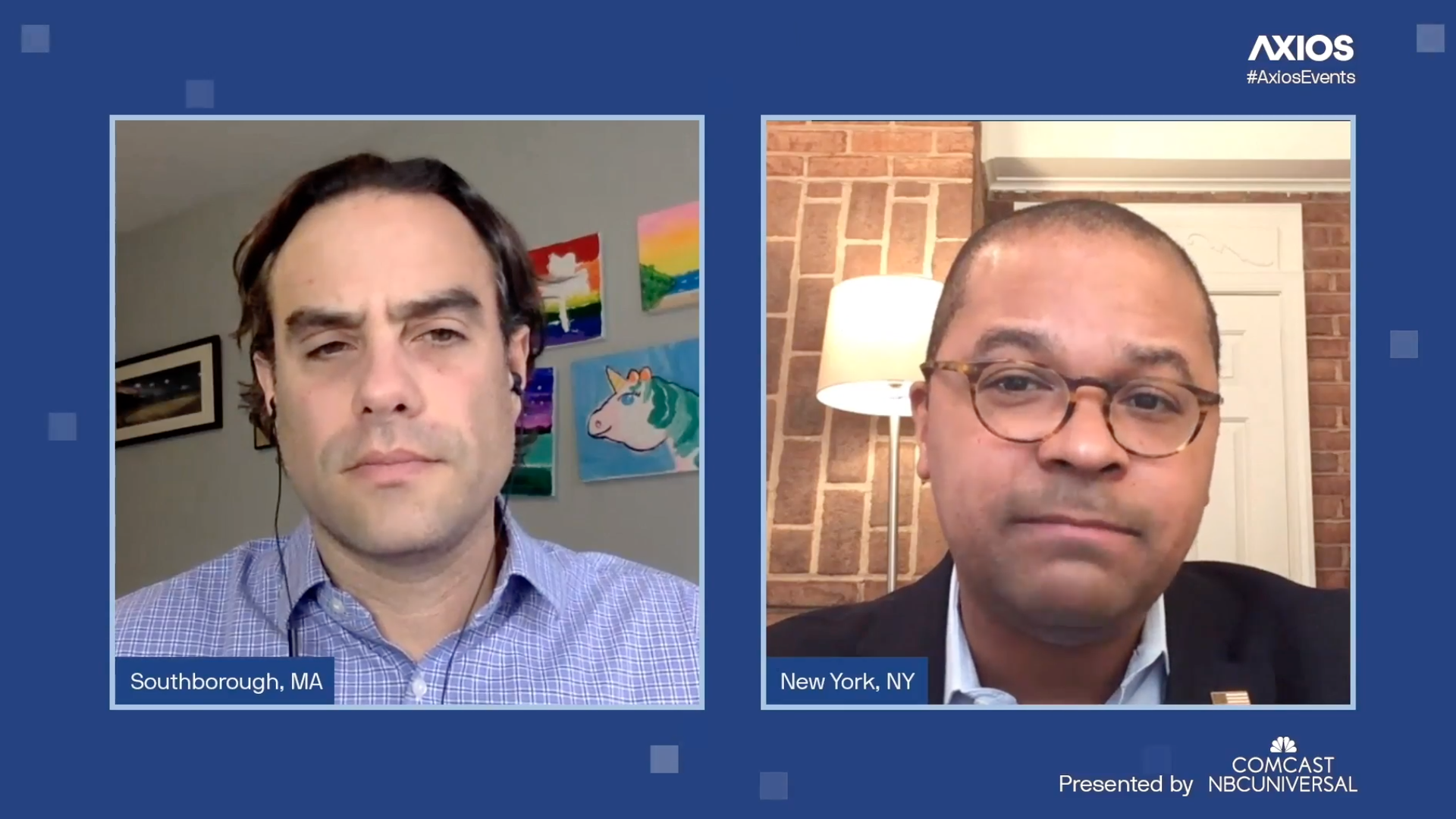
Access to broadband is essential to boost telehealth, which has skyrocketed during the coronavirus pandemic, Federal Communications commissioner Geoffrey Starks said on Thursday at an Axios virtual event on the future of broadband connectivity.
Why it matters: "Access to telemedicine and telehealth via affordable, reliable broadband is going to be extremely important to making sure that folks can safely manage their health from home," Starks said.
YouTube on Thursday introduced new measures to help combat hate speech and make the platform more inclusive.
Between the lines: The changes follow similar efforts introduced this week by Twitter and Facebook, suggesting tech companies might have waited to introduce such changes until after the election.
Broadband should be assessed as a household utility in order to improve access, DreamBox President and CEO Jessie Woolley-Wilson said Thursday at an Axios virtual event on the future of broadband connectivity.
Why it matters: Broadband access has become essential as the coronavirus pandemic shifted work to home offices and classrooms became remote. Low-income households and communities that don't have reliable broadband access are at an increased risk of falling behind during the pandemic.
The U.S. government must invest in workforce development, including providing American workers with IT skills that today's tech-forward economy demands, Per Scholas President and CEO Plinio Ayala said on Thursday at an Axios virtual event on the future of broadband connectivity.
Why it matters: The coronavirus pandemic has exposed vulnerabilities in the American workforce, such as the reliance on restaurant or hospitality work. But Ayala argues skills from those roles are transferable to the IT sector "if you're given the opportunity."
Zoom and Slack are very similar companies. One of them is riding high, however, while the other, beset by losses and a sluggish share price, has ended up selling itself to a strategic acquirer.
Details: Zoom and Slack are both high-profile and highly successful examples of the new breed of enterprise software. The sales technique is to create a super-popular free version that gets adopted by so many people in a company that eventually the CTO agrees to make it official and buy it.
Price discipline is dead. Long live the tech bubble.
The big picture: Determining "proper" tech startup valuations has always been subjective, but lately it's been more akin to throwing a dart at the ceiling than at the board.
A global phishing campaign has been trying to gain information from organizations working to ship coronavirus vaccines since September, IBM's cybersecurity arm said on Thursday.
Why it matters: Successfully distributing a COVID vaccine will already be challenging for the U.S. and other wealthy countries, especially to rural areas with less resources — while poorer countries are expected to have delayed access.
As problematic as the tech industry's diversity statistics are, activists say the focus on those numbers overlooks a more fundamental problem — one less about numbers than about power.
What they're saying: In tech, they argue, decision-making power remains largely concentrated in the hands of white men. The result is an industry whose products and working conditions belie the industry rhetoric about changing the world for the better.


/2020/12/03/1607019354046.gif?w=3840)