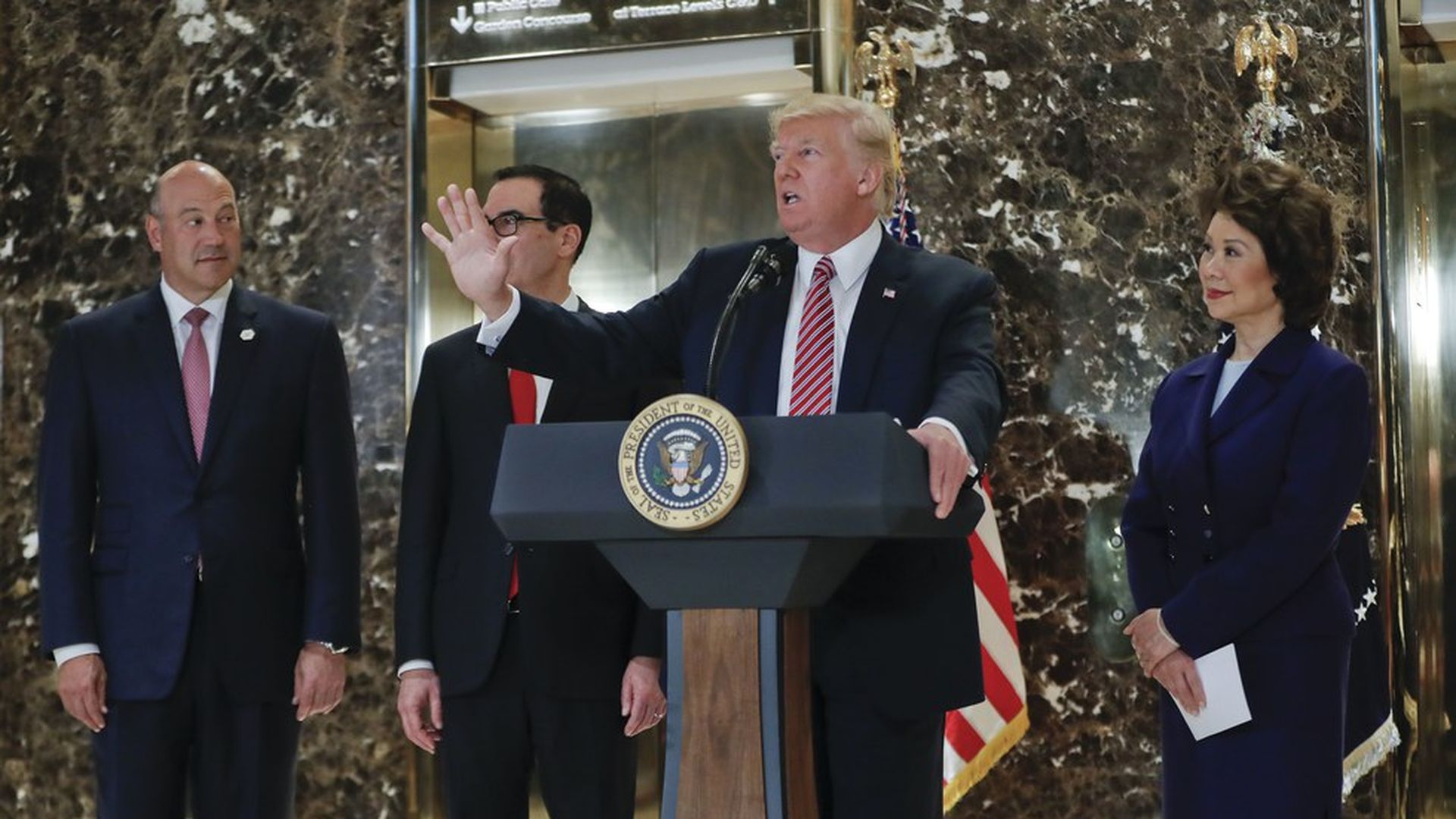
The White House called it quits Thursday on a council that was expected to advise President Trump on how to best improve U.S. infrastructure, acknowledging that participation in the council could subject members to intense criticism given the controversy surrounding Trump's handling of the Charlottesville, Virginia attacks, per the WSJ.
Why it matters: It's Infrastructure Week. And it suggests the Charlottesville fallout is having larger implications.
The announcement: "The President's Advisory Council on Infrastructure, which was still being formed, will not move forward," a White House official said Thursday.
Timing: The move comes just one day after Trump abruptly shut down his two key groups of outside business advisers.
Bad optics: Canceling plans for an infrastructure council the same week that the White House is supposed to be pushing its infrastructure agenda is only intensifying what has already been a tough week for the administration.
In a series of three tweets over 14 minutes this morning, President Trump doubled down on his controversial rhetoric from his Tuesday press conference, calling the removal of Confederate statues a contributing factor to "the history and culture of our great country being ripped apart."
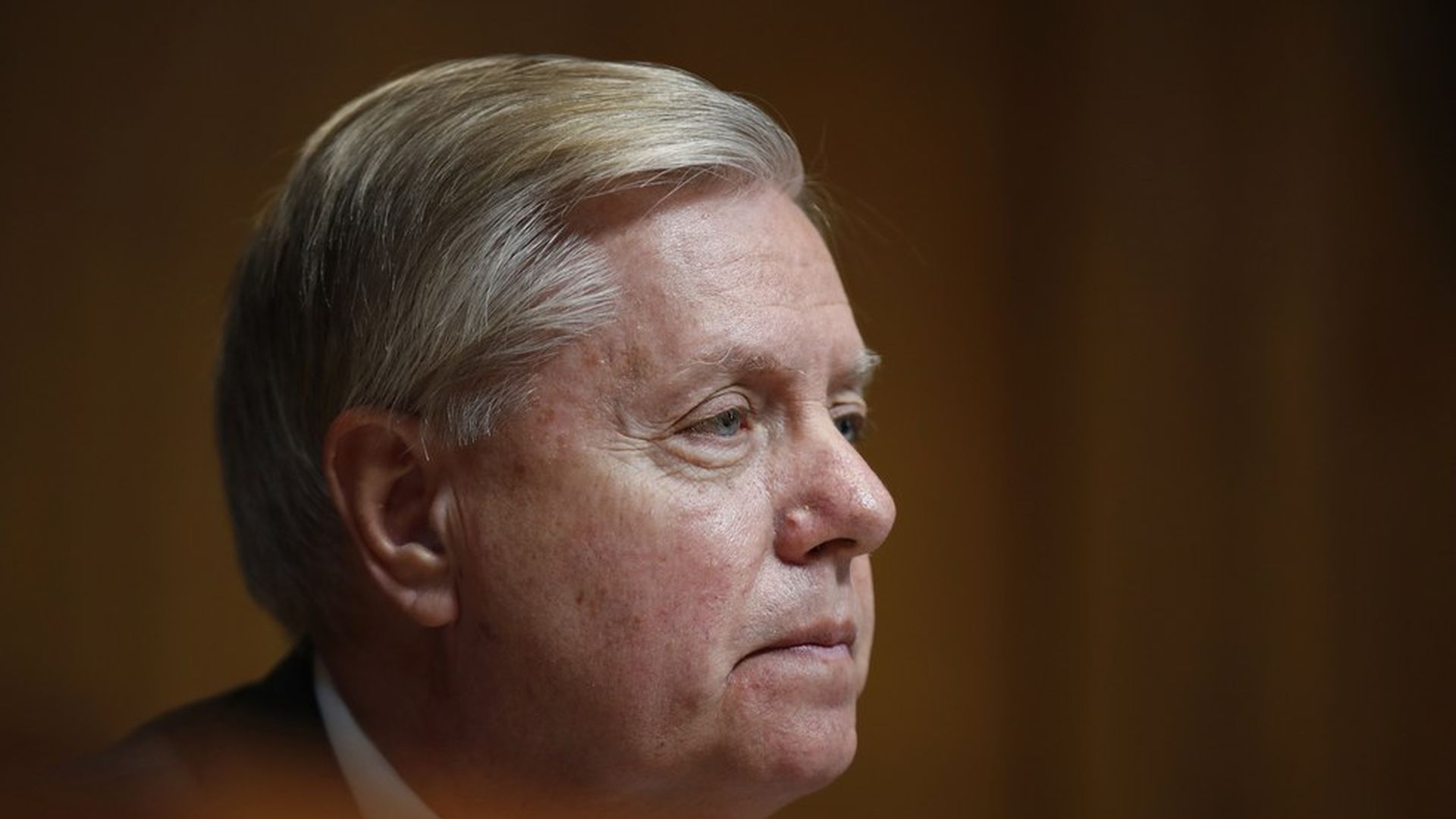
In a string of tweets, Sen. Lindsey Graham told President Trump that he needs to "fix this" because "history is watching us all" after Trump accused him this morning of putting forth a "disgusting lie" regarding Trump's response to the violence in Charlottesville.
A majority of Americans (52%) believe that President Trump's response to last weekend's violence in Charlottesville following a white nationalist rally was not strong enough, per an NPR/PBS NewsHour/Marist poll.
The timing: 80% of the poll was completed after Tuesday's explosive press conference where Trump doubled down on his earlier assertion that "both sides" were responsible for the violence in Charlottesville.
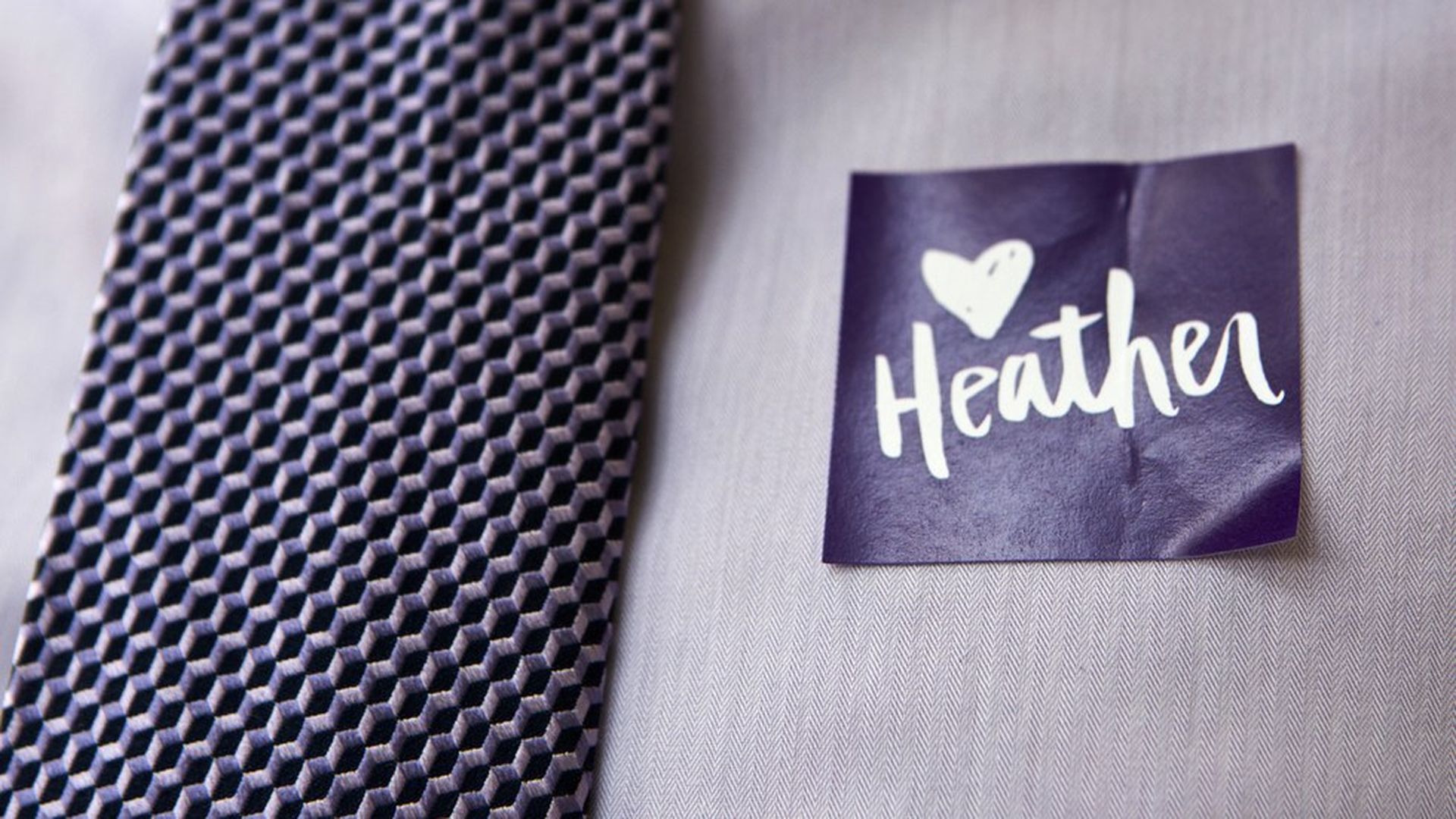
Bipartisan consensus: While most questions in the poll predictably broke down along partisan lines, a majority of Democrats and Republicans — even those who identify specifically as Trump voters — branded the car attack that resulted in the death of Heather Heyer an act of domestic terrorism.
Another stat: A majority of Americans believe that Confederate statues should remain as a historical symbol, an opinion supported by an overwhelming majority of Republicans (86%-6%) and even a significant minority of Democrats (44%-47%).
The Pew Research Center conducted a poll that shows citizens trust Russian President Vladimir Putin more than Trump to do the right thing for the world. That's a huge international rap on Trump.
Stack it up: Japan, South Korea, Venezuela, Mexico, Germany, France, Greece, and Turkey all have more confidence in Putin.
Keep it in perspective: Putin only got a global median of 26% confidence. And it's not all bad for Trump — Israel, Britain, Canada, Australia, Philippines, and Poland all favored Trump over Putin.
Trump criticized Lindsey Graham this morning, calling his statement on Trump's response to the Charlottesville violence a "disgusting lie," and reminding Graham about his election loss. (Keep in mind, Graham won the 2014 election in South Carolina with more than 55% of the vote.)
Lindsey Graham's comment: "President Trump took a step backward by again suggesting there is moral equivalency between the white supremacist neo-Nazis and KKK members who attended the Charlottesville rally and people like Ms. Heyer"
A day after Trump's chief strategist Steve Bannon told left-wing publication The American Prospect that we are in an "economic war" with China "and they're crushing us," China's foreign ministry spokeswoman told the press Thursday that "there is no winner in a trade war."
Hua Chunying added: Beijing hopes "the relevant people can refrain from dealing with a problem in the 21st century with a zero-sum mentality from the 19th or the 20th century."
Why it matters: The whiplash on this interview is likely just starting and could have geopolitical consequences — Bannon also mentioned he doesn't think there's a military solution for North Korea, in addition to making it sound like he was in control of staffing at the Pentagon and State Department. Both of these claims enhance the touchiness of his comments, which were already likely to mount even more pressure than already exists for Trump to fire Bannon.
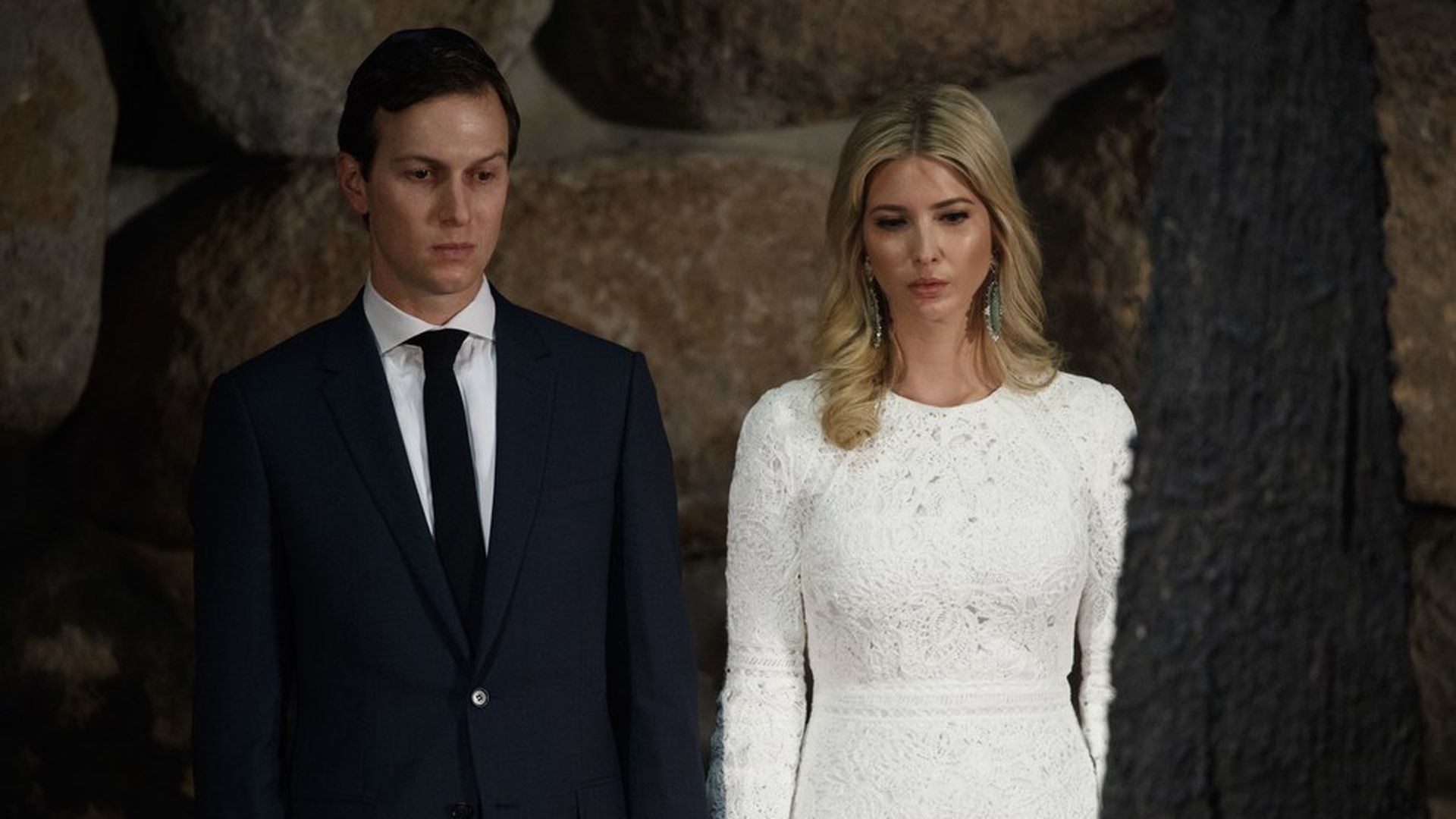
A clear pattern has emerged when President Trump does something highly controversial or deeply offensive to large chunks of America. Within 24 hours, a story is leaked about how Ivanka and Jared are disappointed or tried to stop it.
Why it matters: Jared and Ivanka provided some hope for some on the left who hoped the duo would have power to dissuade President Trump from some of his most extreme promises. But the truth is, they only have so much influence. Roll the tape:
In a statement, Sen. Lindsey Graham criticized President Trump's press conference on Charlottesville, urging Trump to bring the country together and telling him that his "words are dividing Americans."
On Charlottesville: Graham rejected Trump's "moral equivalency" between white nationalist groups and protesters like Heather Heyer, saying that he is committed to fighting back against the notion that the GOP "has a welcome mat out for the David Dukes of the world."
At the same time: Trump tweeted about Heyer's memorial service, calling her "a truly special young woman" who will be "long remembered by all."
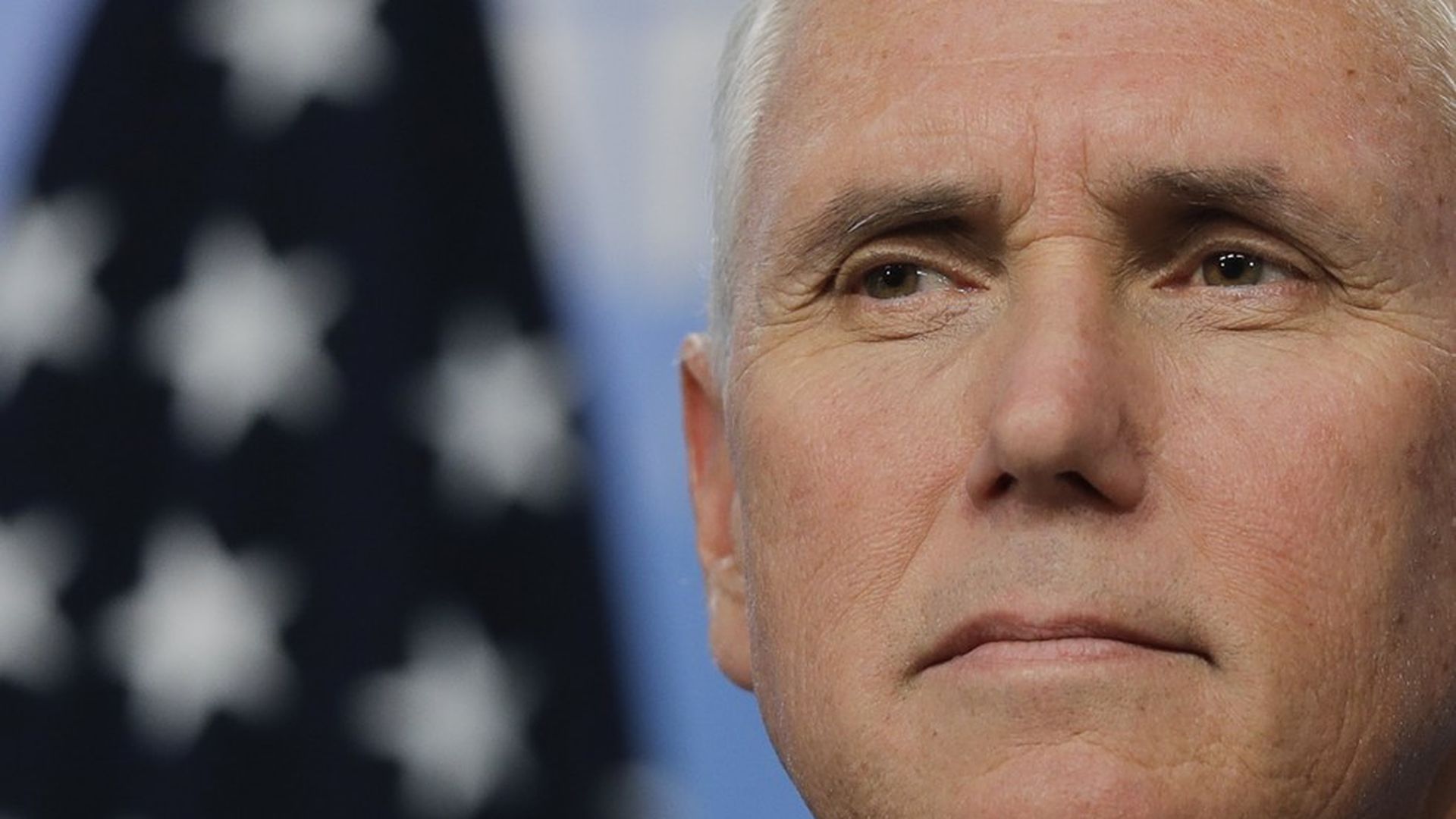
Vice President Mike Pence announced that he will cut short his trip to Central and South America — originally scheduled to run through Friday — and head back to Washington tomorrow for a national security meeting.
What he's missing: Nothing seemed amiss as Pence tweeted a photo of the Andes from Air Force Two earlier this morning on his way to meet with Chilean President Michelle Bachelet, but it looks like he'll be cutting short the Panama portion of his trip.
The reason: It's not Charlottesville. On that front, Pence told reporters in Chile today that he "[stands] with the president." Instead, Trump and Pence are holding a meeting with their national security team at Camp David on Friday "to discuss the South Asia strategy."
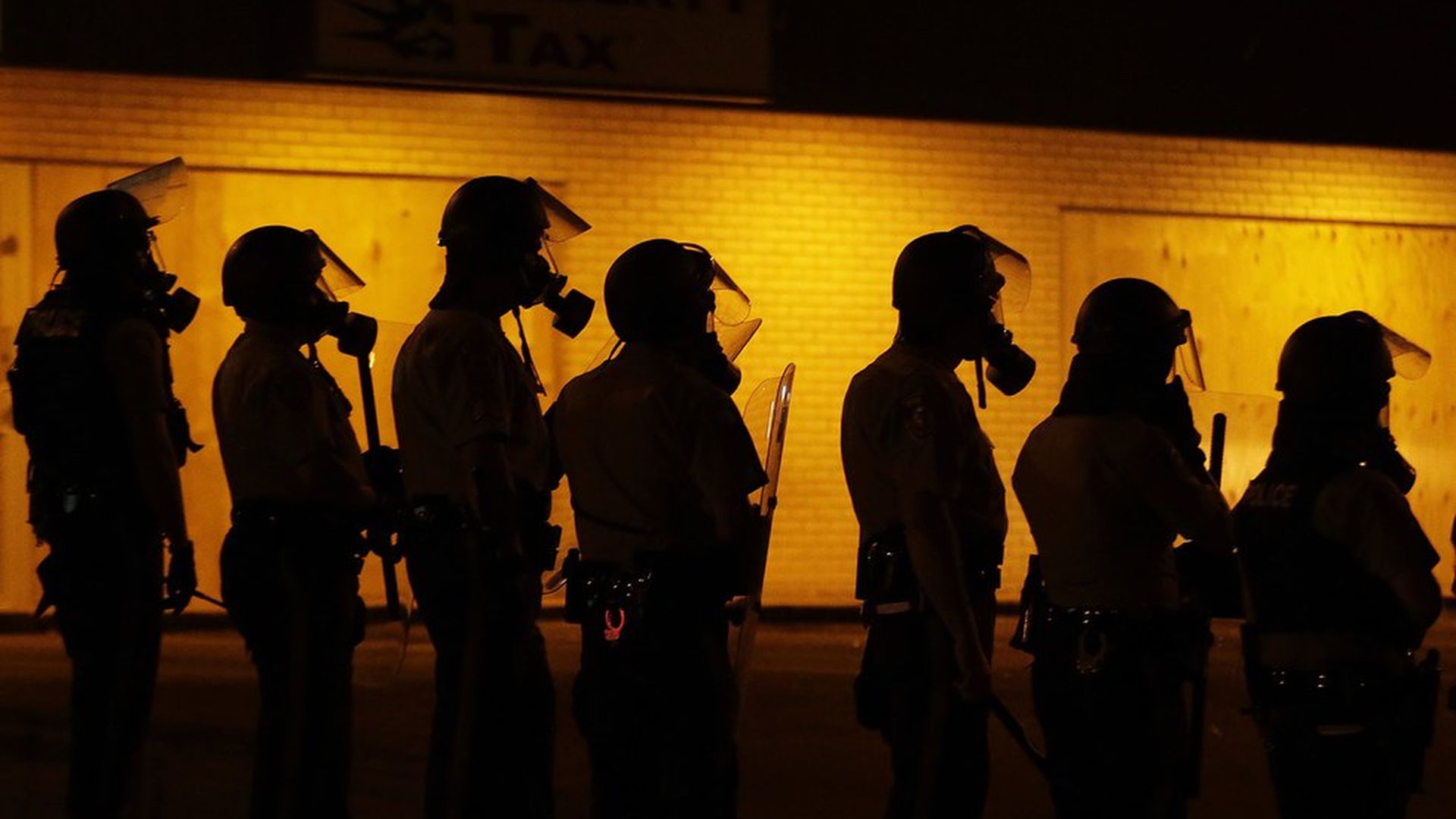
U.S. cities are becoming less livable due to civil unrest linked to Trump's proposed policies and police officers' shootings of black people, according to the Global Liveability Index report from The Economist Intelligence Unit. The index also shows this unrest in the U.S. is due to terrorism-related violence and an increase in mass shootings.
Cities from the U.S. didn't make it into the top 10 globally
Melbourne, Australia, is the most livable city (for the seventh consecutive year)
Honolulu is the most livable city in the U.S., (17th most livable globally), followed by Washington, D.C., Boston, and Chicago.
What makes a top city: "Mid-sized cities in wealthier countries with a relatively low population density" with recreational activities, low crime levels, and infrastructure that is not overburdened.The study compared 140 cities based on several metrics that can present challenges to a resident's lifestyle — stability (crime), healthcare, culture and environment, education, and infrastructure — which is important to note, since it's not just about crime and civil unrest.Top 10 most livable U.S. cities
Hundreds of people came together Wednesday to honor Heather Heyer, the 32-year-old woman who was killed Saturday when a 20-year-old man rammed his car into a crowd of counter-protestors at a white nationalist rally in Charlottesville, Virginia.
During the emotional service, Heyer's friends and family used the opportunity to speak out against the violence and hate that took place over the weekend. Her mother, Susan Bro, made a powerful statement:
They tried to kill my child to shut her up. But guess what? You just magnified her.
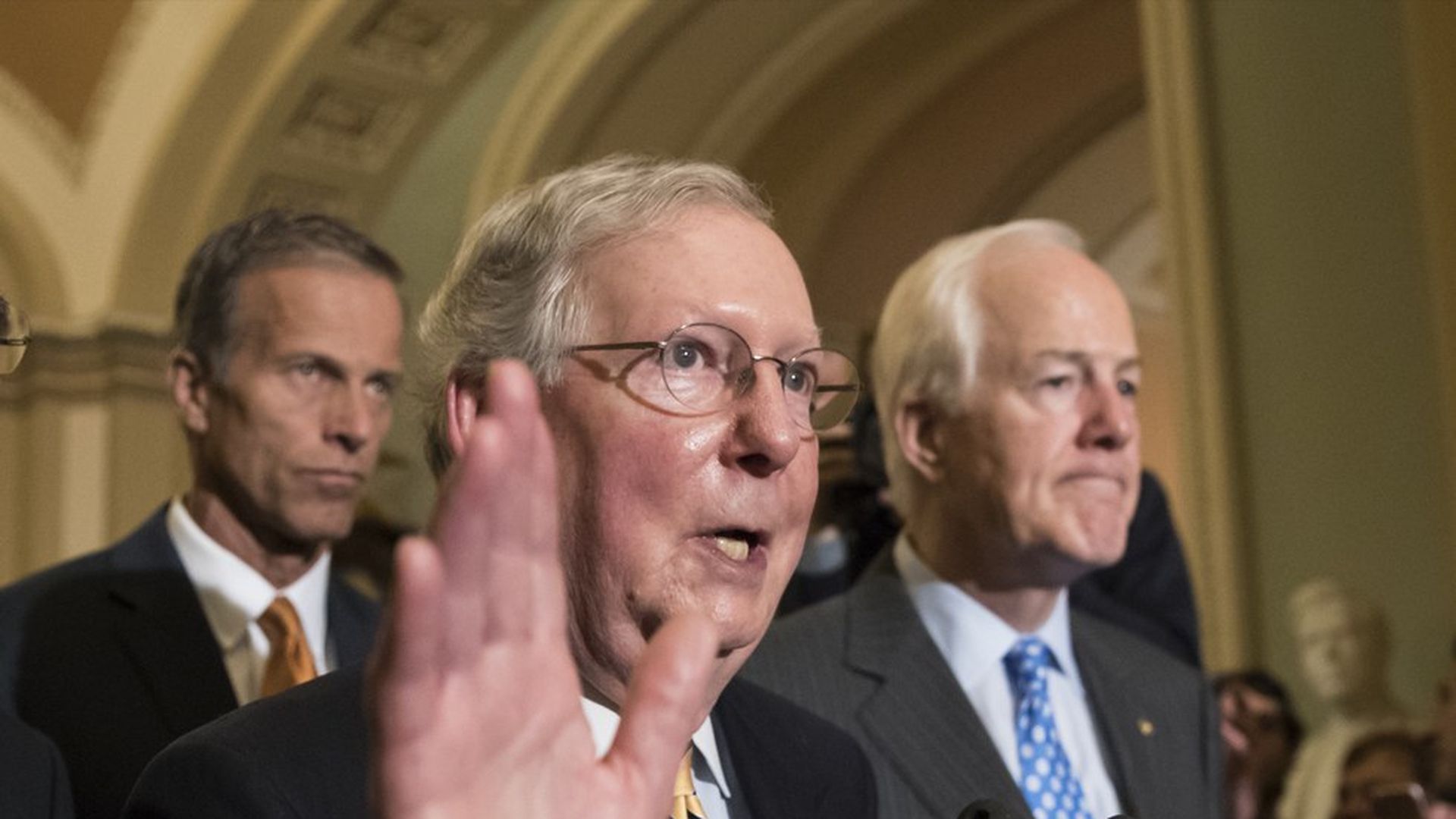
Senate Majority Leader Mitch McConnell issued a statement this morning condemning white nationalist groups after news of a planned far-right rally in his home state of Kentucky, saying that their ideologies "should not be welcome anywhere in America."
Trump's muted criticism of the far-right's violence in Charlottesville and his declaration that there were "very fine people on both sides" seemed to influence McConnell's statement as he declared "there are no good neo-Nazis."
More context: Just before the statement was issued, CNN reported that McConnell was "upset" with Trump.
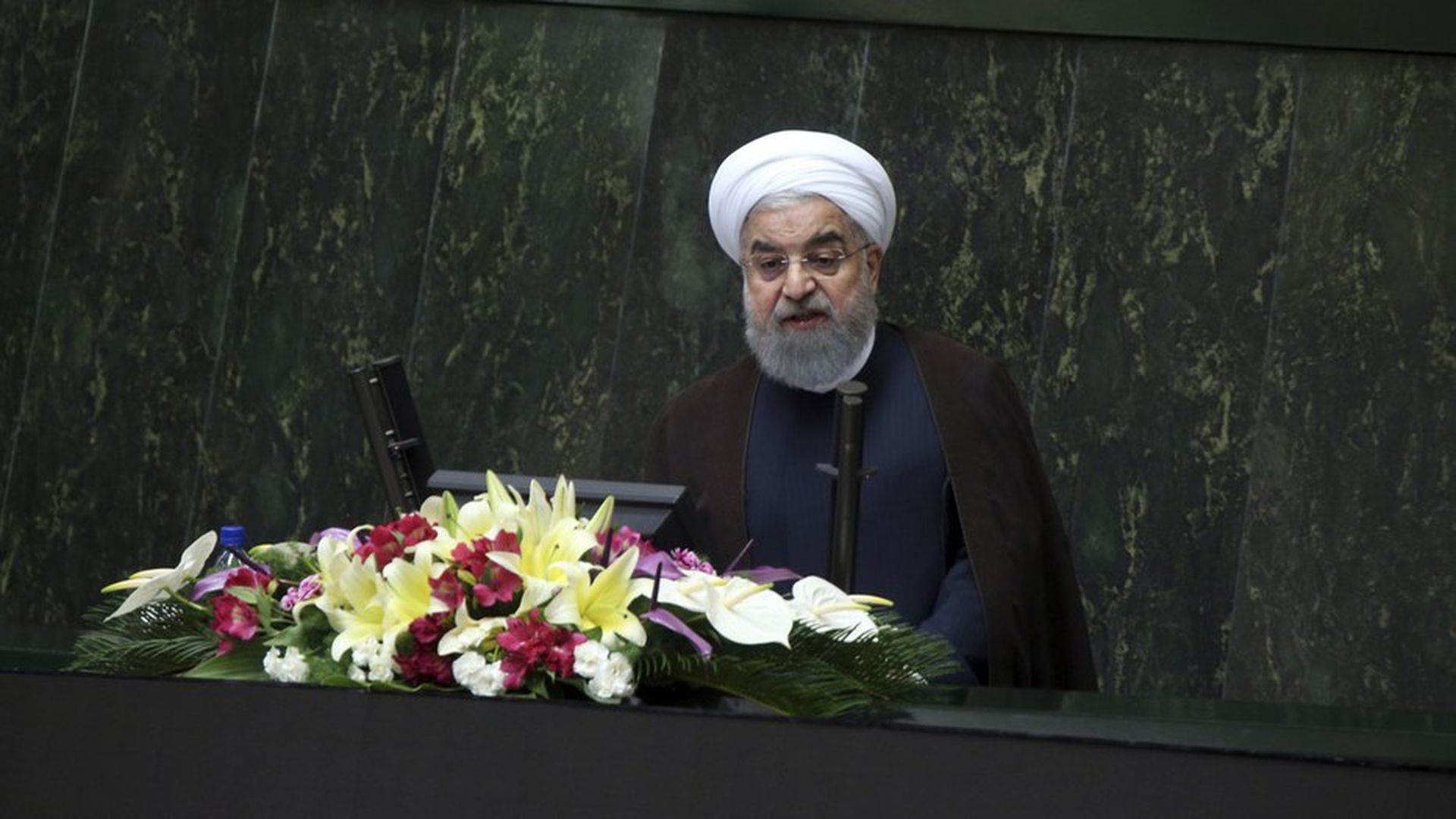
Iranian President Hassan Rouhani says fraught tensions with the U.S. over sanctions related to Iran's ballistic missile program might lead him to quickly restart the country's nuclear program and tear up its 2015 nuclear deal with major world powers, per the WSJ.
Rouhani's quote to his Parliament: "Iran will certainly return to conditions much more advanced than before the negotiations started in a short period, not on a weekly or monthly scale, but on a daily and hourly scale."
Why it matters: It's another potential nuclear threat for President Trump to address — and he hasn't exactly shown restraint when faced with strong rhetoric from North Korea. This one is also a serious threat to Western businesses, who poured billions in investment into Iran's economy after the nuclear deal.
Crews using heavy machinery went around Baltimore's parks and public squares last night and removed a series of statues dedicated to Confederate heroes, per the NY Times.
Baynard Woods, the editor at large of The Baltimore City Paper who documented the night's events on Twitter, described the atmosphere as "celebratory." The workers were also accompanied by a group of police officers, who Woods said were "being cheerful and encouraging people to take photos and selfies."
Timing: The statues were removed under the order of Mayor Catherine Pugh following the City Council's Monday vote to move them. The vote came just two days after a driver ran over protestors at a white nationalist rally in Charlottesville Saturday.