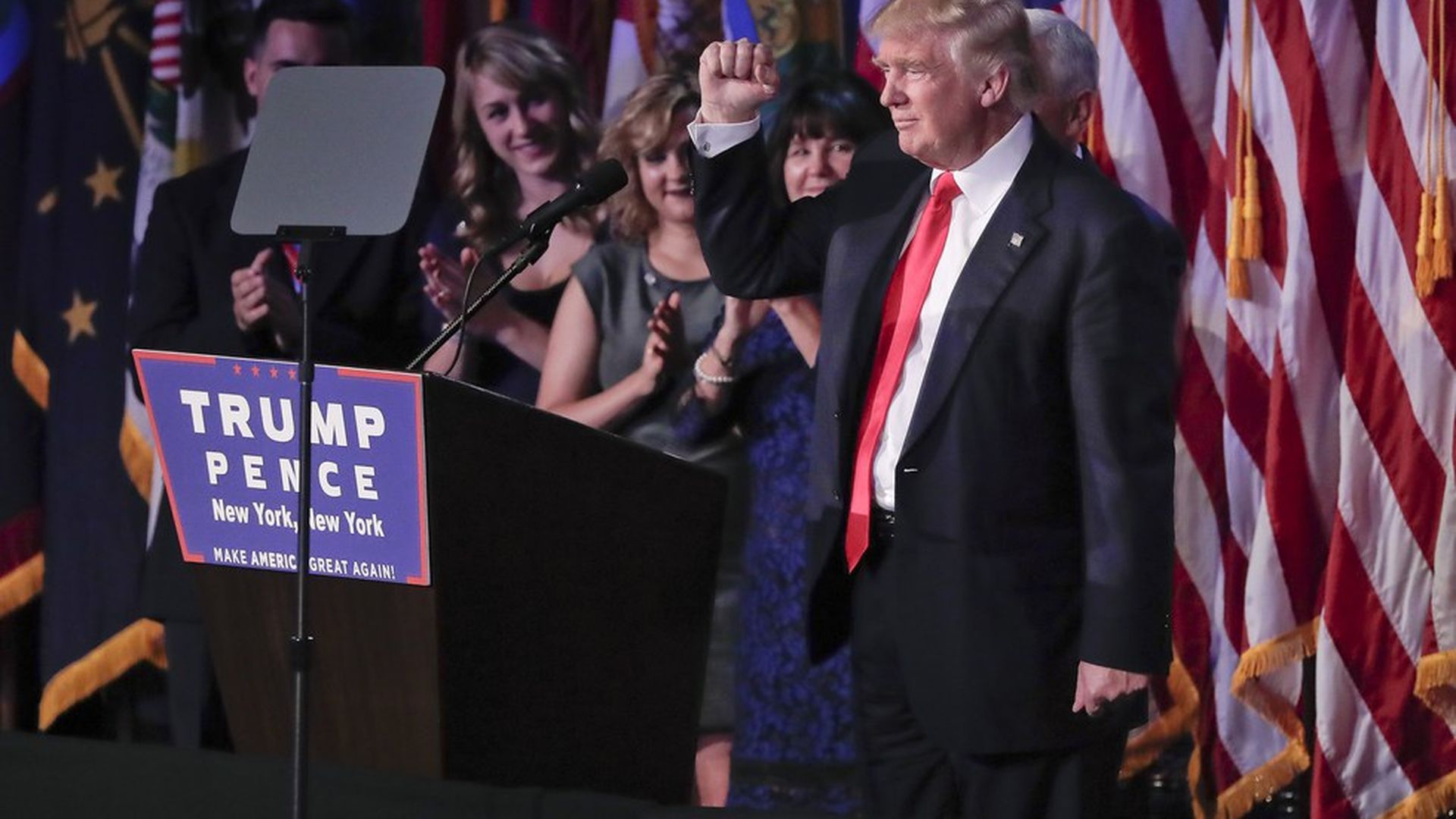
In his forthcoming book Devil's Bargain, Bloomberg Businessweek's Joshua Green writes President Trump didn't have a victory speech prepared on election night, per the Daily Mail. Also on election night, Green writes, Trump became enraged when Chris Christie suggested that Barack Obama call his phone when he reached out to congratulate Trump — a move which contributed to their falling out. Christie's office says that's "complete fiction." Other nuggets:
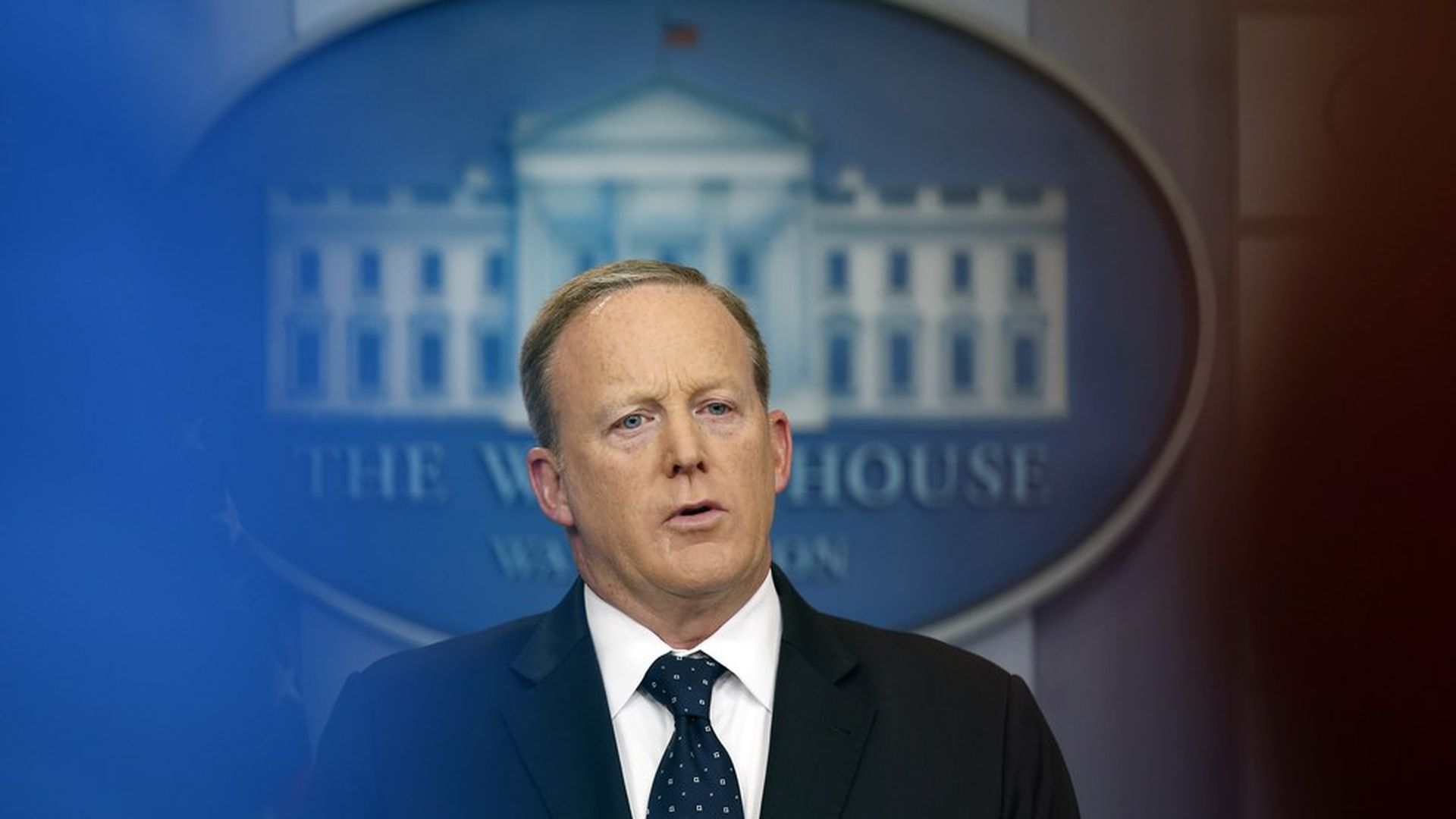
Sean Spicer, who returned to the podium for the first time since June 26, kicked off today's off-camera briefing by touting the administration's "Made in America Week." Yet when asked if this week's White House theme means that the Trump Organization and Ivanka Trump brands will commit to making products in the U.S., Spicer said he felt it was "inappropriate" to comment on their businesses, and added that in certain cases, "the supply chains and scalability" are not always available in the U.S.
41% of Americans think that President Trump should be impeached and 53% disagree, according to the latest Monmouth University poll. Trump's job approval has held steady at 39% with 52% disapproving.
Perspective: During the start of Watergate, Nixon only had 24% of Americans in favor of impeachment, with 62% opposed, but his job approval ratings were similar to Trump's, 39% to 49%, Monmouth pointed out.
Why it matters: Political polarization in the age of Trump is extreme. The numbers suggest that only 11% of Americans disapprove of Trump's performance, but think he should remain in office. For the most part, people either think he's a good president, or think he should be impeached. This is uncharted territory for U.S. politics.
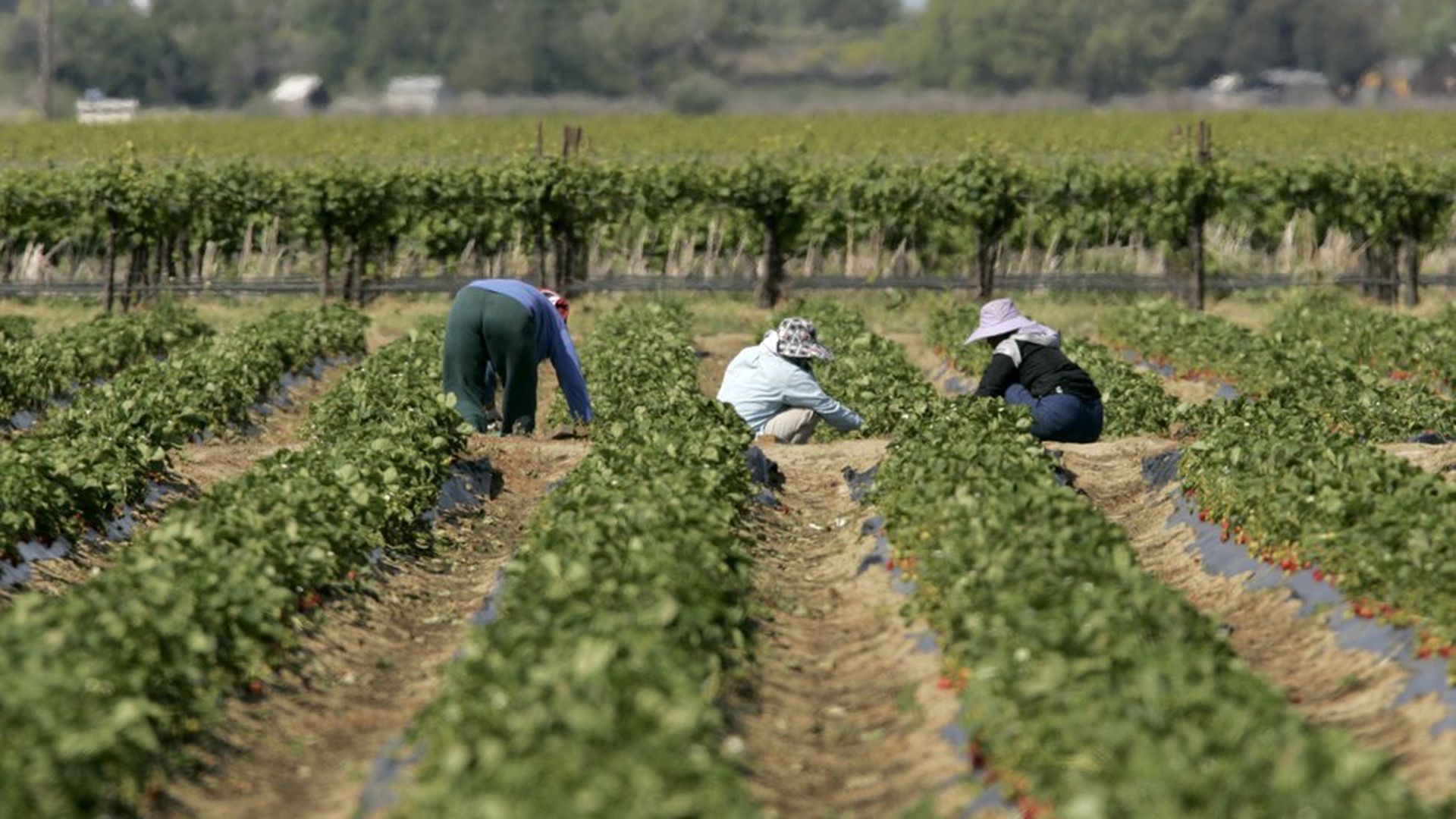
The Trump administration will give out an extra 15,000 temporary H-2B work visas before September 30, per AP. The visas will be used for seasonal, non-agriculture workers and be granted to businesses who argue they need foreign workers to succeed. The Trump Organization is among the businesses that uses H-2B visas, including for workers at Mar-a-Lago.
A few months ago, Congress voted to let Dept. of Homeland Security Secretary John Kelly offer more visas than the allotted 66,000 per year. Kelly celebrated the decision as a "demonstration of the administration's commitment to supporting American businesses."
Kelly has faced backlash from Washington lawmakers for failing to act more rapidly on the decision. Last week, Senator Thom Tillis (R-NC) placed a hold on Lee Francis Cissna's nomination within DHS as a result of Kelly's inaction.
Expect more criticism from Congress and the Senate, since the administration is only giving out 15,000 of the 70,000 additional visas approved by Congress.
In our 100 days report card back in April, Jim VandeHei and I noted that one of Trump's "misses" was: "Little personal growth in office" — a loose style and resistance to structure that leaves White House aides insecure, and created internal inefficiencies and blind spots.
As Trump approaches the six-month mark on Thursday (Day 182, with 1,280 till the next Inauguration Day), that factor is still hampering his presidency, one-eighth of the way into this term.
We asked several top Trump-watchers what has surprised them most about the first six months.
Rinat Akhmetshin, the mysterious Russian-American who attended the June 2016 meeting at which Donald Trump Jr. arrived expecting dirt on Hillary Clinton from Moscow, seems to be a sideshow. But his handiwork — finding and, with diabolical precision, disseminating incriminating records — is a reminder of the important difference between Russian and American tactics in the new age of intelligent cyber-war.
The key takeaway: With its cyber strategy, the U.S. has been fixated on the potential for paralyzing attacks on critical infrastructure such as the electricity grid, and establishing international norms against them. But that left the U.S. blinkered when Russia, seeking strategic advantage, carried out an old-fashioned information roundhouse, tweaked for the cyber age with intelligent fake news bots.