
Axios Generate

August 22, 2023
🌞 Good morning! Today's newsletter has a Smart Brevity count of 1,282 words, 5 minutes.
Ben is off today so you've got me guiding you through today's climate and energy news.
🎵 This week I was the last person on the planet to catch on to the newly viral 2015 hit, "Makeba," from the French artist Jain. It is today's intro tune... (You can read the song's backstory here.)
1 big thing: The brewing battle over carbon tech

Illustration: Aïda Amer/Axios
A multibillion-dollar federal spending commitment, a big corporate deal and one oil executive's provocative comment are fueling skirmishes about the promise and peril of nascent technology to draw carbon out of the air, Andrew writes.
Why it matters: Where the debate leads may shape the future of the direct air capture (DAC) industry and countries' abilities to meet their climate goals.
Driving the news: The discussions are taking place at a time when, for the first time, large sums of money are starting to flow into the DAC industry.
Zoom in: One of the main threads of the conversations has been sparked by the oil giant Occidental's $1.1 billion purchase of the DAC firm Carbon Engineering last week.
- This move has raised key questions around the potential role for oil and gas in the DAC business.
- The technology is meant to draw down excess carbon from the atmosphere and used to supplement carbon emissions cuts.
- If Oxy, or other oil and gas companies, use it as a means of enhancing oil recovery — which involves pumping CO2 into the ground to get more oil out — that would be counterproductive.
- An Oxy spokesperson told Axios via email they do not plan to use DAC under the deal for such purposes.
Using direct air capture for long-term carbon storage could be beneficial, if it is not used to extend high fossil fuel production rates, according to Erin Burns, executive director of Carbon180, a nonprofit focused on carbon removal.
Yes, but: Oxy's intentions have been called into question by a quote that has been making the rounds from its CEO, Vicki Hollub, in which she seemed to say the quiet part out loud.
- By using direct air capture, Hollub reportedly suggested the oil and gas industry can continue producing more fossil fuels for another 80 years.
- Critics of big oil and gas have pounced on that statement, using it to question the viability of DAC technology writ large.
The big picture: Burns told Axios the Oxy deal, plus the unprecedented federal funding, are sparking debates about the role of certain actors in DAC — and carbon removal more broadly.
- She said prominent DAC companies were prepared for questions regarding whether or not they would engage with oil and gas companies.
What's next: The burgeoning DAC community has yet to grapple with how to ensure sure that oil and gas players that want to enter the DAC space do so mainly to siphon excess carbon dioxide out of the air, Burns and her colleagues said.
The bottom line: It may take new legislation or policies in other forms to ensure DAC doesn't become yet another form of industry greenwashing.
2. Hawai'i wildfires' "downward, spiral-like impacts" on food

Photo illustration: Lindsey Bailey/ Axios. Photos: Gonzalo Marroquin, Jeff Greenberg, Bloomberg/Getty Images
Hawai'i's catastrophic wildfires haven't just stolen lives, destroyed an entire town and displaced thousands of residents, Axios' Ayurella Horn-Muller reports.
The big picture: The devastation has also damaged crop cultivation, and the impact of the blazes on small-scale farmers means local food production is going to take years to rebuild.
Zoom out: Wildfires, like the record-breaking blazes that swept through the islands of Maui, Big Island and Oahu, affect agricultural productivity in both the short and long-term, according to Ohio State University agricultural economist Seungki Lee.
- But it's the probable forthcoming impacts on food supply brought on by Hawai'i's wildfires that has him most concerned.
Context: Although the state imports up to 90% of its food, the wildfires have impacted agricultural areas across Maui, where land is largely used for pasture but 7,718 acres is for crops, per 2020 data.
- The vast majority of food grown for local consumption comes from diversified crops — including taro, sweet onions and bananas — and typically produced on smaller land parcels.
- "Although the whole city ... was destroyed by the fire in the Lahaina area, at the same time, the origin of the food-producing area also got affected by this fire," Lee said. "So we'll have some downward, spiral-like impacts."
Zoom in: Experts told Axios that in the short term, residents' food access needs are likely to be alleviated by disaster response and recovery.
- John Torpey, who is leading the World Central Kitchen's efforts across Maui, told Axios his team is working alongside local chefs to prepare and deliver about 6,300 meals per day.
3. Ecuadorians reject oil extraction in parts of the Amazon

A voter casts a ballot during Sunday's elections in Ecuador in Quito. Photo: Franklin Jacome/Getty Images
Ecuadorians voted on Sunday to ban oil drilling in a part of the Amazon rainforest that's considered one of the most biodiverse regions in the world, Axios' Jacob Knutson and Marina E. Franco of Noticias Telemundo write.
Why it matters: The results will require Ecuador's national oil company, Petroecuador, to close all of its active oil wells and remove all infrastructure from a portion of Yasuní National Park within a year.
Catch up quick: Yasuní, located along the eastern portion of Ecuador's border with Peru, is a U.N. Educational, Scientific and Cultural Organization (UNESCO) biosphere reserve site.
- Hundreds of thousands of distinct species inhabit the 2.5 million-acre area, including at least three that have not been found anywhere else.
- It's also home to around 200 and 300 people from two uncontacted Indigenous tribes — the Tagaeri and the Taromenane.
- But the national park holds one of Ecuador's largest crude oil reservoirs.
By the numbers: Roughly six in 10 Ecuadorians voted to halt Petroecuador from operating its 225 active wells or opening other planned wells, according to Amazon Watch, an Oakland-based advocacy group for the rainforest and those who live in it.
- Before the vote, about 54,800 barrels of oil were extracted from the Ishpingo Tambococha-Tiputini oil field every day.
4. Record-shattering heat dome roasts Central U.S.
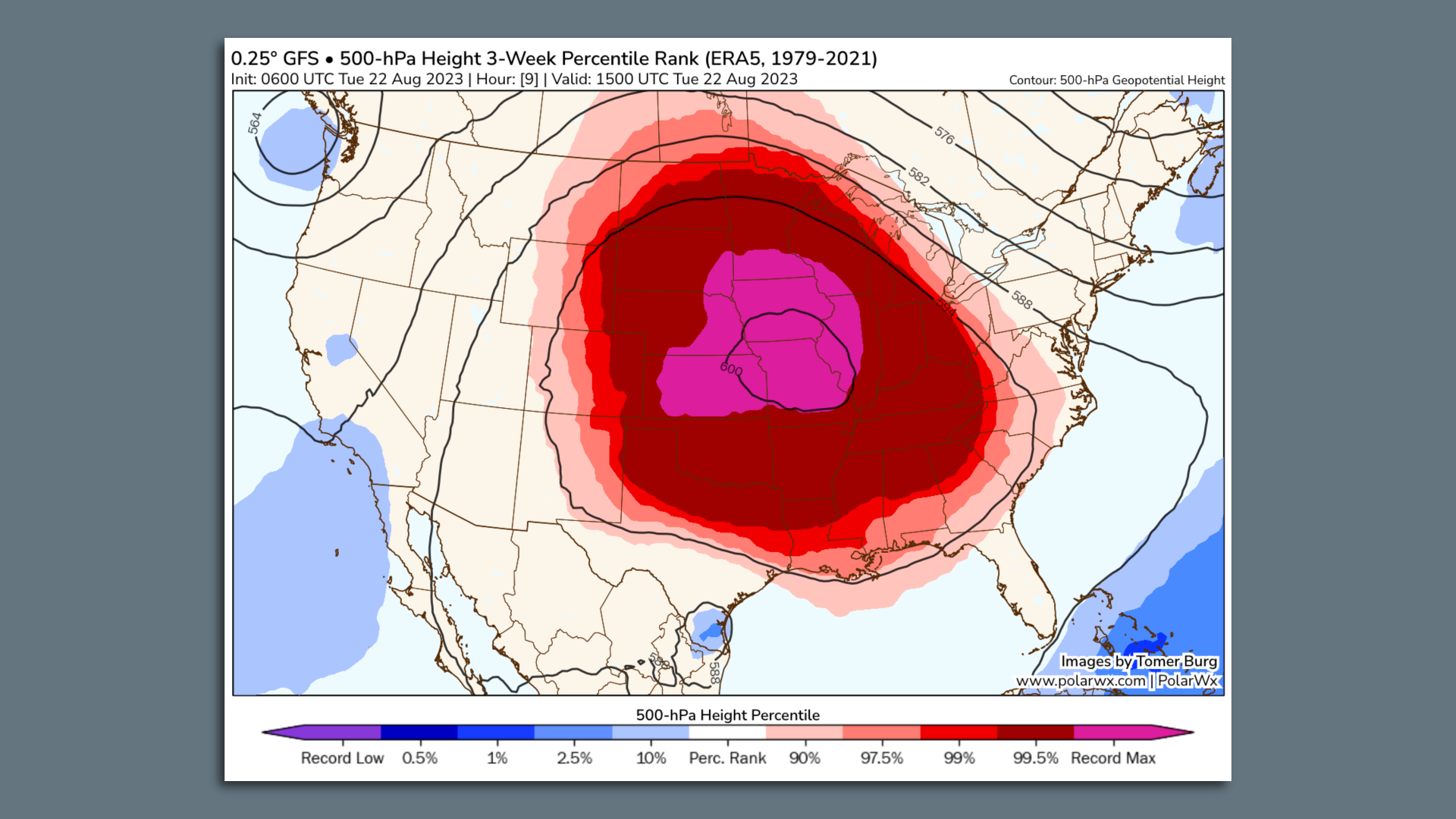
Map showing the percentile rank of the heat dome over the Central U.S., indicating it is at the top of the historical scale. Image: Tomer Burg/PolarWx
A record strong, "brutal" August heat dome that outranks a similar pattern seen during the Dust Bowl era of 1936 has prompted extreme heat alerts for 143 million people in 22 states on Tuesday, Andrew reports with Rebecca Falconer and Jacob Knutson.
Threat level: The heat dome is leading to dangerous heat indices climbing to between 120°F and 130°F. Even in a summer featuring relentless extreme heat, this event stands out.
- The scope of the warnings stretches from Minnesota to coastal Texas.
- Major metro areas including Chicago, Dallas, Kansas City, Louisville, Nashville, Oklahoma City and the Twin Cities will swelter on Tuesday.
What they're saying: "These temperatures are extremely anomalous and likely to break numerous daily and potentially monthly records," the National Weather Service stated Tuesday morning. Forecasters called the temperatures "oppressive."
Context: Human-caused climate change from burning fossil fuels is causing heat waves to be more common and severe.
5. Thunderstorms as the costliest "major peril"
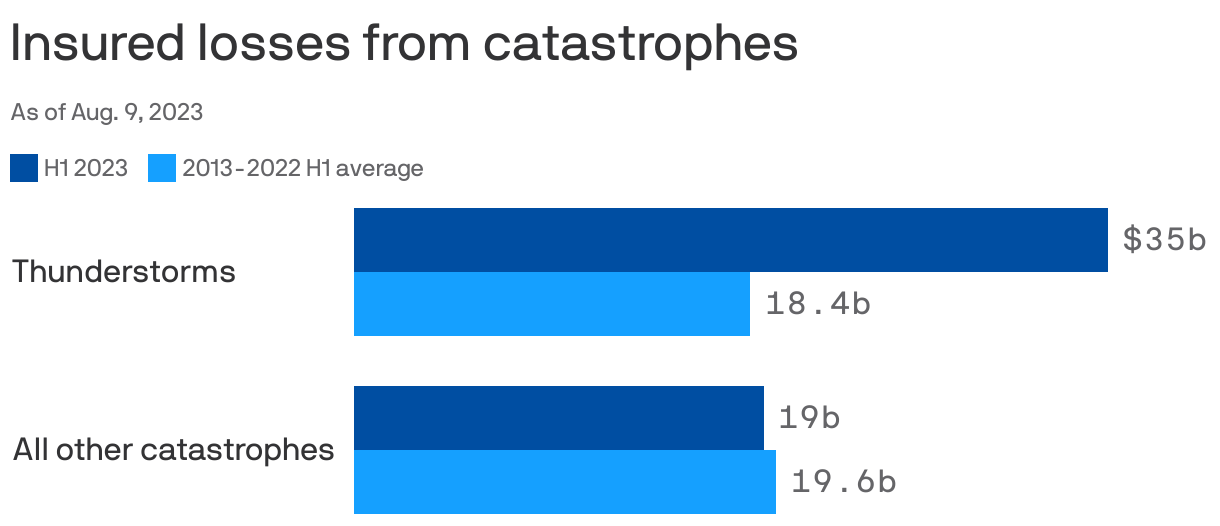
The single costliest type of natural catastrophe for insurers in 2023 isn't hurricanes or earthquakes or volcanic eruptions — it's thunderstorms, Axios' Felix Salmon and Andrew write.
Why it matters: Population growth, expanding cities in storm-prone regions, and climate change-driven trends in severe weather are all helping to vault insurance costs ever higher.
By the numbers: Insured losses from catastrophes are rising at a long-term rate of between 5% and 7% per year, according to insurer Swiss Re.
- According to Steve Bowen, chief science officer with Gallagher Re, the U.S. is headed for a record year when it comes to insured losses from thunderstorms.
- Insured losses from such storms come from flooding, hail damage, and winds snapping trees onto houses and power lines. The total is likely to reach at least $50 billion this year.
Between the lines: Bowen points to the expansion of metropolitan areas as a key driver of growing thunderstorm-related losses.
- "Before any climate influence whatsoever, there's just simply more stuff, more opportunity for things to be damaged," Bowen, a meteorologist, said.
- There are also climate-change related trends in severe thunderstorms. As the seas and air warm, more water vapor and heat enter the atmosphere, allowing for more energy for severe weather outbreaks.
Did someone forward you this newsletter? Welcome, and please sign up.
🙏 Thanks to Chris Speckhard and Javier E. David for edits to today's edition, along with the talented Axios Visuals team.
Sign up for Axios Generate

Untangle the energy industry’s biggest news stories