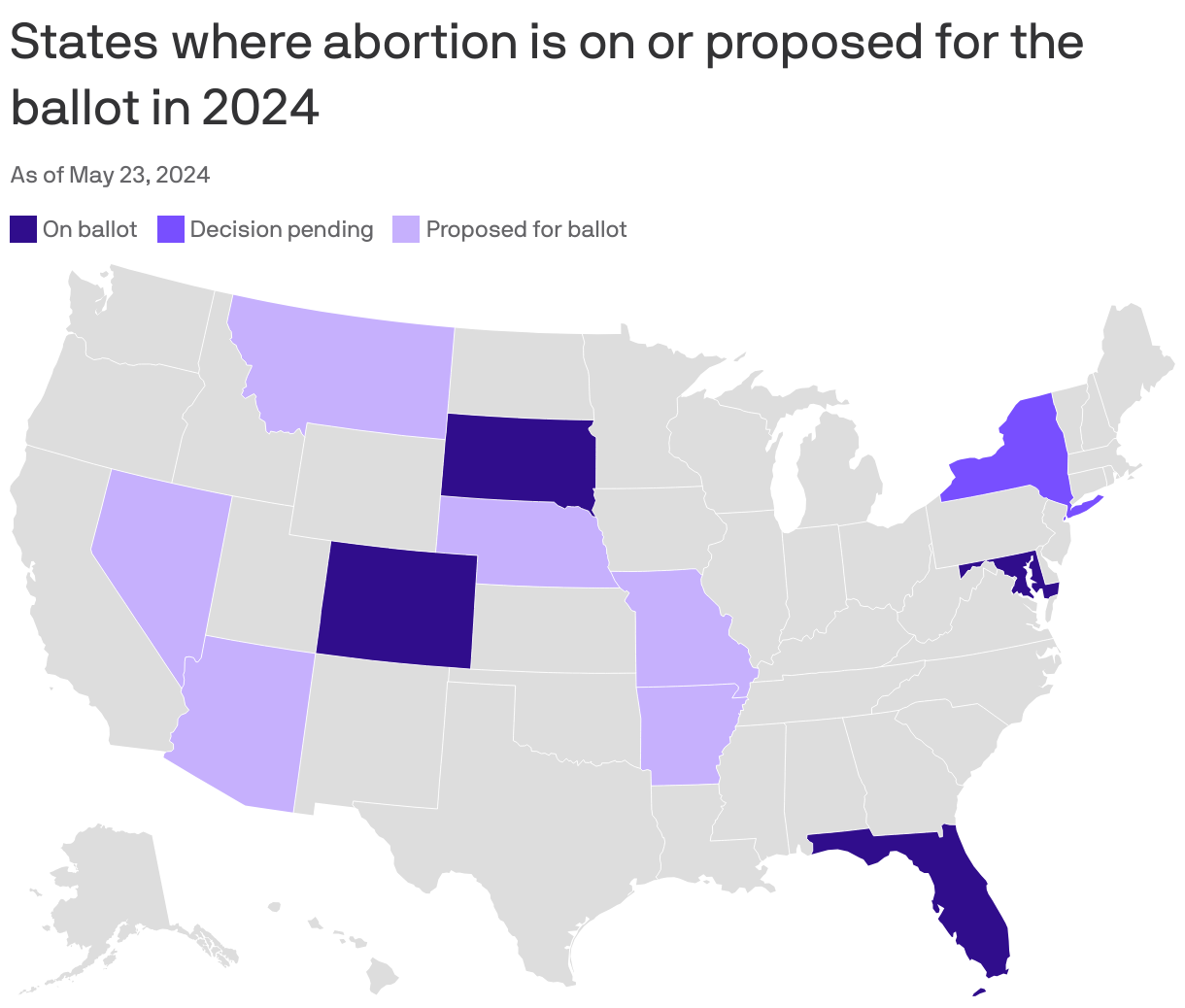
The big picture: Ten states green-lit abortion-related ballot questions, while others — like Arkansas, Iowa, Pennsylvania and Maine — faced significant hurdles that ultimately prevented voters from weighing in on proposed measures.
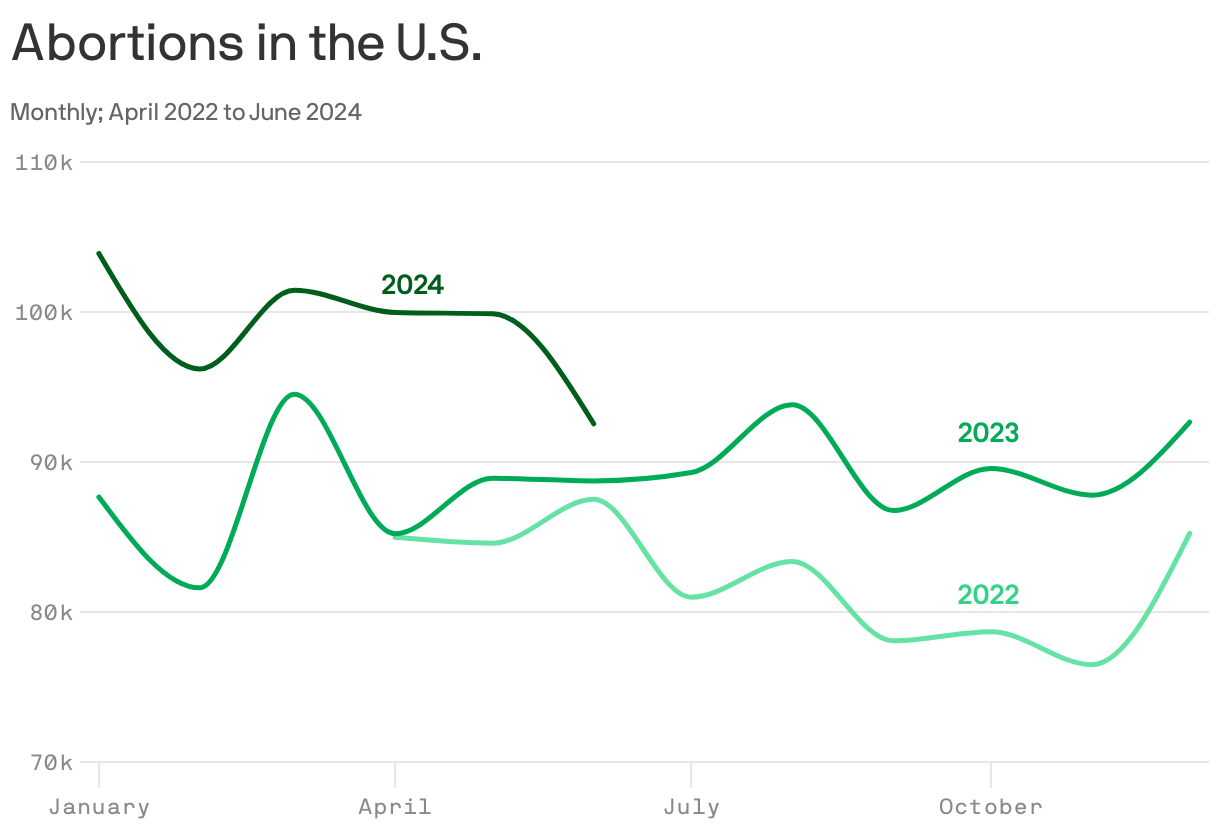
The number of abortions performed in the U.S. continued to climb in 2024, increasing 11% in April to June this year, compared to the same period last year, according to a national report released Tuesday.
The big picture: In the first half of the year, there were nearly 98,000 abortions per month on average — up from 88,000 on average in 2023 and 81,400 in 2022, per the quarterly #WeCount report from the Society of Family Planning nonprofit.
IV fluids from as far away as China are being imported to the U.S. to alleviate nationwide shortages stemming from hurricane damage to a key manufacturing plant in North Carolina.
Why it matters: Hospitals now have 50% more IV fluid available to them than immediately after Hurricane Helene swamped Baxter International's North Cove manufacturing site in Marion, North Carolina, per the Health and Human Services Department. But health providers expect shortages to last weeks longer.
Women visit community health centers at almost double the rate of men, according to data the Centers for Disease Control and Prevention compiled from 2022.
Why it matters: The report adds to the evidence that women are likelier to be proactive about their health — and their family's health — than men.
Infant death rates were higher than expected for several months after the Supreme Court struck down the federal right to abortion, with most of the increase coming from infants with birth defects, researchers reported on Monday in JAMA Pediatrics.
Why it matters: It's the latest evidence suggesting infants born in states with more abortion restrictions are likelier to die before they're 1 year old.
After two years of doom and gloom, digital health deals are showing signs of life, with venture capital firms making more focused bets and interest rate cuts rekindling some of the COVID-era optimism around the sector.
Why it matters: The pandemic experience was supposed to be a boon for direct-to-consumer disease treatments, digital therapeutics and decentralized care.
Former Rep. Liz Cheney (R-Wyo.) during an event with Vice President Kamala Harris on Monday criticized GOP-led states' moves to curtail women's rights since the U.S. Supreme Court overturned federal abortion protections.
Why it matters: Anti-abortion group Susan B. Anthony Pro-Life America gave Cheney an A rating for her congressional voting record, saying she had "stood up against the pro-abortion agenda of the Biden-Harris administration."
New York Magazine and writer Olivia Nuzzi have parted ways after she was placed on leave last month following reports that she had a personal relationship with former independent presidential candidate Robert F. Kennedy.
The big picture: N.Y. Mag said Monday that a law firm reached the same conclusion as the magazine's "initial internal review of her published work, finding no inaccuracies nor evidence of bias" following the allegations.
Health insurance giants Cigna and Humana have rekindled merger talks that they had abandoned late last year, as first reported by Bloomberg and confirmed by Axios.
Why it matters: This would create a new titan in a health-care industry dominated by them, rivaling current insurance leaders UnitedHealth and Aetna.
Here's a puzzle: Working from home appears to make people feel more alone, but forcing them back to the office full-time won't necessarily make them feel better, according to new research published in the Harvard Business Review.
Why it matters: Loneliness is a huge societal issue with often devastating health and cultural fallout, as the U.S. Surgeon General has warned — and in the workplace it can be particularly damaging.
The popular debit cards that Medicare Advantage plans give older adults as a perk for signing up may be cutting off their access to some public assistance because of conflicting interpretations on what counts as income.
Why it matters: The "flex cards" are becoming more common in plans targeted to disabled and low-income older adults, according to an analysis from ATI Advisory shared with Axios. Almost half of all Medicare Advantage plans will feature the cards next year.
Medicare advocates and members of Congress are pressing the Biden administration to clarify that such supplemental benefits shouldn't be considered income as the Medicare open enrollment period continues.
Weight-loss surgery is more cost-effective than taking blockbuster GLP-1 drugs, delivering two more healthy years of life and saving patients about $9,000 a year, according to a new analysis.
Why it matters: Such side-by-side comparisons could be critical to insurers' coverage decisions as demand for drugs such as Ozempic and Wegovy surges.
What they found: Northwestern University researchers found GLP-1s are only cost-effective when used in tandem with weight-loss surgery, to control whatever weight is regained.
Combining surgery and GLP-1s yielded average savings of about $7,200 a year and five more quality-adjusted life years, compared with surgery alone.
Cigna is reviving efforts to merge with Humana after talks fell apart late last year, Bloomberg News reported, quoting people familiar with the matter.
Why it matters: The combined company would be one of the nation's biggest health insurers, but would also likely attract antitrust scrutiny.
Driving the news: The companies have held informal, early-stage discussions about a potential deal, but Cigna is looking to close the sale of its Medicare Advantage business before moving on to other transactions, Bloomberg reported.
While that could eliminate one area of overlap, Cigna still is facing scrutiny from regulators and Congress over its Express Scripts pharmacy benefit business. A recent Federal Trade Commission report blamed the nation's biggest PBMs for rising drug prices. Express Scripts has since sued over the report, calling for a retraction.
Humana recently took a hit on Medicare quality ratings that are linked to payments, a setback that threatens billions in revenue for 2026 and poses what one analyst called a "worst-case scenario" for the company, per Bloomberg.
Singer Lance Bass' efforts to eat right, exercise and take medication weren't helping to manage his newly diagnosed Type 2 diabetes symptoms — until doctors determined he actually had a lesser-known condition known as Type 1.5 diabetes.
Why it matters: The disease — which mimics Type 1 diabetes but kicks in during adulthood — is not yet widely recognized, even by doctors.But appropriate early treatment using insulin can result in much better outcomes for those with the disease, experts say.
The condition, also known as latent autoimmune diabetes in adults, or LADA, occurs when the pancreas stops making insulin, usually because an autoimmune process is damaging cells in the organ.
⚡️ CVS Health ousted CEO Karen Lynch as the pharmacy and health care conglomerate struggled with sluggish growth and rising medical costs and its shares tumbled. (NYT)
💉 Data from the southern hemisphere suggests flu shot effectiveness is on a downward trend and the U.S. could be looking at less successful vaccine effectiveness this winter. (Medpage Today)
✈️ Baxter International plans to import 18,000 tons of IV products by year's end to ease shortages while hurricane recovery efforts continue at a key company plant in North Carolina. (Fierce Pharma)
Singer Lance Bass' efforts to eat right, exercise and take medication weren't helping to manage his newly diagnosed Type 2 diabetes symptoms — until doctors determined he actually had a lesser-known condition known as Type 1.5 diabetes.
Why it matters: The disease — which mimics Type 1 diabetes but kicks in during adulthood — is not yet widely recognized, even by doctors.But appropriate early treatment using insulin can result in much better outcomes for those with the disease, experts say.
Weight-loss surgery is more cost-effective than taking blockbuster GLP-1 drugs, delivering two more healthy years of life and saving patients about $9,000 a year, according to a new analysis.
Why it matters: Such side-by-side comparisons could be critical to insurers' coverage decisions as demand for drugs such as Ozempic and Wegovy surges.
The popular debit cards that Medicare Advantage plans give older adults as a perk for signing up may be cutting off their access to some public assistance because of conflicting interpretations on what counts as income.
Why it matters: The "flex cards" are becoming more common in plans targeted to disabled and low-income older adults, according to an analysis from ATI Advisory shared with Axios. Almost half of all Medicare Advantage plans will feature the cards next year.
Health insurers would be required to cover over-the-counter birth control and additional FDA-approved contraceptiveswithout cost-sharing under a proposal the Biden administration unveiled on Monday.
Why it matters: The effort is aimed at keeping a focus on reproductive health in the final weeks before the election while expanding the Affordable Care Act's mandate that insurers cover at least one form of each FDA-approved contraception method at no cost.