Charted: How GLP-1 drugs are used

Add Axios as your preferred source to
see more of our stories on Google.
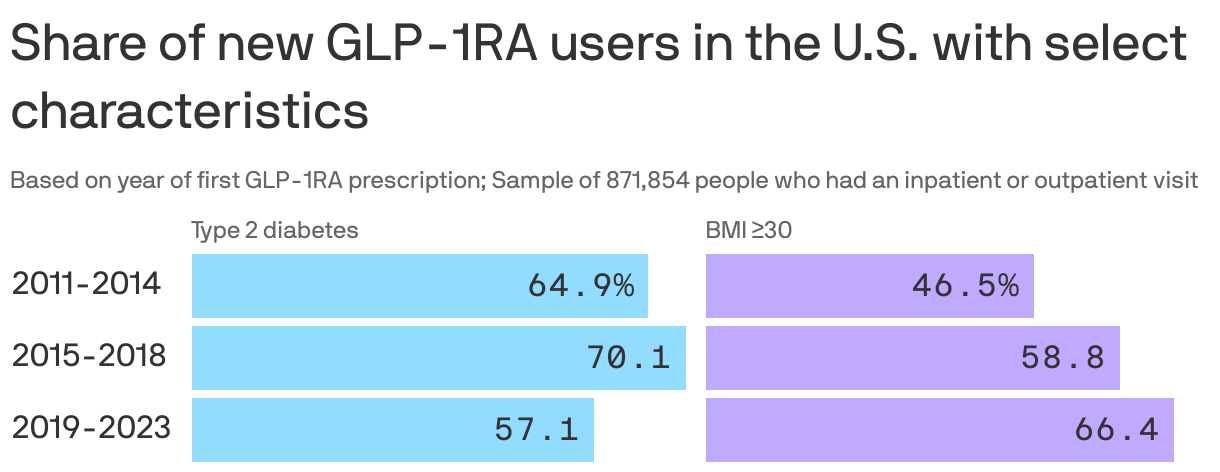
More new prescriptions for blockbuster GLP-1 weight-loss drugs were written in the past few years for people with obesity than with Type 2 diabetes — an accelerating trend that may worsen drug shortages and health disparities, according to a study in the Annals of Internal Medicine.
Why it matters: It's the latest evidence of how large numbers of Americans are embracing drugs developed for the treatment of diabetes for weight loss and raising cost and equity concerns.
What they found: Between 2011 and 2014, an average of nearly 65% of new GLP-1 users had Type 2 diabetes. That average dropped to 57% between 2019 and 2023.
- Meanwhile, an average of nearly 47% of new users had a BMI of 30 or higher from 2011 to 2014. By the end of the study period, that figure rose to more than 66% of new GLP-1 users.
- Between 2011 and 2023, there was a twofold increase in use of GLP-1s by non-diabetics with either a body mass index of 30 or higher or a BMI of 27 to 30 and an obesity-related co-morbidity.
- Perelman School of Medicine at the University of Pennsylvania and Cedars-Sinai studied data from TriNetX, a health research network with records for 45 million individuals in the United States.
Zoom in: The 1 million new GLP-1 users identified were disproportionately non-Hispanic white, female and had a BMI of 30 or greater.
- The proportion of patients taking GLP-1s off-label, without an FDA-approved indication, also increased during the study period.
Zoom out: Semaglutide, the active ingredient in Novo Nordisk's diabetes drug Ozempic, and the company's anti-obesity drug Wegovy, were the most prescribed GLP-1s by far in 2023.
Yes, but: The data may not be nationally representative, and prescriptions from online platforms are not included, the study notes. BMI data was also missing for a higher percentage of patients in the earlier years of the study.
Maya Goldman contributed reporting.
