United States of Ozempic: Where anti-obesity drugs are taking off

Add Axios as your preferred source to
see more of our stories on Google.
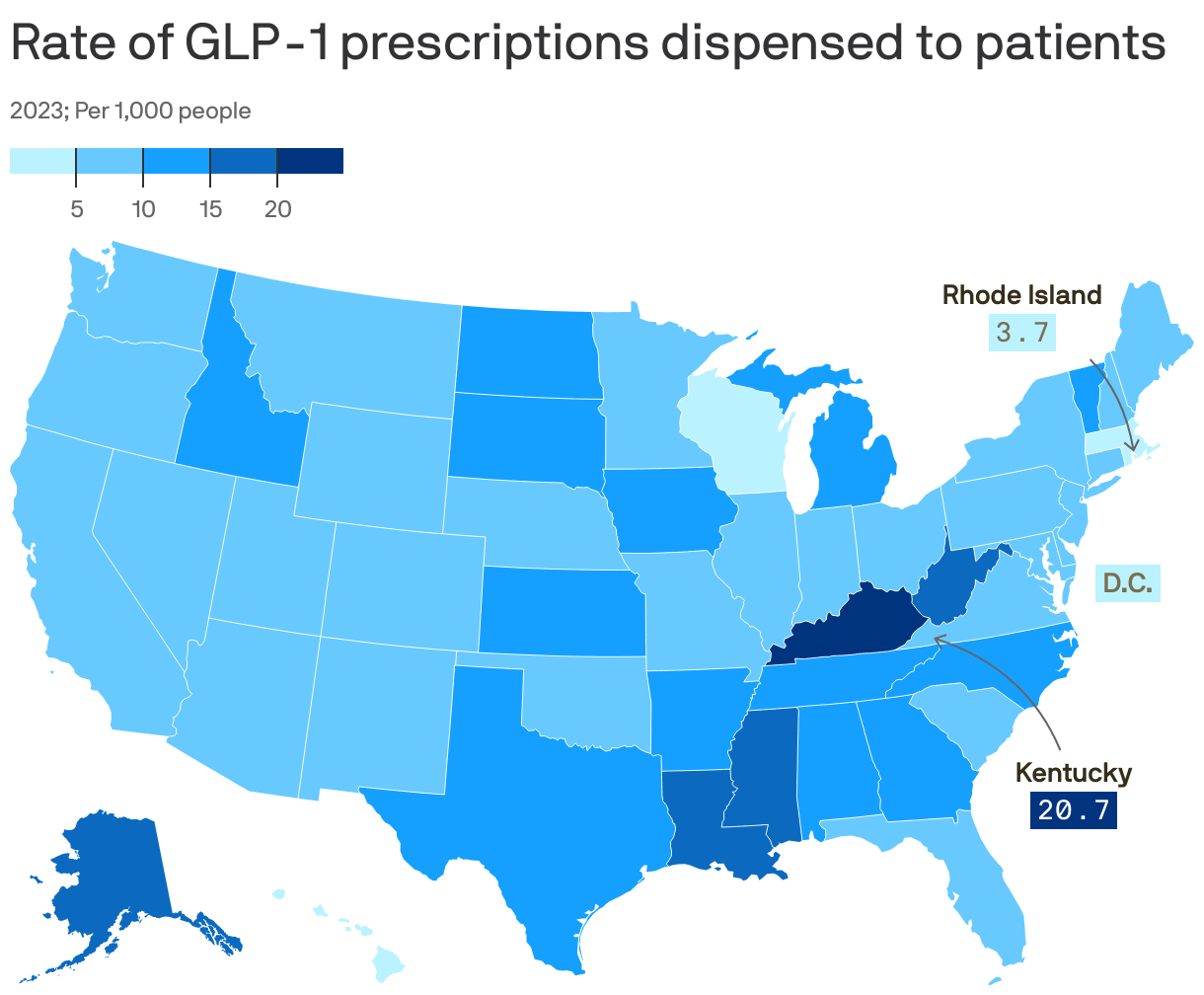
For every 1,000 people in Kentucky, roughly 21 were prescribed a drug that belongs to a buzzy class of diabetes and anti-obesity medications last year — the highest rate of any state, according to insurance claims data provided to Axios by health analytics company PurpleLab.
The big picture: It's among a few Southern states, including Louisiana and Mississippi, that had some of the highest prescribing rates for drugs like Ozempic and Wegovy.
Why it matters: The data offers a snapshot of where drugs known as GLP-1 agonists, seen as game-changers in the fight against obesity, are most in demand in the United States.
- The states with the highest prescribing rates are also among those with greater prevalence of diabetes and obesity, per CDC data, a rough indication that the medicines may be getting to areas where they are in greatest need while shortages, high price tags and insurance restrictions have limited their use.
Details: After Kentucky, West Virginia had the next highest prescribing rate, at 18.9 prescriptions dispensed per 1,000. That was followed by Alaska (17.5 per 1,000), Mississippi (16.1) and Louisiana (15.4).
- Rhode Island had the lowest rate of prescriptions (3.7 per 1,000), and its neighbor Massachusetts had the second lowest (4), followed by Wisconsin (4.3) and Hawai'i (4.3.)
Zoom in: The data is based on a collection of 1.9 billion claims from private insurers, as well as Medicare — which only covers GLP-1s to treat diabetes — and Medicaid.
- The data captures prescriptions for Novo Nordisk's diabetes drug Ozempic, which has been widely prescribed off-label for weight loss, and Wegovy, which was approved for weight loss in 2021.
- It also includes Eli Lilly's diabetes medication Mounjaro and its anti-obesity medication, Zepbound, which was approved by the FDA in November.
- The data lumps the prescriptions together, so it's not possible to tease out how often these drugs are being prescribed for obesity versus diabetes.
- Nor does the data show how long patients took the medications. A previous analysis from Prime Therapeutics found about two-thirds of patients who go on the drugs for weight loss stopped them within a year.
The intrigue: Yes, we've all read about Hollywood's obsession with these drugs — so if it seems that California's prescribing rate is lower than expected, the data doesn't pick up prescriptions that were paid for in cash.
- A month's supply of these drugs paid for fully out of pocket will typically set you back between $900 and $1,300.
Go deeper: Doctors grapple with patients' demand for weight-loss drugs
