The Federal Trade Commission has issued warnings to two trade organizations and a dozen nutrition influencers, warning them about failures to properly disclose paid promotional posts.
Why it matters: The move could establish stronger standards for how social media influencers promote certain foods by making the funding behind paid posts more transparent.
State reporting requirements around individuals considered at high risk of violent behaviors vary so much that it may make the nation's system of background checks for gun purchases less effective, according to a study published today in JAMA Health Forum.
Why it matters: Gun policy is among the most politically divisive issues, but there is broad bipartisan support for restricting gun access among certain individuals who are at particular risk of perpetuating violence, the authors write.
The number of U.S. seniors who report using cannabis has climbed in recent years, according to the National Survey on Drug Use and Health.
Driving the news: In 2022, 8.4% people age 65 or older said they used marijuana in the past year, a significant increase from about 0.4% of seniors who reported using it in the past year when polled in 2007.
The Cybersecurity and Infrastructure Security Agency is rolling out a new plan for health care organizations and hospitals trying to fend off an influx of ransomware and nation-state cyberattacks, an agency official first shared with Axios.
Why it matters: Hospitals and health care organizations have become prime targets for ransomware hackers who are eager to steal sensitive patient information and shut down critical services in order to get a payout.
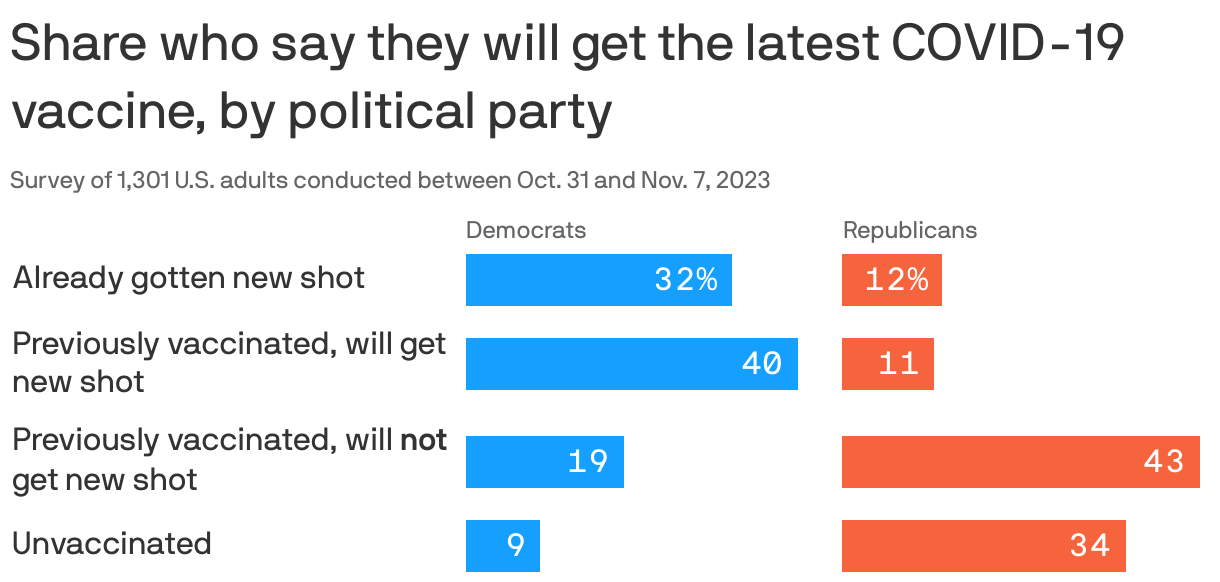
About 6 in 10 adults who previously got a COVID-19 vaccine have not received an updated shot this fall — and about half of them don't plan to get one, according to a new KFF survey.
Why it matters: The survey shows decreasing public concern about COVID near the beginning of respiratory virus season, including among people who've previously protected themselves against COVID.
The idea of mandating that hospitals meet minimum cybersecurity standards is gaining traction amid scrutiny of mounting attacks that have knocked health systems offline for weeks and upended patient care.
Driving the news: New York Gov. Kathy Hochul this week proposed the state become the first to require health systems to adopt certain cyber defenses, including preparation of response plans for a potential attack.
By punting their spending disputes past the holidays, House Republicans have put the kibosh on what's become an annual rite for health care interests: the year-end legislative grab bag sometimes known as the Christmas tree.
The big picture: It's the first December since 2012 without a critical funding deadline, Raymond James analyst Chris Meekins notes.