The Supreme Court's Dobbs decision to end the constitutional right to abortion has been "devastating" to maternal health and widened gaps in care as the U.S. grapples with the highest maternal mortality rate among developed nations, Biden administration officials said Tuesday.
Driving the news: Maternal death rates in 2020 were 62% higher instates that ban or restrict abortion than in states where the procedure is still accessible, according to a report from the Commonwealth Fund released on Wednesday.
The U.S. Preventive Services Task Force on Tuesday recommended prescribing medications that prevent HIV to adolescents and adults who are at increased risk for acquiring the virus.
Driving the news: A draft document to give pre-exposure prophylaxis, or PrEP, the task force's highest recommendation for an "A" grade comes as compulsory coverage for the treatment, as well as the task force's very existence, are both being challenged in federal court.
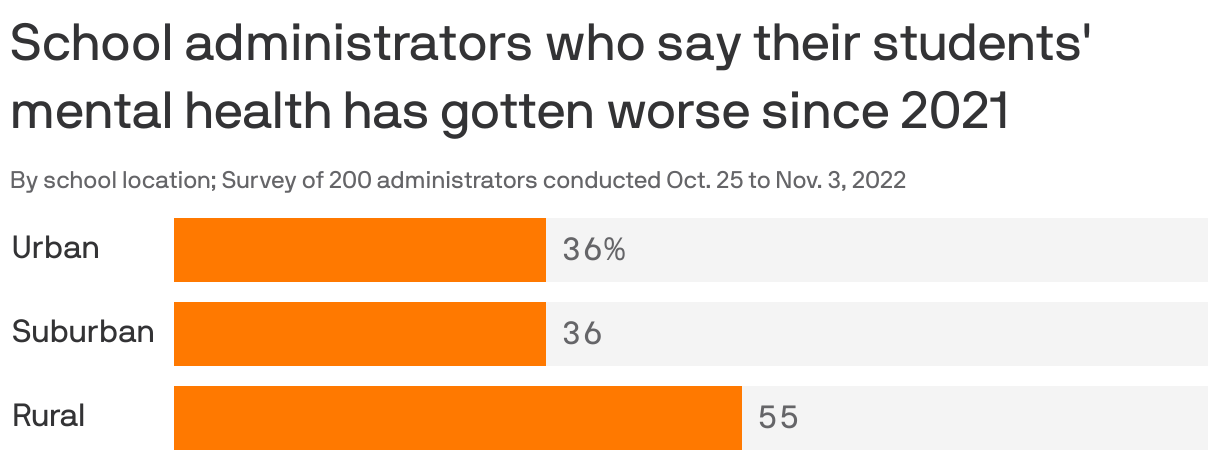
Data: Effective School Solutions via John Zogby Strategies; Chart: Kavya Beheraj/Axios
Almost every school administrator believes the mental health challengestheir students face are moderate to severe, with more than half saying conditions either worsened or haven't improved in the last year.
Driving the news: The findings came from a survey released Wednesday by Effective School Solutions — which provides mental health services for schools — that polled 200 administrators and 1,000 parents with children in K-12.
The Biden administration is moving to make permanent the pandemic rules that allowed take-home drugs to help fight opioid addiction.
Why it matters: The proposed rule from HHS would make it easier for patients with opioid use disorder to access drugs like methadone for home use and for providers to prescribe them via telehealth for patients with opioid use disorder.
Your hectic job, difficult marriage, rebellious children and dwindling bank account? They're probably not raising your blood pressure in a medically meaningful way, according to the latest research.
The big picture: Rather than everyday stressors, the real culprits are genetics and poor habits that are often linked to stress, like overeating, smoking and hitting the bottle.
Long COVID was cited in the death certificates of at least 3,544 people in the U.S. in the first 2.5 years of the pandemic, according to a study published Wednesday by the Centers for Disease Control and Prevention
The big picture: While this represents 0.3% of the more than 1 million people to have died of COVID-19 in the U.S., CDC health scientist Farida Ahmad told the Washington Post the findings underscore that while long COVID is "associated with long-term illness, it "can be a cause of death."
This article originally appeared in Axios Finish Line, our nightly newsletter on life, leadership and wellness.Sign up here.
Even just 10 minutes to ourselves to recharge and relax can change the day.
Why it matters: We underestimate the effect of small and intentional breaks on our well-being.
What's happening: When we've been working at something for a while, our minds start to wander. That's when a well-timed and well-planned break can get us back on track — and actually boost productivity.
In one study, researchers at the University of Illinois asked participants to perform a 50-minute task on computers.
One group had to work without stopping, and another group got two short breaks. Sure enough, the group that worked nonstop saw performance decline by the end, while the group that paused did not.
Here are the top tips for planning breaks, based on research:
1. Make sure it's a real break. The most effective breaks are unrelated to work, per a recent analysis published in the journal PLOS ONE. That means pausing work to catch up on a few emails doesn't have the same benefit as stopping to take a short walk and get some air.
2. Time yourself. Microbreaks — lasting 10 minutes at most — work best when it comes to refocusing yourself on the task at hand. Go much longer and you'll lose momentum.
Bigger breaks — 15 or 20 minutes — are also important to fully refresh after a longer work session or between larger tasks.
3. Pay better attention. Short breaks are especially helpful when you're doing something repetitive or tedious, researchers have found. Creative work doesn't benefit as much from pauses.
The bottom line: Use breaks to boost your mental and physical health no matter what you're doing.
And if you're a manager, encourage your employees to take smart breaks! In the long run, they'll be more engaged and more creative.
Anti-transgender campaigns resulted in the online harassment of 24 different hospitals and health care providers in 21 states over a recent four-month period, according to a report from Human Rights Campaign shared first with Axios.
The big picture: Despite being uniformly recommended by major medical organizations including the American Medical Association and the American Academy of Pediatrics, gender-affirming care has been under fire from a variety of directions, including via legislative attacks and online threats.
The Biden administration faces a host of high-stakes decisions on prescription drug costs over the next several months, accompanied by pressure from congressional Democrats eager for a sequel to pricing components in the Inflation Reduction Act (IRA).
The big picture: Democrats just delivered on their decades-long promise to allow Medicare to negotiate drug prices. But that legislative victory kicked off a series of difficult decisions the administration will have to make as it decides how much further to go addressing costs.