Health officials' longstanding fears about the potent mix of armed conflict in weak states — combined with a highly infectious disease outbreak — are being realized. In the Democratic Republic of the Congo (DRC), an Ebola virus outbreak is now at a tipping point and threatens to expand.
Why it matters: The current outbreak began Aug. 1 and appeared to be slowing down, as most of the new cases were contacts of known infected people. However, as security deteriorated, new cases surged — with 25% of all suspected and confirmed cases being recorded in the first 2 weeks of this month alone. Experts say a combination of ongoing violence in North Kivu's Beni town, community distrust, population density and other factors are hampering containment efforts.
Public health officials are escalating their hunt for the cause of a mysterious ailment afflicting young children, known as acute flaccid myelitis (AFM). Cases of AFM have spiked recently, leaving some young children with partial paralysis and muscle weakness.
Why it matters: While the illness remains very rare, there are currently 127 suspected and 62 confirmed cases in 22 states, according to the Centers for Disease Control and Prevention. And — despite years of testing prior cases — the cause of the illness is "still a mystery," Anthony Fauci, director of the National Institute of Allergy and Infectious Diseases, tells Axios.
A serious illness will often wipe out your life savings even if you have health insurance. That's the sobering conclusion from a new national survey of people who have had to rely on the health care system intensively.
The big picture: "You’re kind of at a disadvantage as a consumer going against these big complicated systems that don’t always have your best interest at heart," University of Michigan professor Sarah Miller told the New York Times, which helped analyze the survey. "And I think that’s why there’s so much financial burden, even among people with private insurance."
The earnings and stock prices of health care companies have increased a lot more than the broader market since former President Obama signed the Affordable Care Act into law in 2010.
Between the lines: The ACA was designed to expand coverage and nudge companies toward new behaviors. But despite critics' warnings about the end of private insurance or a government takeover of health care, the law has not upended the system's underlying structure or stifled the industry's ability to reap large profits.
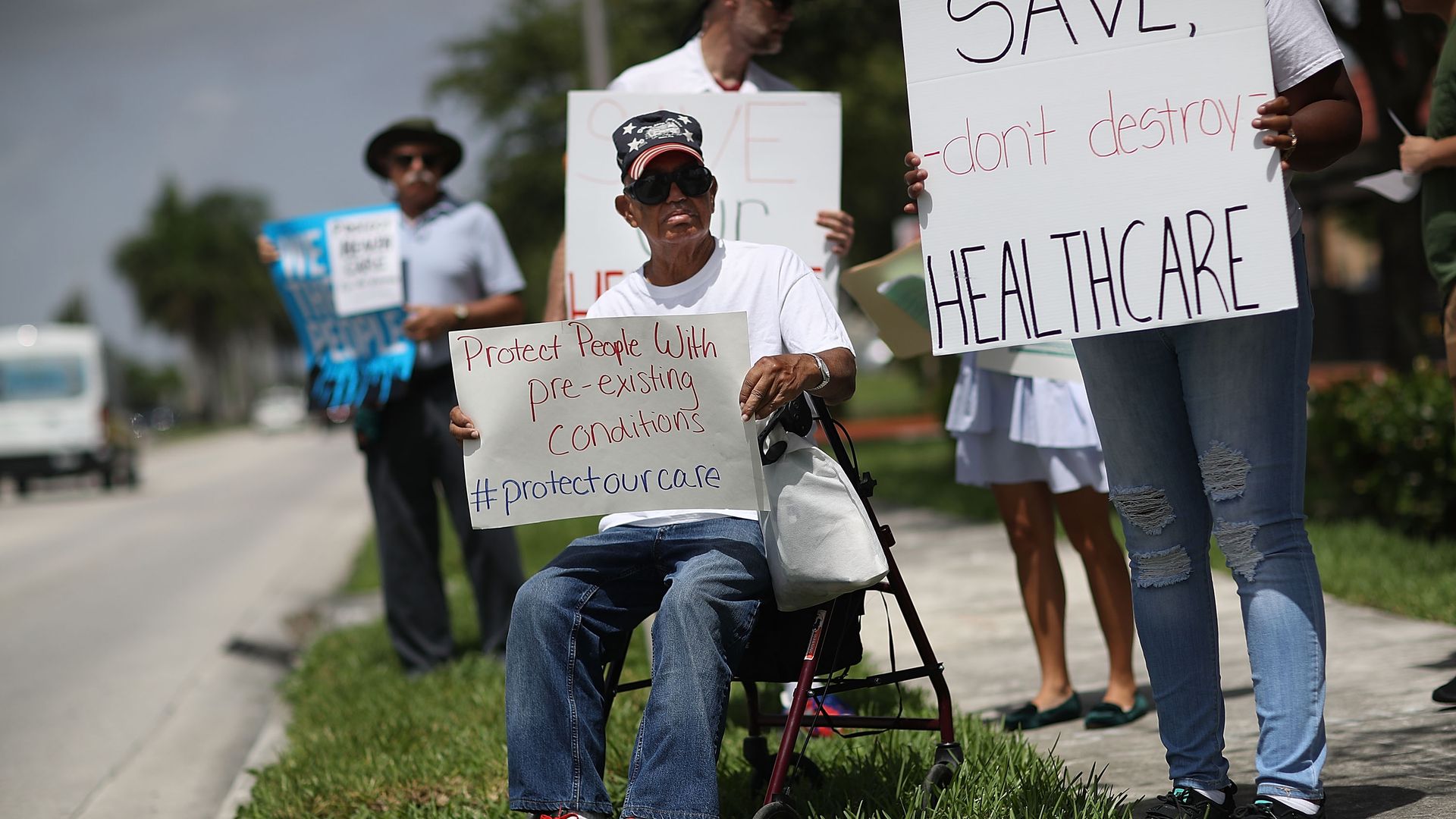
Texas' lawsuit over the Affordable Care Act could roll back protections for pre-existing conditions even among people who don't get their coverage through the Affordable Care Act.
Why it matters: These protections are the most popular part of the ACA, and have led to a lot of sick people getting coverage. Millions of people could lose all or part of that security if this lawsuit succeeds.
Senate Majority Leader Mitch McConnell suggested to Reuters Wednesday that Republicans could make another run at repealing the Affordable Care Act if they pick up enough seats in the midterm elections.
Between the lines: The quote has an obligatory tone to it: “If we had the votes to completely start over, we’d do it. But that depends on what happens in a couple weeks." It would be hard for McConnell to satisfy the Republican base without suggesting they'd try again if they won more votes. But that doesn't mean it's an enthusiastic goal — or a realistic one if Democrats win the House.
Centers for Disease Control and Prevention officials are investigating a multidrug-resistant strain of salmonella infantis that has already led to 21 people being hospitalized and nearly 100 infected people reported in 29 states, the organization announced on Wednesday.
Why it matters: While no deaths have been reported, officials are concerned because the strain is resistant to multiple antibiotics, fueling growing concerns about antibiotic resistance. The CDC is not advising people to stop eating properly prepared chicken, but says this outbreak strain is "present in live chickens and in many types of raw chicken products, indicating it might be widespread in the chicken industry."
The Centers for Disease Control and Prevention is “frustrated” by the mysterious spread of an illness similar to polio, cases of which have now been confirmed in 22 states. Seems like a very reasonable cause for frustration, to be honest.
By the numbers: 127 cases of acute flaccid myelitis, or AFM, have been reported so far in 2018, including 68 confirmed cases, according to CDC data. There were 33 confirmed cases last year.
Staggering surprise medical bills are finally getting some scrutiny from policymakers. But to take patients off the hook for those bills, the money has to come from somewhere else — usually from higher insurance premiums or out of doctors’ bottom lines.
The big picture: Getting an unexpected bill for thousands of dollars is a gut-level problem. Yet that problem is a product of the health care system’s complexity, and every potential solution runs into roadblocks from an industry that wants to protect its profits, or skepticism from policy experts or political opposition.