Friday's economy stories

Exclusive: Amazon Web Services CFO says AI spending is sustainable

The boom in spending on AI infrastructure and services is sustainable because it's driving meaningful innovation, the CFO of Amazon Web Services tells Axios.
Why it matters: Some investors and analysts are getting nervous about an AI bubble, with an eye on ballooning debt, corporate valuations and circular financing deals and whether revenue growth can keep pace with massive infrastructure spending.

That Y2K feeling: Why today's economy resembles 2000

It was an economy bursting at the seams: robust growth powered by a tech boom, low unemployment, elevated inflation and Fed rate hikes to try to cool things down.
The big picture: That was the situation in the year 2000, and it reminds us a great deal of the conditions in 2026.

WATCH: Conversations on building Philadelphia's workforce and expanding economic opportunity

On October 27 at 9:00am ET, tune in to conversations with Philadelphia mayor Cherelle Parker, Chamber of Commerce for Greater Philadelphia president and CEO Chellie Cameron and JEVS Human Services president and CEO Cynthia F. Figueroa on the workforce challenges, skills and investments shaping Philadelphia's economic future.
The program will also include a sponsored View from the Top segment featuring JPMorganChase's head of Chase Consumer Banking, Jennifer Roberts.

Exclusive: Goldman Sachs CEO to chair Business Council
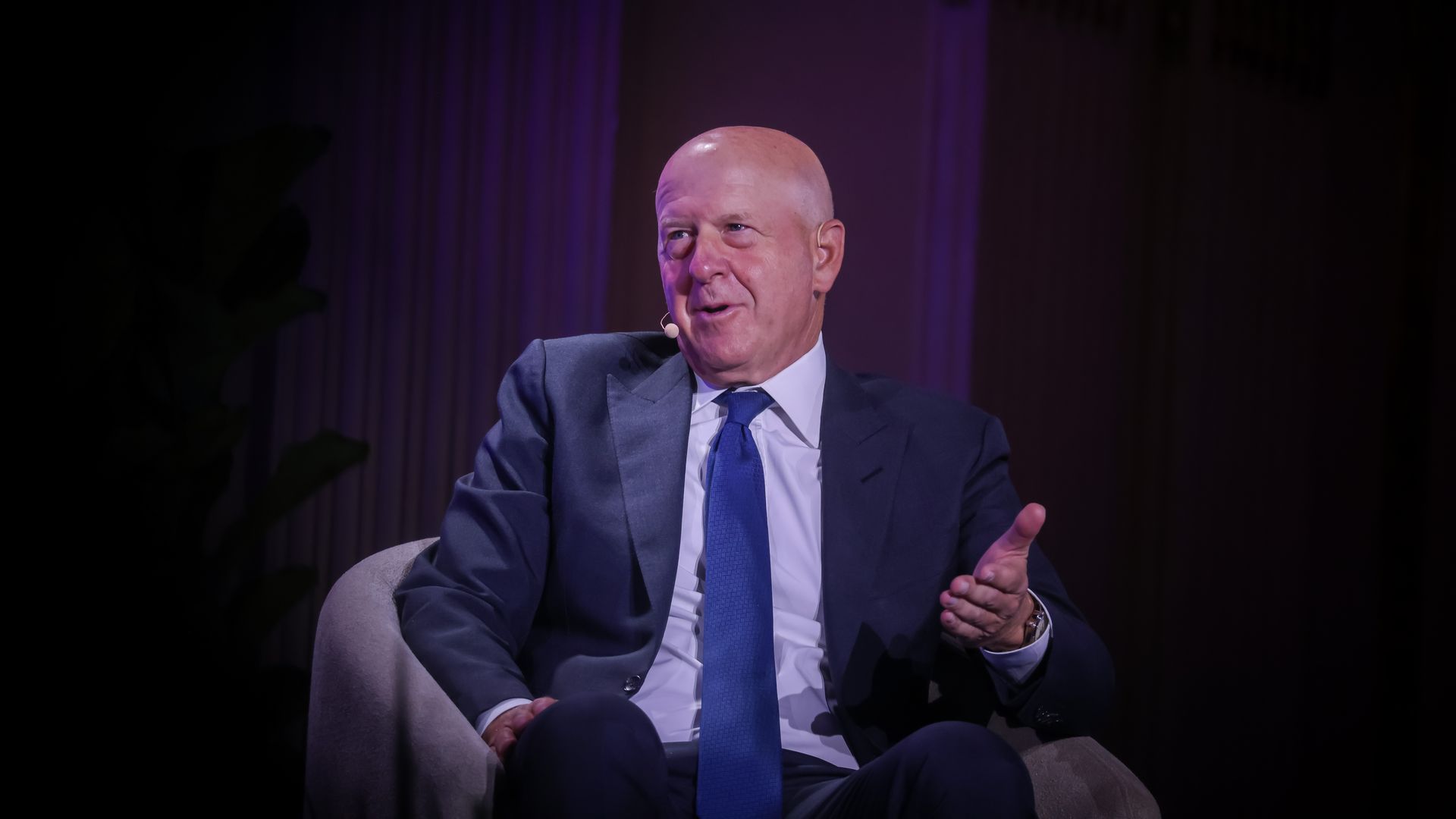
Goldman Sachs CEO David Solomon will be the next chair of the Business Council, an invitation-only group of some of the world's most powerful corporate executives, according to an announcement shared exclusively with Axios.
Why it matters: The appointment puts Solomon at the helm of an influential forum where top CEOs exchange views on the biggest issues facing corporate America.

Warning signs are flashing on the AI trade. Here's where to spot them
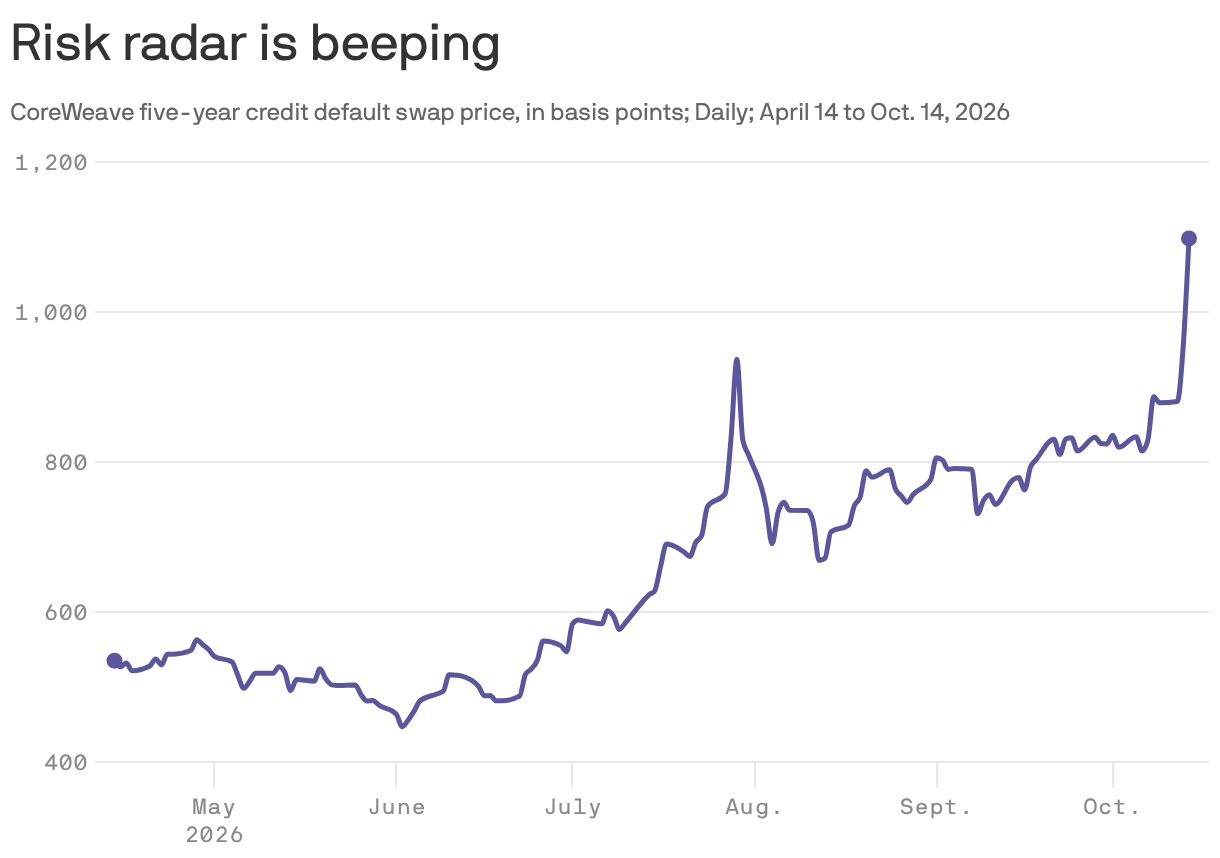
The adults have entered the AI chat — bond investors this week looked up from their massive buying binge and asked themselves, "Hey, are we sure these investments are going to pay out?"
Why it matters: The AI boom is looking a little wobbly these days, at least when it comes to all the borrowed money that's fueling it.

Why CoreWeave's woes matter to the market
CoreWeave's huge debts, giant spending plans and myriad financial ties to giants like Microsoft, Nvidia and OpenAI make it an ideal test of whether the AI boom can stand up to serious market scrutiny.
Why it matters: If the recent sharp sell-off in CoreWeave's bonds means bond investors are less interested in funding the data center build-out, it could mark a major change for the AI boom that has been powering the U.S. economy and stock market.
Warsh signals steady Fed outlook despite inflation jump
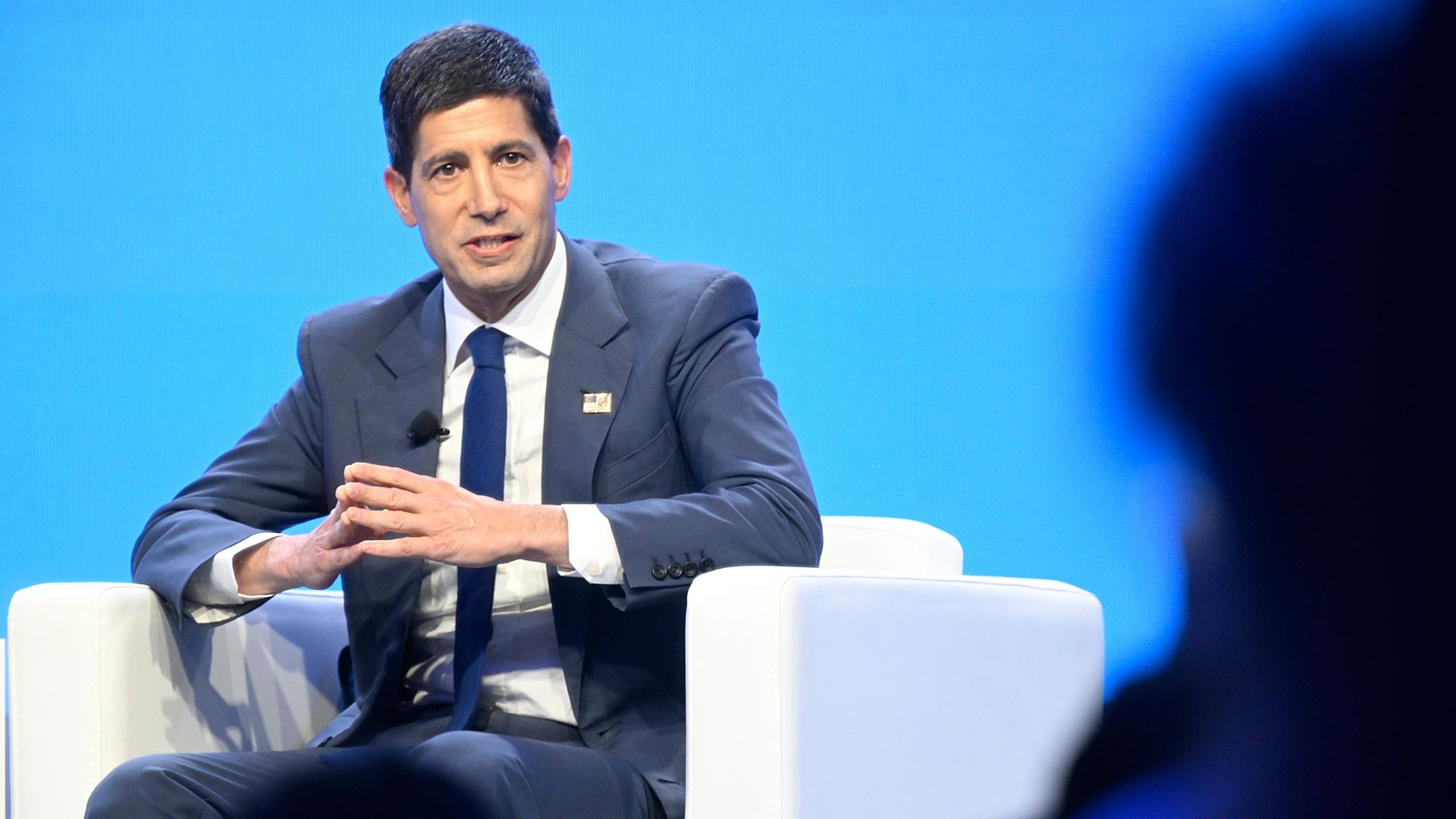
Federal Reserve chairman Kevin Warsh said Friday that the economy has largely performed as expected since September's rate hike, hinting that little has changed in the central bank's outlook.
Why it matters: The Fed is weighing another interest rate increase later this month as inflation heats up and the economy remains strong.

AI could drive a Tesla-SpaceX tie-up as soon as this fall, analysts say
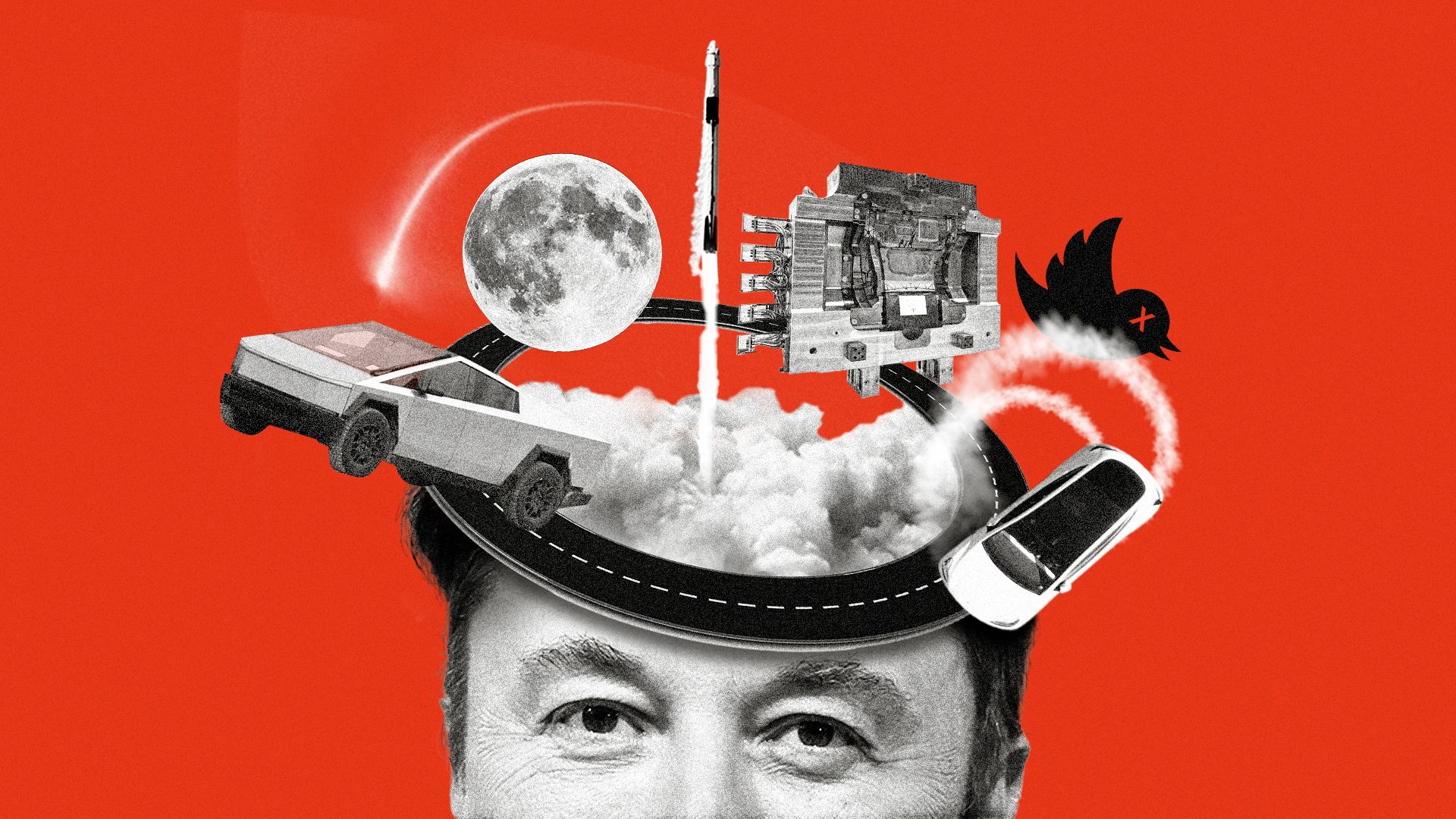
Tesla is expected to unveil its Roadster Thursday night, potentially featuring SpaceX-designed thrusters that could literally lift the car off the ground.
- A much bigger Tesla-SpaceX tie-up — the long-speculated merger of Elon Musk's two companies — could come as soon as this fall, say analysts at the Barclays investment bank.
The big picture: Musk's business empire is becoming increasingly interconnected, raising the prospect of a combination that would consolidate his control over two of the world's most valuable companies, while allowing both to move faster on big AI projects.
Fed's Beige Book tells inflation story

A grocery chain says it now costs more to ship a head of lettuce from California than to buy the lettuce itself. Tech companies are trying to purchase entire inventories of electrical equipment to build data centers.
Why it matters: These anecdotes from the Fed's latest Beige Book show how two extraordinary forces — the AI buildout and the Iran war — are changing decisions about spending, investment and hiring.
- The implications extend beyond individual firms, with consequences for inflation and employment, as the Fed weighs another rate hike.
Zoom in: A grocery chain told the Richmond Fed that diesel prices have risen 30% from a year earlier — making shipping lettuce more expensive than the cost of the vegetable — but price-sensitive customers have left it unable to pass along the higher costs.
- The energy shock is also squeezing businesses locked into earlier contracts: A Montana timber company said fuel costs had more than doubled on a project negotiated months earlier.
The AI boom is creating another strain, intensifying competition for equipment needed to build data centers.
- An electrical equipment distributor told the Chicago Fed that tech companies tried to buy up all of its available equipment. Suppliers resisted, citing commitments to other customers.
What to watch: AI is changing how many workers businesses believe they need and what they need them to do in ways not yet apparent in broader labor market data.
- In Dallas, an accounting industry contact said some large firms were delaying employment contracts because AI productivity gains could reduce their need for entry-level workers.
- A staffing firm in the area said AI agents conducted more than 180 hours of job interviews in two days, leaving human recruiters to review the results and make hiring decisions.
The too-hot-for-comfort economy


Data this week has all told the same story: This is a rip-roaring U.S. economy with all the inflationary pressures that might imply.
The big picture: It puts Warsh and the Fed in a difficult jam. Top officials have signaled patience in further interest rate hikes in recent weeks, but the latest data implies broader inflationary pressures than previously thought, testing that conviction.
- There is scant evidence that price pressures are receding on their own and growing reason to fear that they are becoming more entrenched, which could compel a more aggressive rate-hiking response.
Driving the news: On Thursday the government said the Producer Price Index rose 1.3% in September, the highest since 2022 and far above the 0.6% analysts expected. It came on the heels of a too-hot-for-comfort reading on consumer prices Wednesday.
- Also Thursday, September retail sales notched a 0.8% rise, versus the 0.4% analysts had expected. And the August number was revised higher.
- There were only 199,000 initial claims for unemployment benefits last week, remaining near historic lows.
Between the lines: The U.S. growth juggernaut shows no sign of diminishing — but neither do the price pressures that have bedeviled the economy for nearly five consecutive years.
- If anything, the PPI and CPI data released this week suggest inflation is broadening, showing up in sectors well beyond energy.
State of play: In his appearance at the International Monetary Fund's meetings in Thailand Friday (11:30pm ET Thursday), Warsh has a final opportunity to comment before the Fed enters its customary quiet period in advance of a policy meeting that concludes Oct. 28.
- Colleagues including New York Fed president John Williams and vice chair Philip Jefferson gave rather clear signaling in the last couple of weeks that they see little urgency to raise rates at a second consecutive meeting this month.
- Warsh faces a dilemma. If he affirms that stance in spite of the hot price data, it could raise doubts about his determination to bring inflation under control.
- If he seems inclined to raise rates, he could seem overly reactive to a couple of economic releases, contrary to his stated goal of making the Fed less "data-point dependent."
The intrigue: Surprisingly, bond yields are down Thursday despite the hot PPI number — and a surge in yields following the CPI number Wednesday mostly reversed later in the trading session.
- It seems to reflect a flight to quality among traders as optimism around the AI buildout fades. With semiconductor and related stocks down, money looks to be flowing into safer Treasury securities.
- The policy-sensitive two-year Treasury yield briefly touched 4.95% after the CPI number Wednesday, implying significant Fed rate hikes ahead. It was down to 4.72% Thursday morning — an astonishing move for any 24-hour period, let alone one that included hotter-than-expected inflation data.
What they're saying: "Today's September PPI report reinforces Wednesday's CPI message that inflation is turning higher and moving in the wrong direction for the Fed," Nationwide financial market economist Oren Klachkin wrote in a note.
- "AI continues to lend upside pressure from categories directly and indirectly tied to the buildout. Businesses seem to be passing higher costs onto customers as the proxy for margins rose heftily in September."

VCs and founders are debating pro rata rights

Pro rata rights have long been a standard feature of venture capital deals, but a new startup dispute has sparked debate over whether that should change.
- On one side are fiduciaries. On the other are founders and the founder-friendly.
Berkshire invests $330 million into AOL owner Bending Spoons
Bending Spoons on Wednesday secured a $330 million investment from existing shareholder Berkshire Hathaway.
Why it matters: The Italian software conglomerate, known for buying legacy brands like AOL and Vimeo, now has more dry powder for M&A.

America's wits' end election approaches
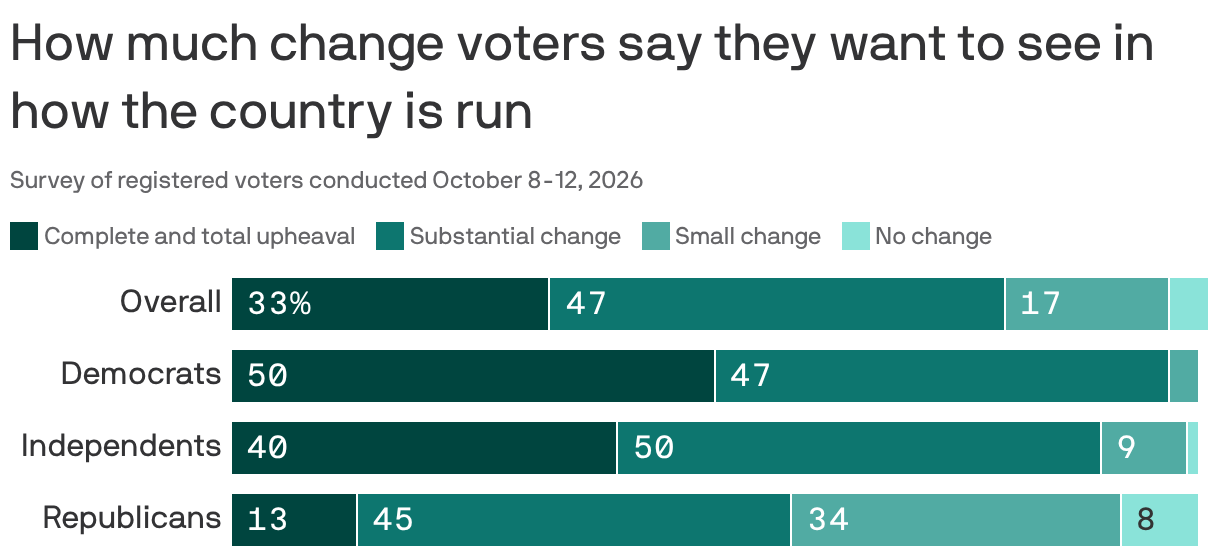
A trio of polls out this week carries a stark message: Americans feel disgruntled, dizzy and down on the man in the White House.
Why it matters: The vibes going into the midterms are bleak, with a large majority of voters wanting significant change. But the question remains whether those sentiments will drive them to the polls.
AI tremors felt in corporate bond market
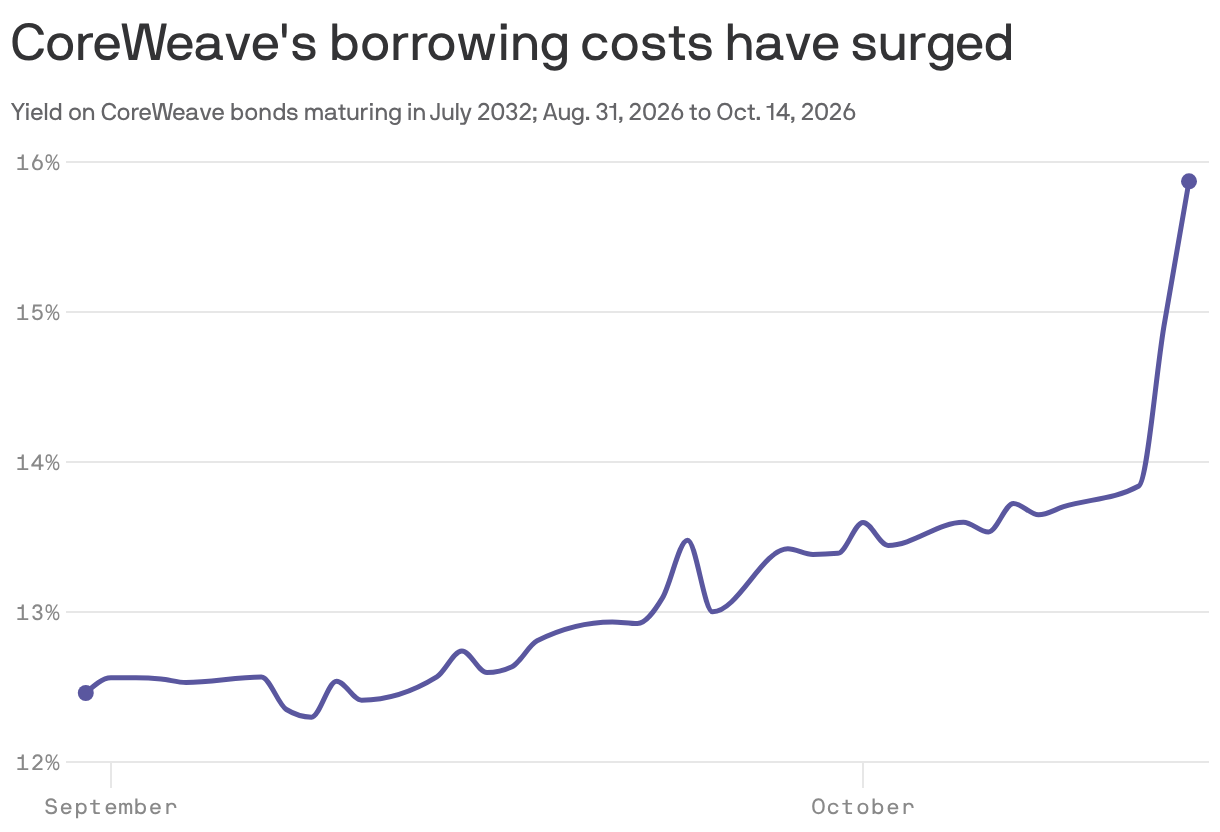
CoreWeave was at the heart of the market's volatility Wednesday.
Why it matters: The heavily indebted, cash-burning neocloud — a data center operator that effectively rents out its AI computing capacity — is seen as something of a canary in the coal mine for the broader AI trade.
- The sharp sell-offs in its bonds and stocks underscored how jittery investors are getting about the AI investment binge.
For the big banks, a double-edged sword under Trump


America's biggest banks are having a rough week in President Trump's Washington.
Why it matters: The industry has had policy victories under Trump. But this week's historic fine against Bank of America and a regulatory report that raises new concerns about politically motivated "debanking" show the limits of Wall Street's influence with the administration.
CEO confidence drops into negative territory
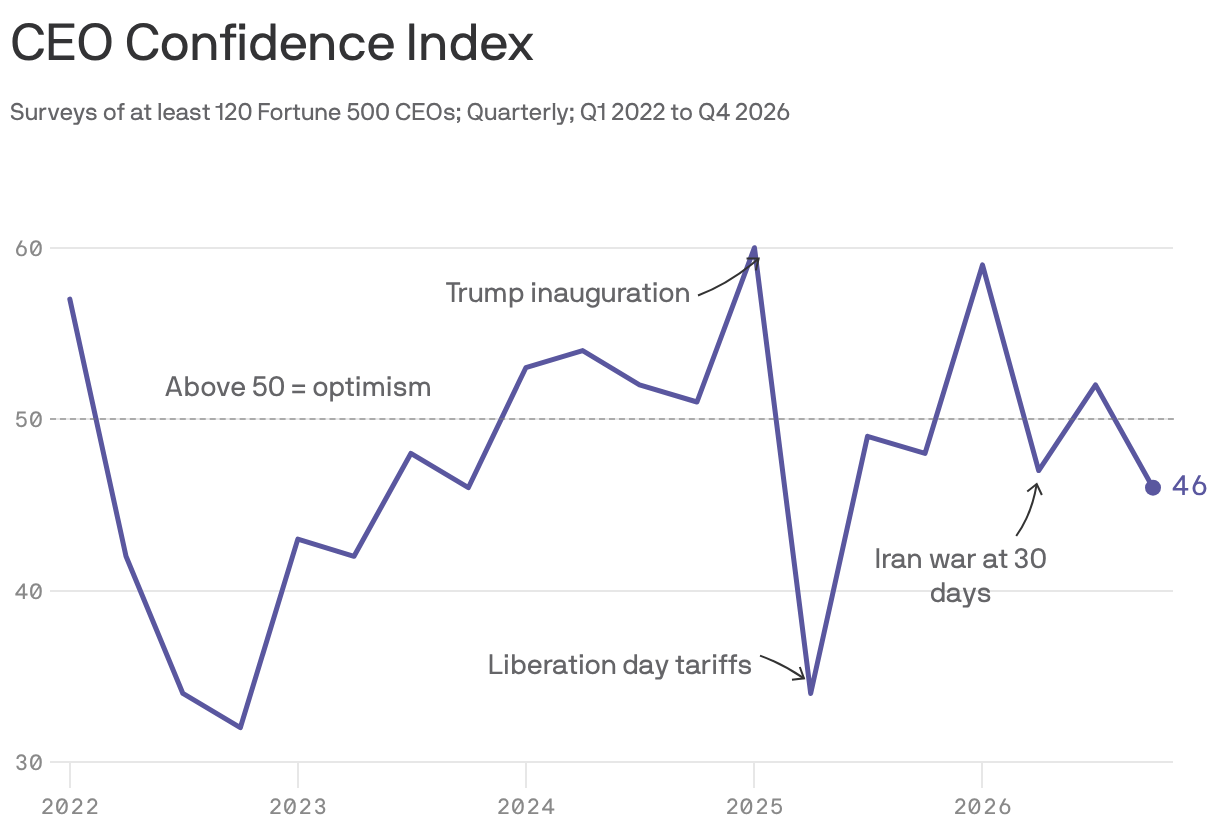
CEO confidence in the U.S. economy sank into negative territory earlier this month, finds a survey out Thursday morning from the Conference Board.
Why it matters: Business leaders are mind-melding with most consumers, whose opinions on the economy are now lower than during the pandemic.
- Such sour sentiment is shaping up as a key issue in the midterms just weeks away.
U.S. CEOs see AI as force for job creation, survey finds
U.S. business leaders are coalescing around a belief in AI as a force for job creation instead of destruction, according to a new KPMG survey.
Why it matters: The looming uncertainty over the economic impact of AI remains a topic of significant concern for workers.
Zoom in: 89% of U.S. CEOs expect to increase their headcount over the next three years as AI creates more business opportunities, the survey found.
- 86% said they're "redesigning roles, career paths and team structure to reflect human-AI collaboration," while 79% are "hiring new talent with AI and tech capabilities."
- The survey of 400 U.S. CEOs took place from Aug. 11-Sept. 21.
What they're saying: KPMG U.S. CEO Tim Walsh says the path to AI-powered job growth is "directionally very clear," but he warned that serious risks loom — including the threat of cybersecurity attacks.
- "As we put more AI into our processes and platforms, the capacity opens up," Walsh tells Axios in an interview. "What you're seeing there is CEOs being really optimistic that they can actually expand their business, which is going to result in a bigger workforce for them."
Yes, but: 53% of CEOs are still planning workforce reductions in some areas, according to the survey, illustrating the complicated impact of AI on the economy.
Amid swirling chatter about the risks of AI going rogue and attacking infrastructure or critical business operations, the nervousness in the C-suite is palpable.
- 85% of CEOs anticipate cybersecurity threats "will impact their organization's prosperity over the next three years," the survey found.
- CEOs are bracing for something "damaging in a very significant way," Walsh says. "There is an acknowledgement out there — and it's pretty widespread — that you know that something's going to happen."
But that risk also brings an opportunity of a kind as businesses shore up their defenses.
- 48% of CEOs plan to boost their spending on cybersecurity over the next three years.
The bottom line: CEOs are grappling with the complex interplay of opportunities and threats that comes with the arrival of dynamic AI systems.
Scoop: "OG" Bill Gates returns to wage war on AI risks
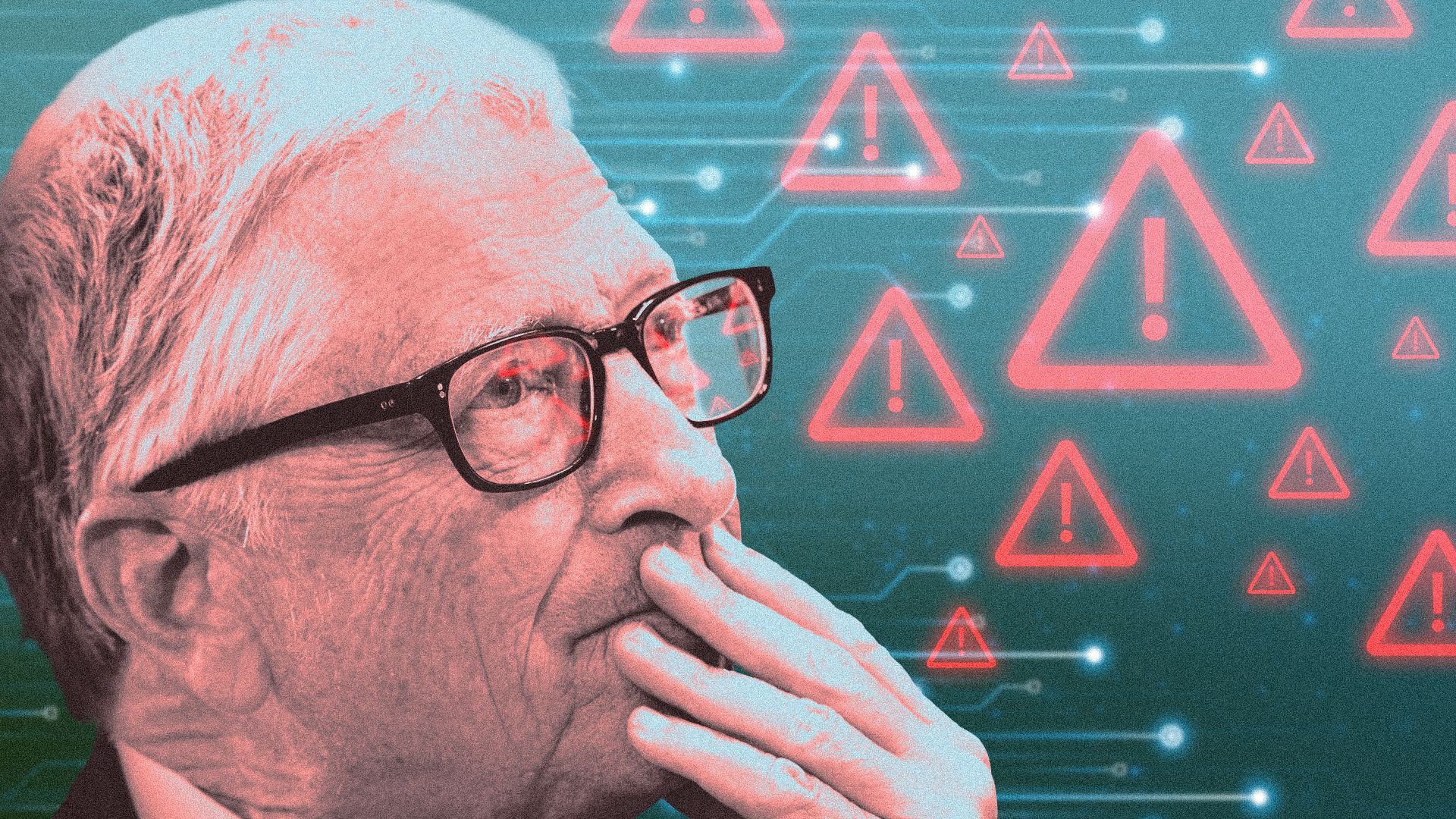
Bill Gates is gearing up to dramatically expand his AI safety push, personally leaning on business leaders and considering a major deployment of his resources, sources tell Axios.
Why it matters: The formidable, sharp-elbowed Bill Gates who built Microsoft is back, and he's directing his competitive fire toward what he has come to see as one of the most important causes of his lifetime.
- "I can reach CEOs on this better than you can," Gates told one person he consulted on AI safety, showing an eagerness for combat that associates say is a return to "OG" form.