Warning signs are flashing on the AI trade. Here's where to spot them

Add Axios as your preferred source to
see more of our stories on Google.
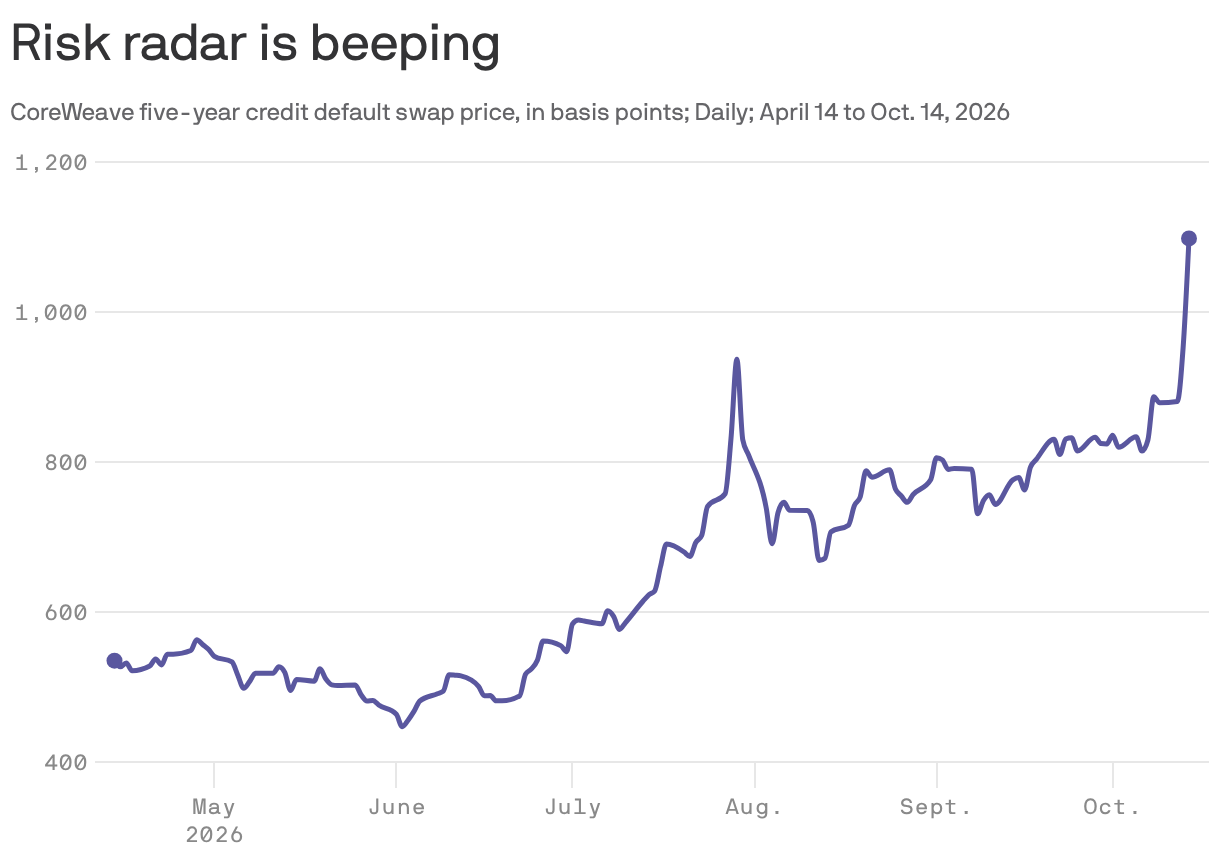
The adults have entered the AI chat — bond investors this week looked up from their massive buying binge and asked themselves, "Hey, are we sure these investments are going to pay out?"
Why it matters: The AI boom is looking a little wobbly these days, at least when it comes to all the borrowed money that's fueling it.
- "Credit markets are where some of the AI boom's weaknesses can show up first," Robert Schiffman, a senior credit analyst at Bloomberg Intelligence, tells Axios.
- If you look back at the history of many big investing booms that later went bust — from railroads to housing — the first warning signs were with the bonds.
The big picture: Bond investors — the adults in the room — can often spot trouble brewing in a market.
- Why's that? Stock investors place a much higher value on growth. Their basic question is: How high will this go?
- But bond investors are all about risk. They just want to know: Will I get paid back?
Follow the money: A few factors have converged to cause bond investors to have a rethink about AI debt.
- At the macro level, the Iran war that began earlier this year led to a surge in energy prices that drove up inflation.
- And that has helped drive interest rates higher, creating a potential problem for weaker borrowers that need to raise fresh money or refinance existing loans.
Zoom in: That's especially true for the so-called neoclouds, "the newest layer of the AI economy," as Mark Malek, chief investment officer at Muriel Siebert, calls them.
- These are companies racing, alongside Big Tech, to build and rent out AI compute. You've likely not heard of them — Crusoe, Nebius, Nscale, Lambda and, most prominently, CoreWeave.
- Unlike the hyperscalers — Microsoft, Alphabet, Amazon — the neoclouds are smaller and are more dependent on borrowing to build data centers and buy the chips to fill them up.
- "This is the subprime tranche of the AI trade," Gil Luria, head of technology research at D.A. Davidson, tells Axios.
Catch up quick: Investors have been selling off CoreWeave's bonds for weeks, worried that the revenues from AI may not be enough to sustain its growing debt burden.
- The prices for its bonds have now tumbled, pushing its yields (or interest rates on the bonds) into distressed territory.
- The accelerated deterioration shook the broader AI trade.
- Bonds issued to fund several different data centers have also tumbled in recent weeks, as the Financial Times noted — one investor called it a "Darwin moment," where only the strongest would survive.
By the numbers: On Thursday, five-year credit default swaps on CoreWeave — a kind of insurance that investors can buy to protect them against a company defaulting on its debt — jumped to nearly 1,100 basis points (or 11 percentage points) for every $100,000 of CoreWeave debt to be insured.
- That means it costs about $1.1 million a year to insure $10 million of CoreWeave bonds against default.
Between the lines: Luria, perhaps inadvertently, helped push the sell-off this week. He went on the "Prof. G Markets" podcast Wednesday, and warned that CoreWeave's stock price could go to zero if the AI investment cycle turns.
- Attention on the company started building the previous day when venture capitalist Chamath Palihapitiya posted a chart showing CoreWeave's record-high bond yield. To cap it off, Elon Musk replied, "Yikes."
- "All this stuff was coming together," Luria says. As for his quotes? "I don't know that they were the reason or the problem, but it probably didn't help."
Reality check: Investors and analysts still believe AI demand is strong enough to keep the cycle turning.
- But the recent weakness in CoreWeave and others shows where a break in the excitement is likely to start.
- It's unclear if there would be contagion from there.
