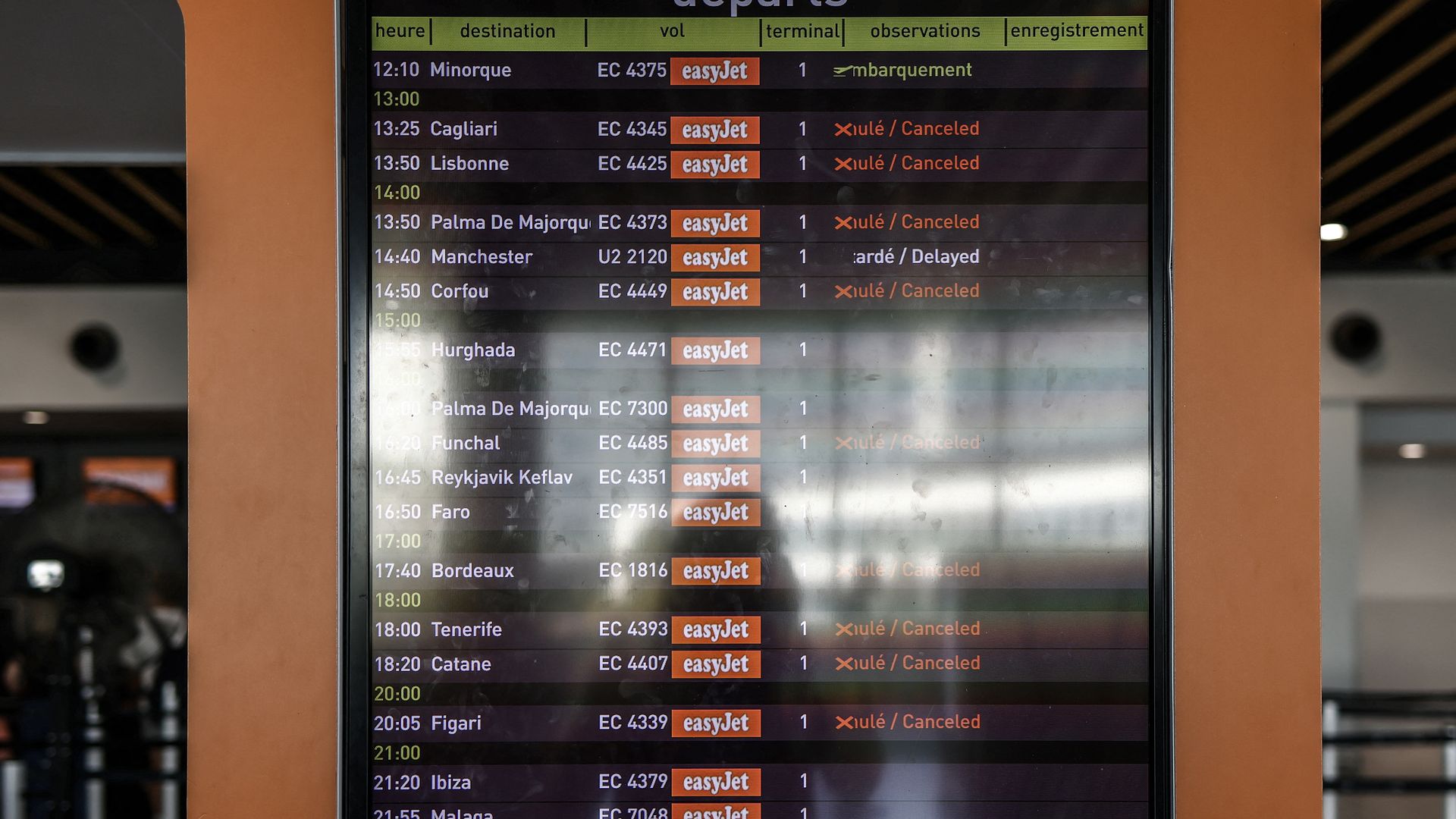
Air travel is being squeezed from multiple directions this summer as extreme weather, capacity constraints and geopolitical conflict strain the global aviation system.
Why it matters: Overlapping pressures across the aviation network are leaving travelers more vulnerable to delays, cancellations and higher fares, with no immediate end in sight.
A majority of U.S. adults under 30 are now more concerned than excited about AI's growing use in daily life, according to a Pew Research Center report published Tuesday.
Why it matters:AI excitement has dropped off across all age groups since 2021, as concerns about the technology's impact on job availability and society have grown.
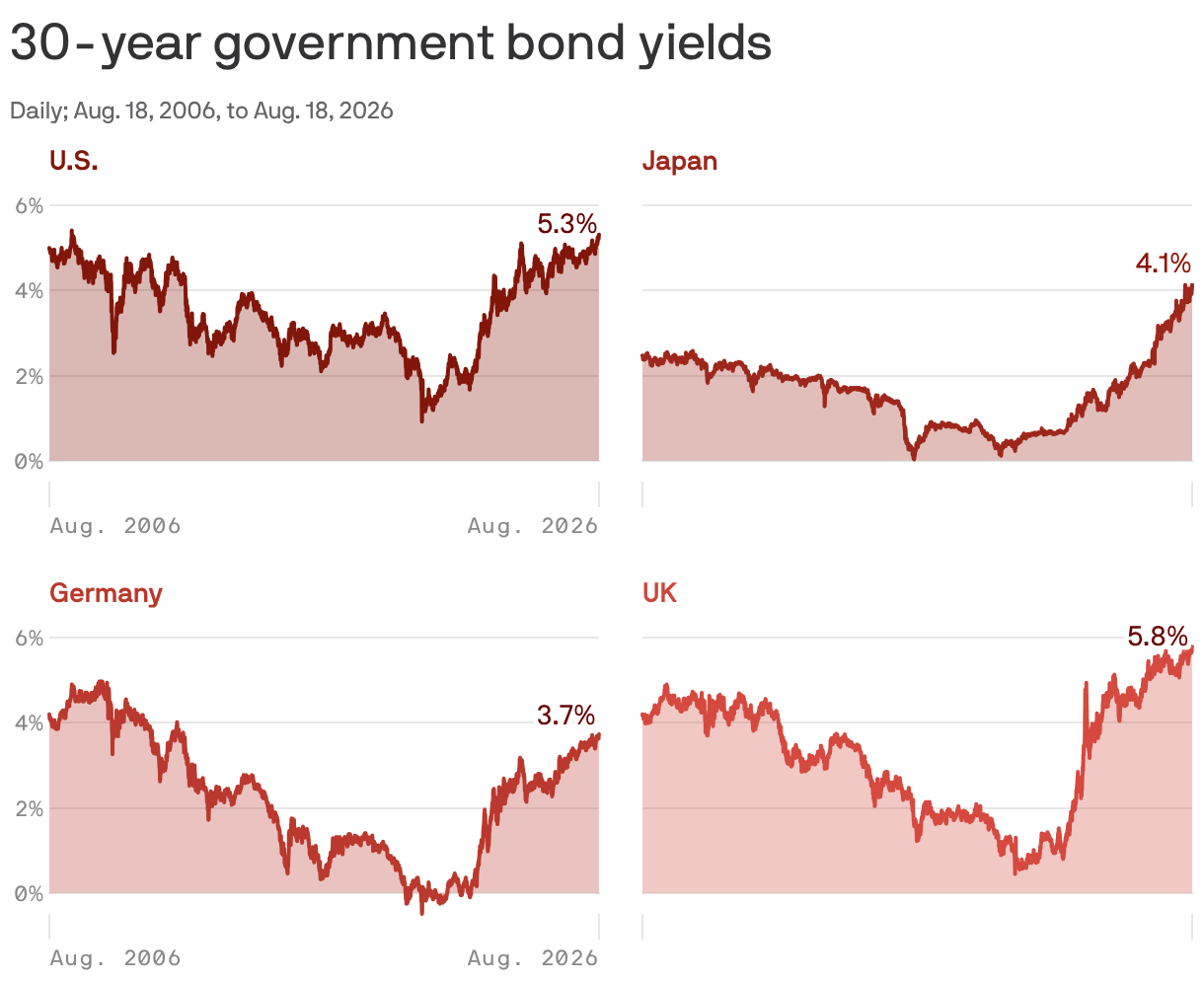
Governments around the world are entering a new era of higher borrowing costs already deeply indebted. More revenue will go toward interest payments as old debt gets refinanced at today's higher rates.
America is already watching that dynamic play out: Annualized interest costs have reached $1.2 trillion, exceeding defense spending.
The world has anew, expensive problem: The cost of borrowing money for decades keeps going up, making it getting harder to dismiss as a temporary market tantrum.
Why it matters: The relentless rise in borrowing costs in recent months makes a long-feared scenario harder to dismiss: that investors demand higher and higher returns in ways that make it prohibitively expensive to finance investments meant to power the next era of economic growth.
The consequences extend far beyond financial markets.
The U.S. violent crime rate plunged 9.7% last year — the largest annual drop since the FBI's national estimates began in 1936 — according to the bureau's data released Friday and reviewed by Axios.
Why it matters: The FBI's 2025 report indicated that the post-pandemic declines in violent crime accelerated sharply last year in communities of all sizes across the U.S. (That drop appeared to continue during the first half of this year, a separate Axios analysis of big cities' violent crime data found last week.)
Among the declines cited by the FBI:
Murder and nonnegligent manslaughter dropped 18.1%.
Robbery fell 18.5%, rape 7.6% and aggravated assault 7.2%.
Meanwhile, the U.S. murder rate decreased 18.5% to 4.1 per 100,000 residents, tying 1955 and 1956 for the lowest rate since FBI national estimates began.
Property crime declined 12.4%, led by drops in motor vehicle theft (22.7%), burglary (15.8%) and larceny-theft (9.8%).
Zoom in: The decline in crime was unusually broad, touching every population group in the FBI's violent-crime data — from the largest cities to small cities, suburbs and rural counties, an Axios analysis found.
Cities with 500,000 to 999,999 people had the biggest decrease, 15.3%, including drops of 27.4% in murder, 22.8% in robbery and 12.6% in aggravated assault.
The report is the FBI's final one for 2025 crime, but the national figures remain statistical estimates. The FBI estimates missing data to produce nationally representative figures.
17,075 law enforcement agencies submitted 2025 data, covering more than 96% of the U.S. population. Every city agency serving at least 1 million residents submitted a full 12 months.
Between the lines: The breadth and timing of the overall decline in crime decline make it difficult to credit any single president, policing strategy or local policy.
The decline in homicides began in 2022 under President Biden, continued through 2025 and has extended into the second year of President Trump's second term.
Trump came into office casting America as being overrun by crime at time when the numbers already were falling dramatically.
As that decline has continued Trump has taken credit for it, often linking it to his administration's National Guard and federal interventions in cities such as Washington, D.C., and Memphis, to declines in violent crime.
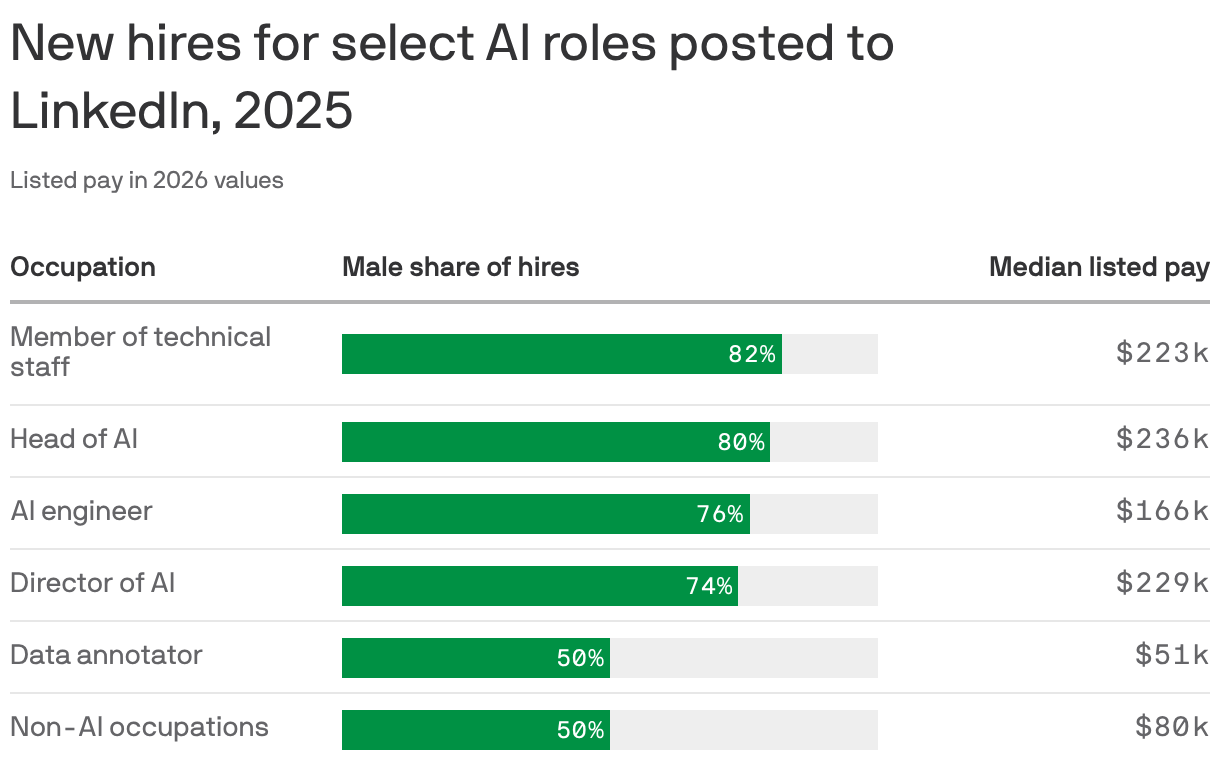
Women made up just over a quarter of new hires in the U.S. for AI roles last year — compared with half of new hires in non-AI occupations — per new LinkedIn data out Tuesday morning.
Why it matters: These jobs are some of the fastest-growing and highest-paying in the country right now — at a time when the overall labor market is pretty sluggish — and the report shows women are getting left behind.
Google is acquiring Spirit Airlines' emails, calendar info, chats, documents, spreadsheets and other business data, according to a bankruptcy court filing.
It will use the data to improve its products and AI models.
Why it matters: Spirit Airlines ceased operations earlier this year after it failed to emerge from its second Chapter 11 bankruptcy, but attorneys are still handling the disposition of its assets.
China's economic weakness and its AI ambitions are putting competing demands on policymakers.
Reviving the economy means getting households to spend more, but competing with the U.S. in AI means turbocharging an already production-heavy economic model.
Why it matters: China's push to supercharge production even as domestic demand weakens leaves China's producers more reliant on foreign buyers and pressures industries abroad.
Lilian Weng last month stepped down as a cofounder of Thinking Machines, just a year after it raised $2 billion from venture capitalists at an $8 billion pre-money valuation.
Then she rejoined OpenAI, one of the 800-pound gorillas that Thinky is trying to unseat.
OpenAI announced a 20-year lease for a sprawling data center in central Ohio with financing partly guaranteed by Nvidia, saying it will create 35,000 construction jobs and 2,500 permanent operating positions.
Why it matters: The facility — which will be built and owned by SoftBank's SB Energy — illustrates the immensity of the computing and power needed to fuel the growth of the AI economy.
Stripe has agreed to acquire AI model marketplace OpenRouter for more than $8 billion in cash and stock, Axios has learned.
Why it matters: Stripe's stubborn refusal to IPO hasn't dimmed its acquisition ambitions, despite its lack of a public currency, as this deal comes amidst ongoing efforts to buy PayPal.
Yields on U.S. government bonds — known as Treasurys — continue to climb, thanks to groaning federal deficits, bonkers corporate borrowing and uncertainty about monetary policy under Federal Reserve chairman Kevin Warsh.
Why it matters: Virtually all borrowing costs — for mortgages, business loans, auto financing, etc. — are based in part on bond yields produced by trading in the Treasury market each day.
When the U.S. government has to pay higher interest rates to borrow — yields are effectively those interest rates — it raises the floor for almost everyone else too, increasing borrowing costs across the economy.
America is experiencing its biggest prescription drug price deflation in generations.
Why it matters: By one important measure, there is a striking reversal underway for one of health care's most stubbornly expensive necessities amid a major Washington push to lower drug costs.