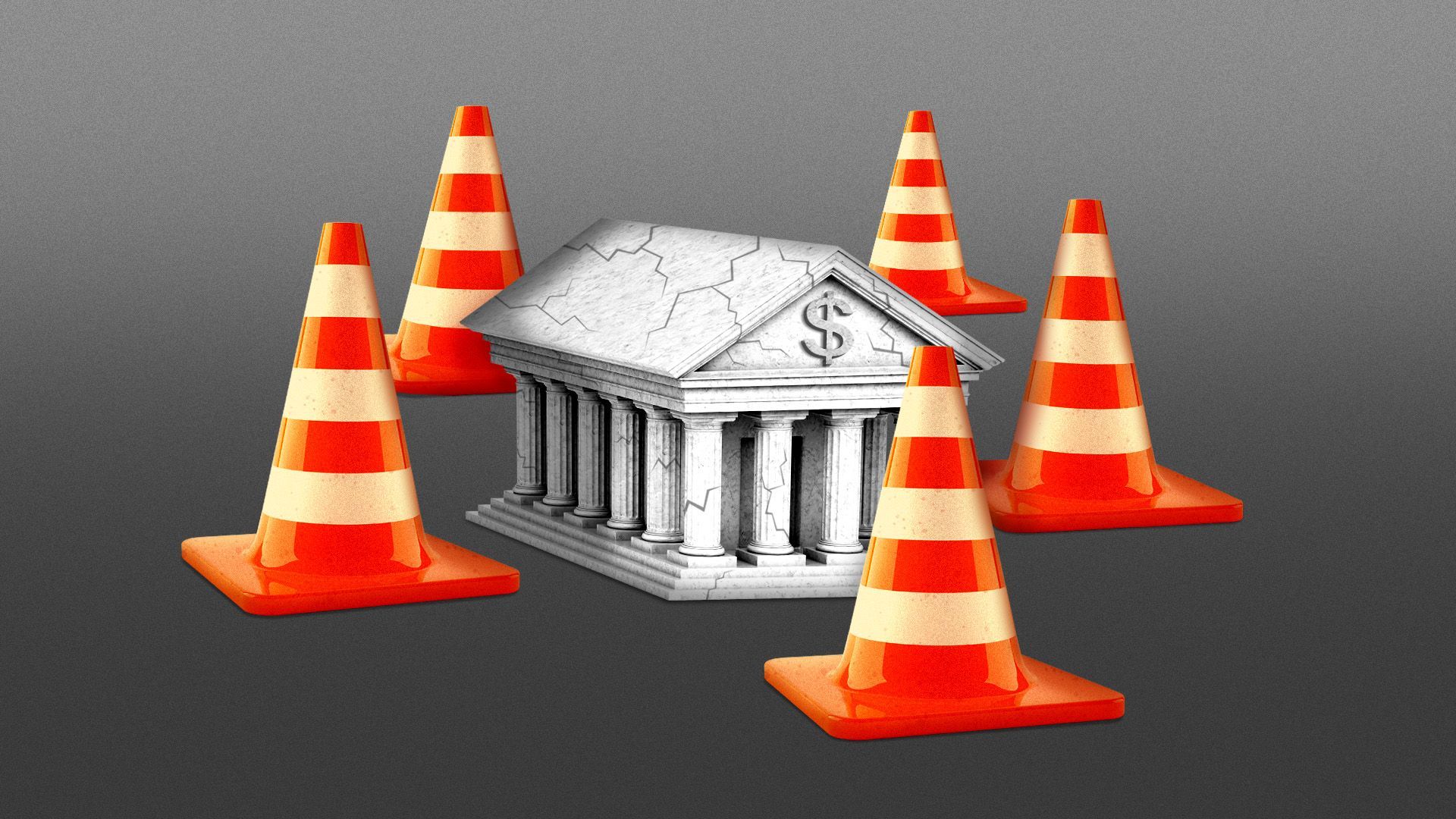
Republic First, a small Pennsylvania lender doing business as Republic Bank, was seized Friday by regulators who sold most of its assets and liabilities to rival Fulton Bank.
Why it matters: The Fed's rate hikes have slashed the value of many banks' assets. When those banks are losing money, as Republic was, they're likely to fail.
Data: U.S. Bureau of Economic Analysis; Chart: Axios Visuals
Americans saved a smaller share of their income in March than in any other month since 2022.
The personal saving rate, the percentage of income people are putting away after spending for things and accounting for taxes, dropped to 3.2% in March, according to government data.
Zoom in: That's down from 3.6% in February, and the 4.3% averaged over the prior 15 months from November 2022 to January 2024.
— Schenectady, N.Y., day trader Richard Persaud to the AP in a report on investors who have made tens of millions shorting Trump Media & Technology's stock.
The economic surprisein recent years is the resilience of the American consumer: high borrowing costs and lingering inflation are not crimping overall spending.
Why it matters: The drivers of such robust spending — and how long they can last — are key to what's ahead for the economy.
Following the 🥑 halving, some folks might be waiting for 🍊 bitcoin prices to rocket higher.
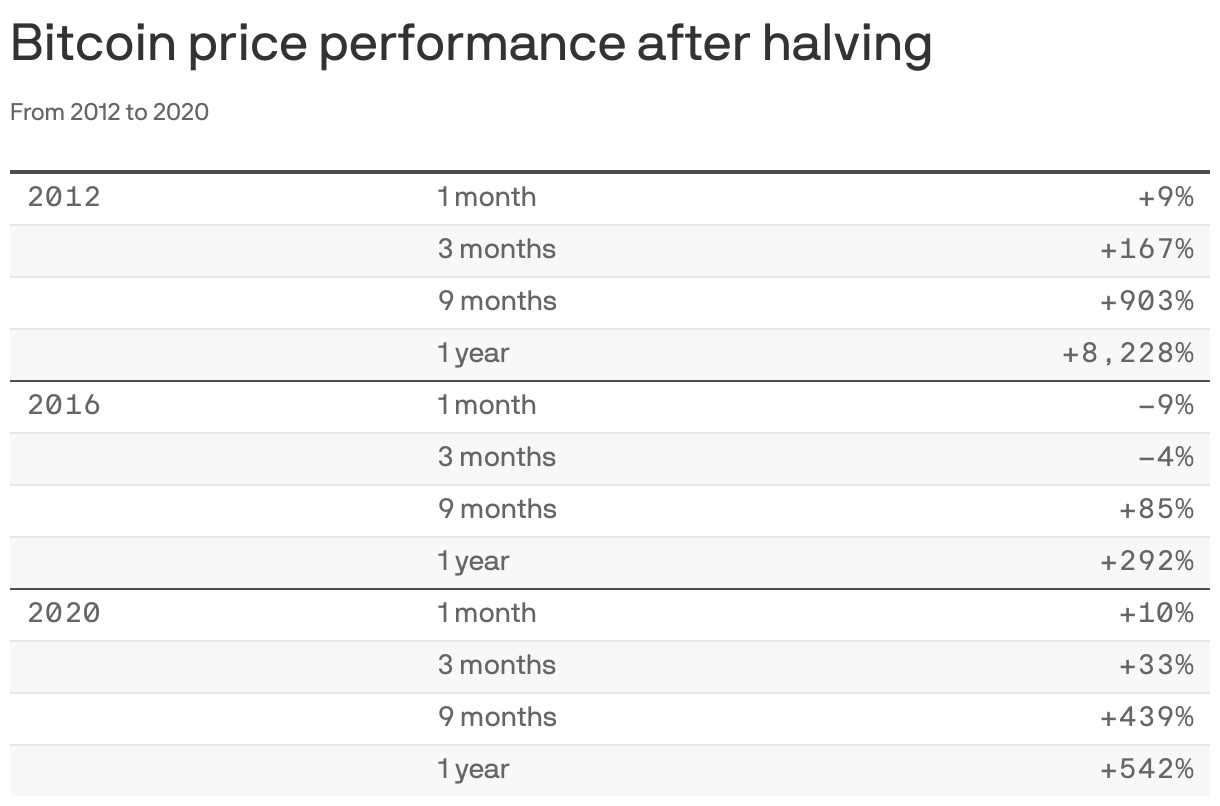
An analysis of price performance after halvings shows that the biggest returns come nine months after the event, or one year, according to Kaiko Research.
One year after the 2012 halving, BTC posted a 8,228% gain — the best performance it put up historically.
In 2020, its price was up just 542% one year after the halving.
Turkish people are leaning hard on stablecoins as the Turkish lira continues its decade-plus fall.
Why it matters: It's a sign that some parts of the world really are embracing cryptocurrency as an economic refuge when inflation becomes too severe.
Between the lines: According to the spring report from Chainalysis, spending with stablecoins in the Mediterranean nation has hit 4% of GDP.
Context: The lira has been losing against the dollar going back to 2008.
Other developing nations are also seeing significant stablecoin use.
Using data from CCData, Chainalysis shows that Thailand is also seeing more than 1% of GDP in stablecoin transactions, and Georgia is at more than 0.5%.
Why it matters: The European payments giant has had positive things to say over the years about cryptocurrency as a way to pay for things, but it nixed its experiments with using it after the market fell apart in 2018.
The latest: They have only incorporated Circle's usd coin (USDC) so far, but on several different blockchains.
It sounds like other cryptocurrencies may be coming.
But wait... there's more: Stripe co-founder John Collison seems genuinely delighted by how far the cryptocurrency user experience has come.
He buys something for 99 USDC on Solana live on stage, using the Phantom wallet, and it's done lickety-split.
The bottom line: This is a man who knows a little something about the UX of payments.