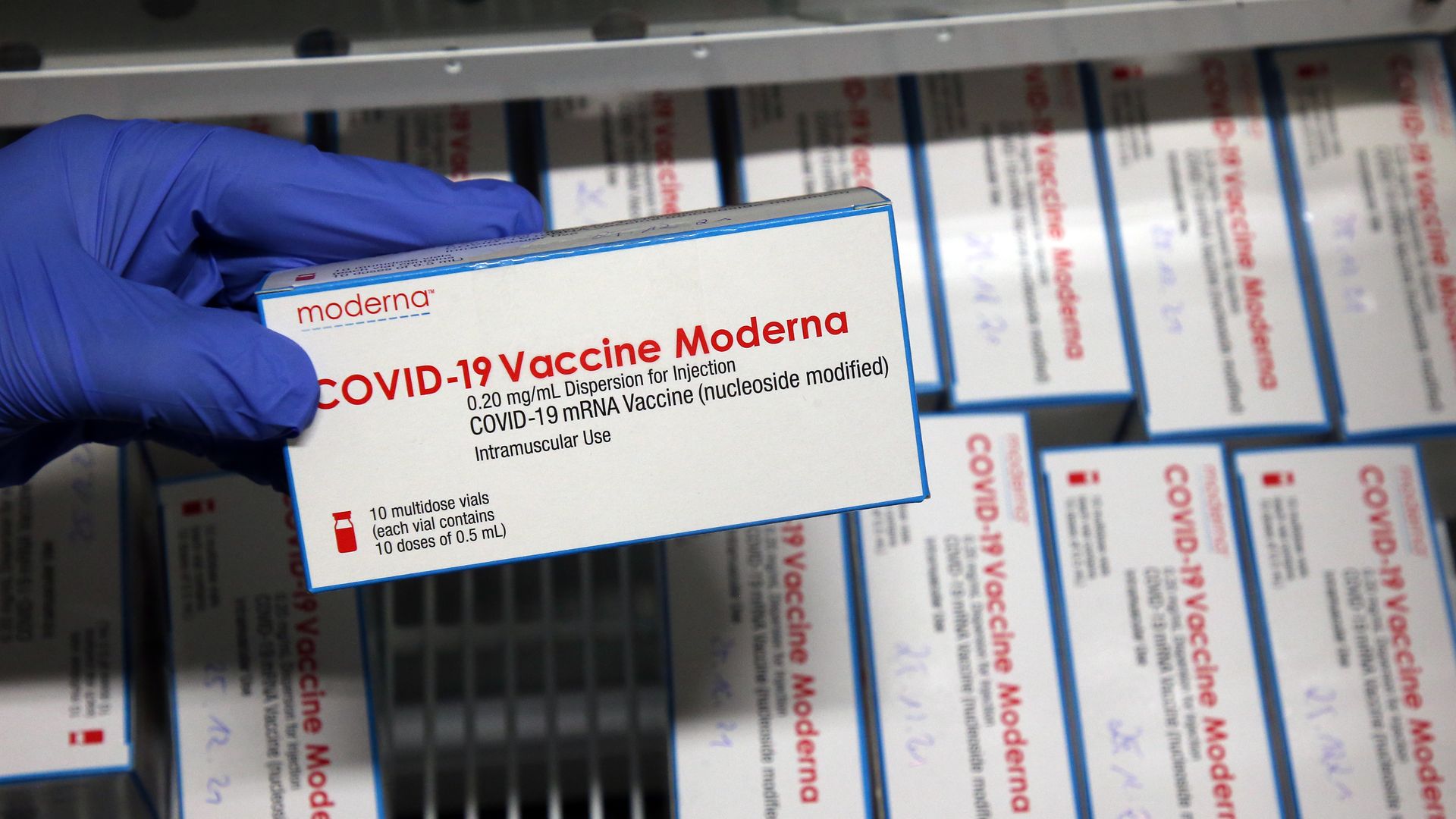
A federal appeals court on Wednesday dismissed two patentchallenges from Moderna over key components involved in making its COVID-19 vaccine.
Why it matters: The court's decision to side with Arbutus Biopharma means Arbutus could potentially sue Moderna for patent infringement and demand royalties from Moderna's COVID-19 vaccine, which is expected to generate up to $18 billion of revenue this year.
How can a physical artwork become an NFT? One new company has just spent $12.9 million on a Banksy in an attempt to try out a new way of converting the real into the virtual.
Why it matters: The art market globally sees volume of about $60 billion per year, almost all of which is trade in physical objects. Art-world insiders including former Christie's c0-chair Loïc Gouzer are on the lookout for ways to monetize physical paintings without necessarily giving up physical ownership of them.
Ozy Media, which recently imploded amid investigations into alleged fraud, has reached a severance settlement with most of its former full-time employees, Axios has learned.
Behind the scenes: Silicon Valley investor Ron Conway, who surrendered his Ozy shares, quietly hired law firm Wilson Sonsini to represent the ex-employees, with a final deal signed just before Thanksgiving. It included final paychecks, requested reimbursements, accrued but unused PTO and other owed wages (e.g., commissions).
Blue Prism (LSE: PRSM), a British robotic process automation company, agreed to a £1.24 billion takeover offer from SS&C Technologies (Nasdaq: SSNC) and withdrew its support for a slightly lower bid from Vista Equity Partners.
Why it matters: Vista has a reputation for winning deals with its wallet, not for getting beat out on price.
Cristiano Amon, who took over as Qualcomm CEO earlier this year, says the company will look much different in three years' time, with PC chips finally making up a more meaningful part of its revenue and Apple's business little more than a blip.
Why it matters: Qualcomm helped create the modern cellphone industry and is the largest remaining U.S.-based force in setting cellular standards, in addition to being the largest maker of mobile chips.
Exxon on Wednesday unveiled 2030 greenhouse gas targets as it faces investor and activist pressure to do more on climate.
Driving the news: They include a 20%-30% cut in corporate emissions intensity — that is, emissions per unit of output — and a 40%-50% intensity cut in oil-and-gas exploration and production.
Funds are making moves to achieve climate solutions breakthroughs, as well as investing in companies that seek to help communities better manage the climate risks they already face today.
Driving the news: StormSensor, a company that monitors watersheds in real time, including providing flood data, announced on Wednesday that it has closed a $10 million funding round. The funding is co-led by Orbia Ventures and Buoyant Ventures, with participation from other funds and individuals.
Nigeria, Saudi Arabia and South Korea on Wednesday became the latest countries to report cases of the Omicron variant of COVID-19. They followed similar announcements made in Brazil and Japan on Tuesday.
Why it matters: The arrival of the "variant of concern" in more countries underscores the difficulties governments are facing as they seek to reopen economies stalled by nearly two years of pandemic restrictions in the era of global air travel.
Pandemic shocks have gotten easier for the stock market to stomach.
Driving the news: "Covid-related stock market drops are getting milder and shorter," as DealBook noted earlier this week. Bad pandemic news hasn't prompted nearly as much turmoil as the early days of COVID-19.
The U.S. Supreme Court heard oral arguments Tuesday about whether the federal government had the authority to cut hospitals' payments for outpatient drugs.
Why it matters: The controversial case involves billions of dollars for hospitals, pits not-for-profit hospitals against rural and for-profit facilities, and tests the broader legal theory of whether federal agencies can take matters into their own hands when laws are vague.
A new United Nations report warns that global tourism will see only modest revenue gains in 2021 after last year's historic losses amid the COVID-19 pandemic.
Why it matters: Tourism revenues in 2020 fell by more than half from the previous year — a significant blow to the global economy, according to an analysis by the UN World Tourism Organization (UNWTO).
Donations to the Clinton Foundation plummeted to $16 million last year, down nearly 75% from the organization's peak when former secretary of State Hillary Rodham Clinton was running for president, records reviewed by Axios show.
Why it matters: The foundation was a financial juggernaut in the years after Bill Clinton served as president and while his wife led her own political career. In the time since, COVID-19 shuttered the sort of public events that had driven millions to the group — although Clinton loyalists expect increased donations this year.
The growing popularity of food delivery has given rise to startups that open "ghost kitchens" — kitchens in warehouses or trailers that prepare food solely for delivery and have no option to dine in.
But they can come with a whole host of problems.
The big picture: The concept of "ghost kitchens" has been dubbed the next big thing in the future of services, with high profile backers like Uber founder Travis Kalanick. But these kitchens can be hard to run or unsafe.