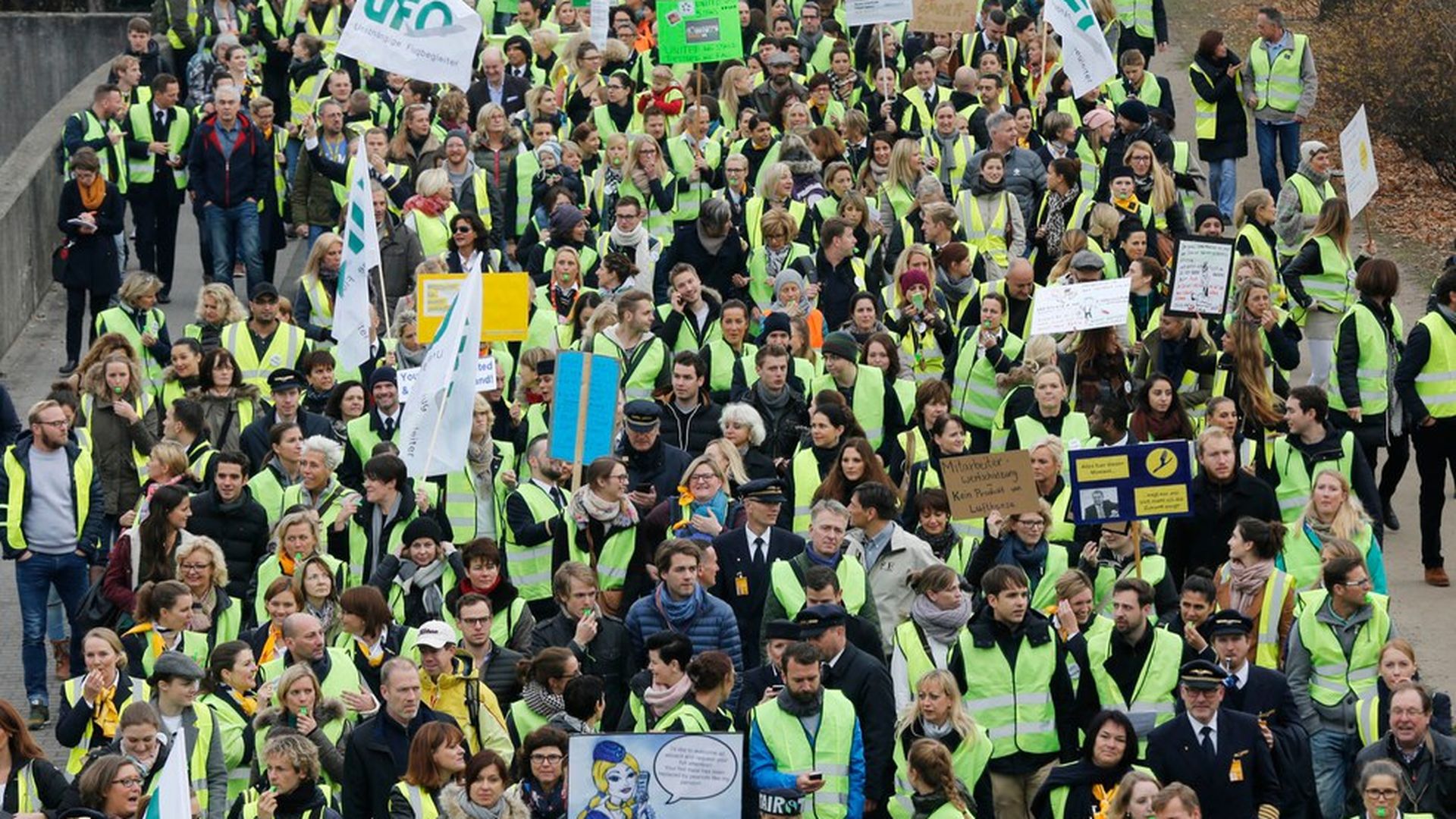
German labor leaders don't fear technological unemployment but say they are embracing the robot revolution as an inevitability that can be leveraged to supplement an aging workforce and relieve workers from onerous, dangerous tasks.
Why it matters: Unions in the United States and Europe were caught flat footed by deindustrialization, which took jobs from their members through automation and outsourcing. German labor groups say that to survive they must both protect remaining industrial workers, but also prepare for the economy of the future, and recruit workers who will be working along with robots and artificial intelligence.
Walmart isn't hiring seasonal workers this holiday season, and will instead increase existing employees' hours, a decision that underscores the American consumer's strengthening preference for online rather than in-store shopping.
Why it matters: According to retail consultant Challenger, Gray, and Christmas, seasonal retail employment grew last holiday season at the smallest rate since 2009. Seasonal jobs in warehousing and transportation of goods sold online are partly making up for the loss of in-store employment, but those jobs tend to be less evenly distributed geographically than traditional retail gigs.
Many real estate markets across the U.S. are in the midst of an affordability crisis because of rising home prices, tight access to credit, and a homebuilding industry that has been slow to build new homes. That's made it hard for renting millennials — the oldest of whom are well into the prime homebuyers years of their mid-thirties – to afford down payments. 70% of them in a recent survey by real estate data company Zillow said that saving a down payment was the single biggest factor preventing them from buying,
Why this matters: Entrepreneurs across the country are recognizing the opportunity to profit from a broken real estate finance industry that is failing to serve many prospective homebuyers. Startups like Unison and Loftium are looking to profit by investing money upfront with real estate shoppers.
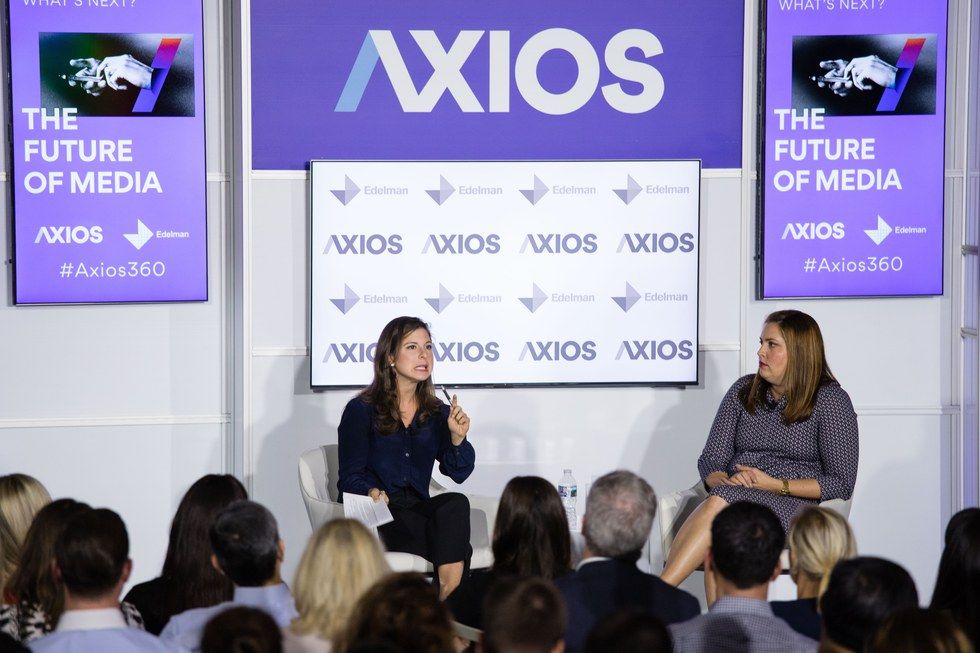
Axios Media Trends reporter Sara Fischer hosted a conversation on the future of media Tuesday night. Discussing what today's trends will mean for platforms, brands, and agencies, Fischer dug into the industry's biggest questions with four experts:
Liz Bowyer, Global Co-Head of Brand & Content Strategy, Goldman Sachs
Laura Gentles, Executive Vice President, Brand Practice, Edelman
Peter Hamby, Host, Good Luck America, Snapchat
Jim VandeHei, Co-Founder & CEO, Axios
Go deeper: Read Axios' Shannon Vavra's recap here.
Thank you Edelman for partnering with us on this event.
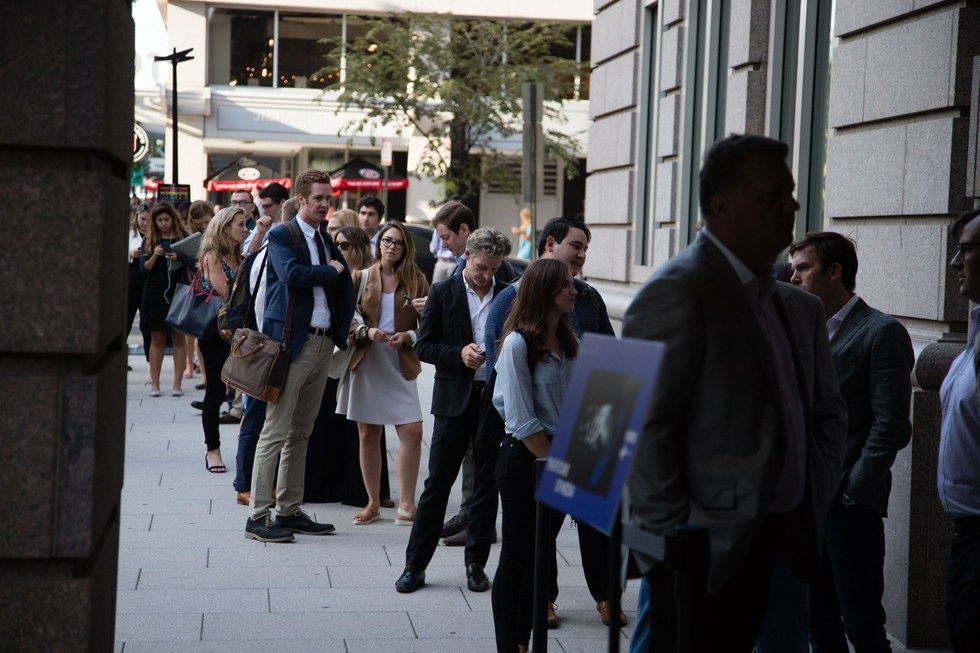
Guests lining up outside The Showroom in D.C.Chuck KennedyPeter Hamby, Host of Good Luck America, SnapchatChuck KennedyThree fish with a longer attention span than youChuck KennedyLiz Boyer, Global Co-Head of Brand & Content Strategy, Goldman SachsChuck KennedyAxios360 serving one of its three bite-sized foods worthy of your taste buds. Chuck KennedyA guest scrolls through the Axios stream on a giant iTabChuck KennedyLaura Gentles, Executive Vice President, Brand Practice, EdelmanChuck KennedyGuests, coming from industries across D.C., enjoying the post-event receptionChuck Kennedy
Yoshua Bengio, the artificial intelligence pioneer, says the centralization of wealth, power and capability in Big Tech is "dangerous for democracy" and that the companies should be broken up.
Why it matters: Bengio is a professor at the University of Montreal and a member of the three-man "Canadian Mafia" that pioneered machine learning, the leading method used in AI. His remarks are notable because of his influence in the AI community and because he or his peers all either directly lead or consult for Big Tech's AI programs. Says Bengio: "Concentration of wealth leads to concentration of power. That's one reason why monopoly is dangerous. It's dangerous for democracy."
Numerous startups in the tech hub of Toronto say they have had steady, double-digit increases in job applications from the United States since last year's presidential election. This is among the first concrete evidence that President Trump's hard line on immigration may be impacting the global race to attract the best minds.
What they're saying: "I've been in tech for over 20 years in Canada and in Silicon Valley, too. I've never seen candidates from the U.S. apply for Canadian positions from places like Silicon Valley," Roy Pereira, the CEO of Zoom.ai, told Axios. "That's never happened."
Howard Schultz, who rose from the projects in Brooklyn to create Starbucks, is making it a personal mission to find jobs for some of the least-advantaged and, in his view, most deserving in the United States: veterans and their families, refugees, and, with a job fair today, young people who are neither going to school nor working.
Why it matters: Schultz and his partners are attempting to pull a much-overlooked segment of U.S. society into the work force at a time that public hostility is driven in large part by low and stagnant salaries, and deep pockets of joblessness in inner cities and rust belts.
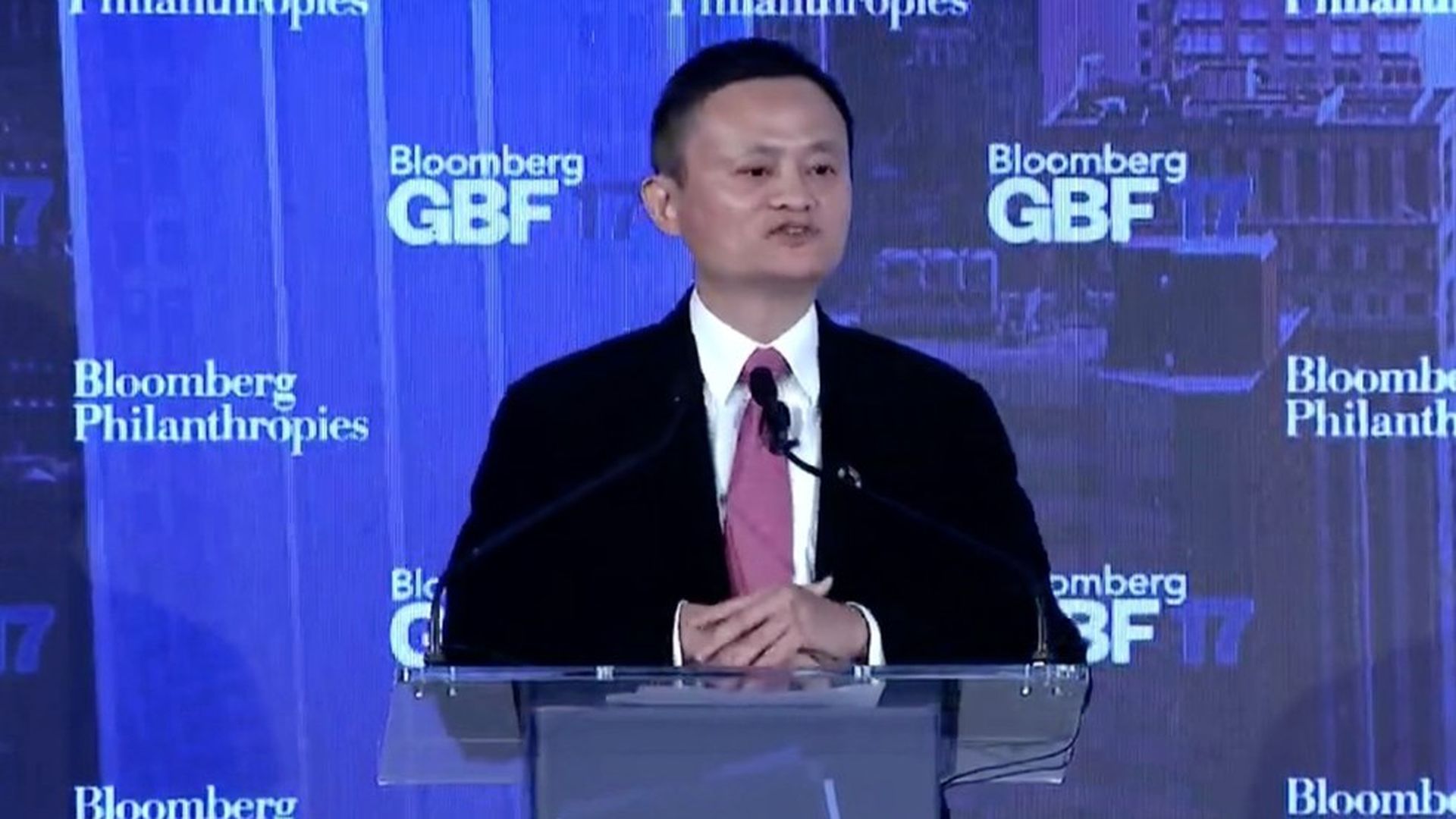
Jack Ma, founder and CEO of Alibaba, spoke about the future of work at the Bloomberg Global Business Forum Wednesday, warning governments to pay attention to the next 30 years, to those under 30 years old, and to small businesses — "I believe the small is beautiful and is powerful." He also zeroed in on how the servic industry, not manufacturing, will be the driver of job creation.
Man vs. Machine: Ma said there are a lot of people with worries, but most overestimate what this new technological revolution will bring to the world. He said that machines will be faster and stronger than humans, but "human beings have the heart, soul, beliefs and value."
When American shot-putter Adam Nelson learned he had won the 2004 Olympic gold medal, he didn't feel elation —he could only contemplate what he had lost. That's because his triumph was confirmed in a laboratory years later, when the International Olympic Committee determined that the man he lost to, Ukraine's Yuriy Bilonoh, used steroids to win. Nelson got his medal in 2013 during a rushed meeting with an IOC official outside Burger King at the Atlanta Airport.
Why it matters: In 2016, the IOC disclosed that doping cheats had robbed dozens of athletes of their deserved medals. For many of those vindicated, any thrill has been clipped by the reality of lost windfalls.