Wednesday's economy stories


Apple makes its easier for publishers to monetize
Apple announced Wednesday that publishers can now use two new ad formats (standard sizes you would typically find on mobile) and are able to utilize third-party ad tags to better track and measure ads. Publishers can also now view demographic information about their audiences, like age and gender, on the Apple News dashboard.
Why it matters: These advertising updates (mostly the ad tags) will make it easier for publishers to monetize on Apple News. The introduction of ad tags will also help Apple win more ad business, since most other platforms allow tags for measurement and tracking purposes.
This is the latest update Apple news has made to beef up its platform as a major news distribution destination. Last month, Apple announced it hired Lauren Kern as its first-ever editor-in-chief for Apple News.

Jack Ma: "The next 30 years is going to be painful"
Alibaba founder Jack Ma is traveling the world to get people thinking and talking about the opportunities and risks that will come with the age of artificial intelligence and globalization. He told CNBC that he thinks the era of Apple, Google and Amazon ruling the market will end, AI will ultimately lead to shorter working hours and more travel, but that this third technology revolution could also lead to a third world war.
"If they do not move fast, there's going to be trouble. So when we see something is coming, we have to prepare now. My belief is that you have to repair the roof while it is still functioning."

Average yearly income of top 1% in America: $1.3 million
The jobs market is humming these days, but income inequality continues to grow. Torsten Slok, Chief International Economist with Deustche Bank Securities, sent the following chart to clients on Tuesday, drawn on the most recent work by inequality researchers Thomas Piketty, Emmanuel Saez, and Gabriel Zucman. Pikkety is the author of the much-discussed 2014 book, Capital in the 21st Century.
Why it matters: The yawning gap between U.S. haves and have nots is only growing more severe, and there are no signs that the trend will slow on its own. These are the numbers Bernie Sanders studied before wagering that the Democratic Party's path to electoral success is through aggressive economic populism.


Former FCC official the front-runner for telecom's top cop
The front-runner to be the next head of the FCC's Enforcement Bureau is a lawyer and former agency official who has worked with Comcast and media companies. Two sources familiar with the position say that Rosemary Harold, currently a partner at the law firm Wilkinson Barker Knauer, is the likely candidate for the job.
Why it matters: The FCC can use its authority to aggressively pursue the nation's telecom firms if they violate the agency's rules. Republican administrations tend to be less aggressive on the enforcement front, and it remains to be seen how tough of a cop Chairman Ajit Pai will be. His predecessor Tom Wheeler slapped a few telecom providers with large fines for fraud and misleading consumers, for example, but was also criticized by the industry for being too aggressive.

Ford will import Focus from China, not Mexico
Ford announced plans Tuesday to import its compact Focus model from China, after scrapping a proposal earlier this year to expand a plant in Mexico. The planned Mexico facility had been roundly criticized by President Trump during last year's campaign, and the economics of the Mexico plant have been called into question as the Trump administration considers changes to NAFTA that could eliminate the advantage of producing in Mexico relative to China.
A blow to U.S. auto workers: Profit margins for sales of compact cars in the U.S. are thin, so it makes little sense for Ford to expand production of the Focus in the U.S. But when such cars are built in Mexico rather than China, they are typically sourced with American-made auto parts, supporting at least some domestic employment. The vast majority of parts for Chinese-built cars are made in China.

Ryan and Pence promise sweeping tax reform in 2017
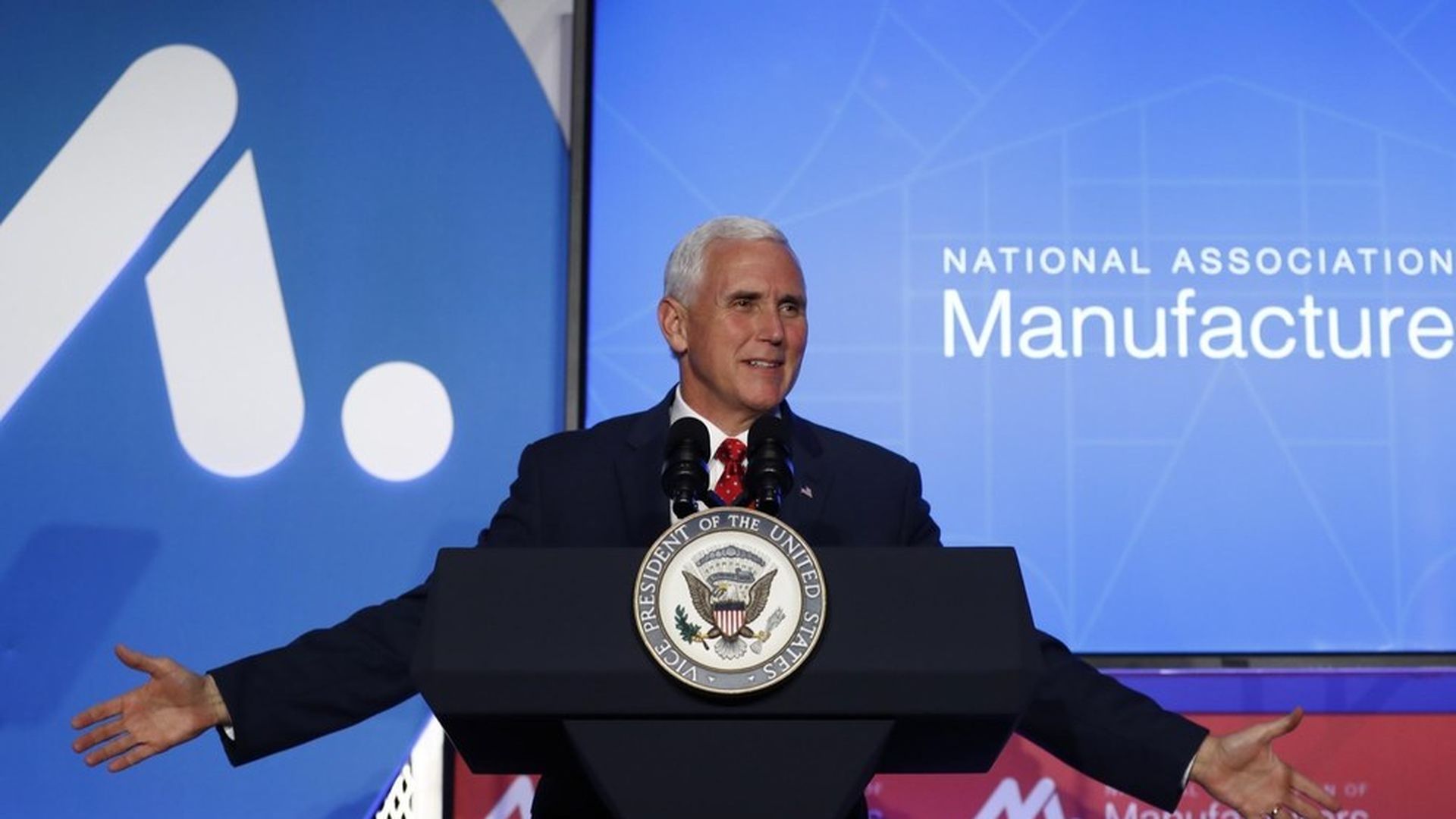
Speaker of the House Paul Ryan and Vice President Mike Pence both addressed the National Association of Manufacturers' 2017 Manufacturing Summit this afternoon with a clear commitment to pass massive tax reform before the end of the year.
- Ryan: "We are going to get this done in 2017…because we have to get this done in 2017. We cannot let this once-in-a-generation moment pass us by."
- Pence: "We're going to pass the largest tax cut since the days of Ronald Reagan, and we're going to do it this year."

Google now using AI to put job listings right in your search results
As of today, certain job-related search-queries will yield job postings culled from different job boards — and they'll show up right in your search results. Those postings will be augmented, in some cases, by the time it would take to commute from your house and by the employer's ratings on sites like Glassdoor.
Why it matters: The project is part of a larger initiative called Google for Jobs that the company talked about at its annual Google I/O conference. It's also part of a larger trend of Google putting information directly in search results in an attempt to help people get more information without leaving Google's site.

Trump supporters: Manufacturing jobs dangerous, low-paying
President Trump won the White House by promising to bring back manufacturing jobs that companies sent overseas to take advantage of cheap labor. But actual Trump supporters say the issue is that manufacturing jobs in the U.S. today for blue-collar workers are dangerous or low-paying.
- Reuters interviewed workers in the manufacturing hub of Elkhart, Indiana, where voters supported Donald Trump by a 2-to-1 margin in November.
- The unemployment rate in Elkhart sits at just 1.9%, but the manufacturing jobs there that pay well are so physically demanding that many workers cannot stay for long before medical issues force them to accept lower-paying jobs elsewhere.
- Why it matters: Offshoring and immigration aren't to blame for the lack of high-paying but low-skilled jobs in manufacturing as much as automation technology, which has left for humans tasks that are either low-value, high-skilled, or dangerous.

Regulators not convinced by 3D-printed titanium airplane parts
Major parts suppliers for airplane manufacturers like Boeing are ready to use cutting-edge 3-D printing technology, but regulators like the U.S. Federal Aviation Administration have yet to sign off.
- Boeing subcontractor Spirit AeroSystems Holdings is ready to produce thousands of its parts 30% more cheaply by using 3-D printing technology, The Wall Street Journal reports, whereby titanium is melted and then precision-deposited, layer-by-layer, to build the final part.
- The Journal reports the FAA isn't ready to certify the technology as "reliable enough to ensure identical strength and other properties from batch to batch," and the approval process could take until 2018.
- Why it matters: Technology is advancing more quickly than regulators are keeping up. In the case of aerospace manufacturing, this dynamic is about ensuring passenger safety. But for other technologies like self-driving cars, regulators will be concerned about other effects like job loss.