CenturyLink, one of the country's largest telecommunications providers, has a new employee, Harvard Business Review reports. She is Angie, who sends around 30,000 emails a day, identifies hot leads, sets up sales appointments, and then transfers the conversation to said sales rep.
Angie is artificial intelligence-powered, and has made CenturyLink $20 in new customer contracts for every dollar spent on her.
CenturyLink isn't alone: Other companies like Epson America and RapidMiner are using AI assistants, too. "AI tools are the only way I can scale 'helpfulness' to a global community of 200,000-plus users with a team of two," one chief marketing officer told HBR.
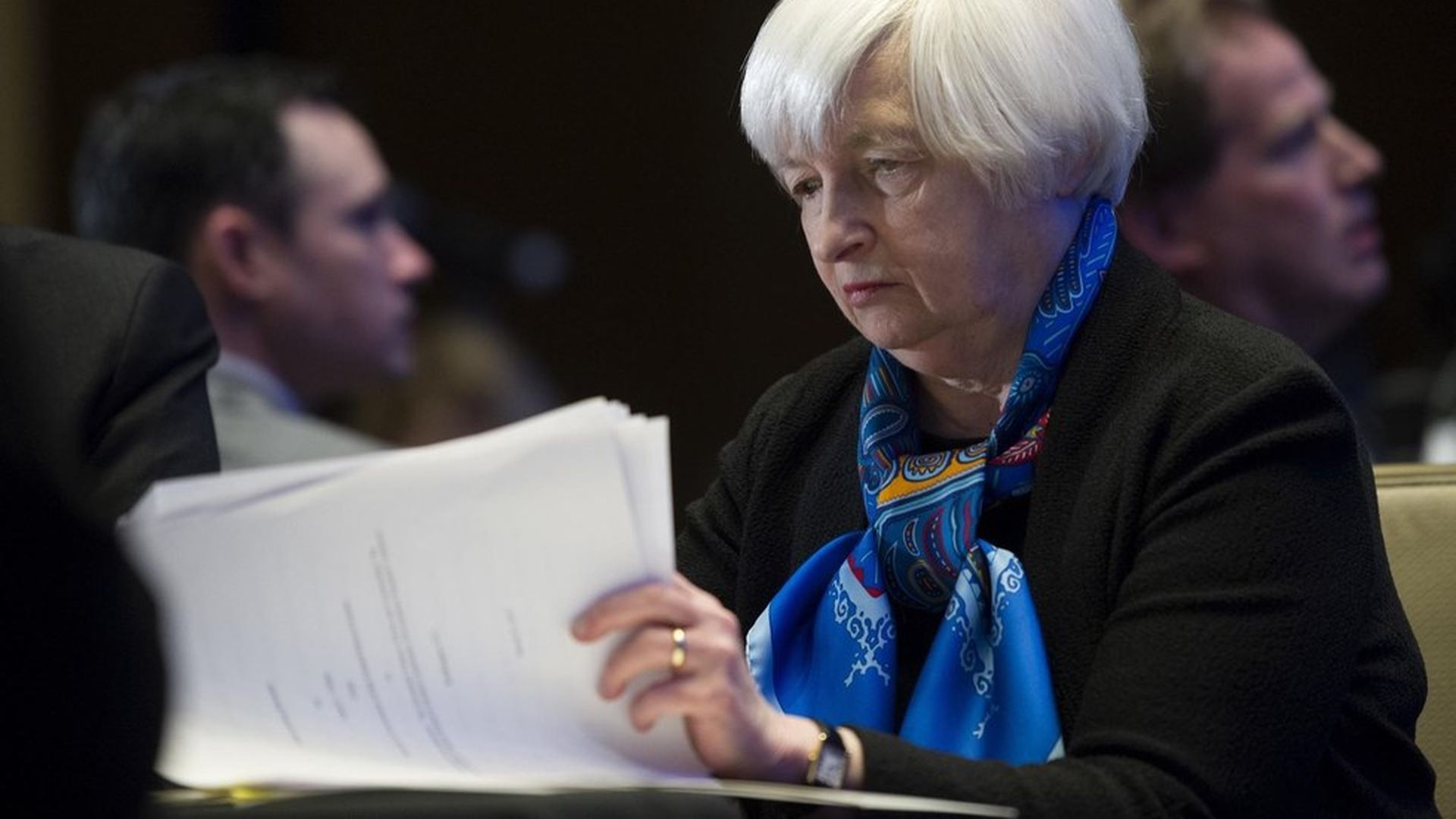
The Federal Reserve will raise the rate at which banks borrow 0.25% to 1.125%, the fourth such increase since December of 2015. The move was announced Wednesday following the Fed's June meeting, and suggests Fed Chair Janet Yellen thinks the steadily falling unemployment rate will soon spark faster wage growth and overall price increases.
Not so fast: The board's statement was more cautious than the one it issued in March — reflecting the fact that core inflation growth has fallen for three straight months, a trend Ian Shepherdson of Pantheon Macroeconomics calls "alarming, but not definitive." In other words, the Fed is currently sticking to its belief that inflation is going to accelerate this year — and that they must raise rates to head it off — but incoming data could cause it to abandon that view before July's meeting.
What it means for workers: The Fed thinks the U.S. economy is at full employment, and that significant further declines in the unemployment rate could spark a dangerous inflationary cycle. The concern is that low joblessness forces employers to pay higher wages, which then ups prices for products and services throughout the economy.
Goldman Sachs is automating the work previously done by associates earning $326,000 a year, and Bloomberg reports that half of the tasks needed to prepare for an IPO can be done by algorithms as well.
According to a recent study by the bank, half of the 127 tasks done to prepare for initial public offerings of stock can be automated.
Why it matters: Investment banking is another job on a growing list of high-paid work that is being automated, along with legal services and medicine.
Why it may not (technically) kill jobs: Goldman swears that this technology won't reduce headcount, but will instead free bankers to focus on tasks like shaping marketing strategy and spending time with clients. But it also says that it has eliminated thousands of hours of human work, which will reduce the need to increase its headcount going forward.
Uber is in the prediction business, but it wants to get better. So the company's artificial intelligence team has proposed a new algorithm that it says improves its forecasting of demand in extreme situations like bad weather and major holidays.
Uber researchers are applying a machine-learning architecture called "long short-term memory" (LSTM) to predict demand for drivers during "holidays, concerts, inclement weather, and sporting events." In a new blog post, they said that this new approach improved the accuracy of their existing forecasting algorithm between 2% and 18%.
Why it matters: Better AI forecasting models could impact fields as diverse as medicine and earthquake prediction. The latest craze among hedge funders is using LSTM architecture to predict asset price changes.
Publishers are leaving Medium, the crowdsourced-based content platform, amid business changes that make It harder for them to make money. Most notably in the last month, Bill Simmon's sports/culture blog The Ringer moved to Vox and Condé Nast's tech blog BackChannel moved to Wired.
Why it matters: Medium's long-term solution to this problem is to wait until its subscription model is out of beta and revenues will go up. But their interim strategy of retaining publishers despite having no short-term revenue plan is failing. Medium's struggle is shared by other internet publishers struggling to figure out how to build a sustainable long-term subscription model while ad revenues collapse in the wake of Facebook and Google's dominance.
China's increasing investments in artificial intelligence are attracting top scientific talent to the country and bolstering concerns in the United States about brain drain and corporate espionage as the nations face off in a battle — largely taking place in boardrooms and banks — to dominate cutting-edge technology.
What is happening: The United States wants to strengthen its ability to scrutinize Chinese investment in American tech companies, especially when it comes to artificial intelligence, per Reuters.
Why it matters: China appears to be outspending the U.S. to be at the forefront of artificial intelligence just as the Trump administration is slashing government research funding. U.S. officials worry that some of America's most cutting-edge companies could become beholden to the whims of a foreign adversary, and that the outcome will be China overwhelming the U.S. with soft power.
The Karolinska Institute in Sweden tested drones to rush defibrillators to simulated heart-attack patients and found they arrived in an average of 5 minutes and 21 seconds, versus 22 minutes for an ambulance to arrive in a six mile radius.
Why this matters: The survival rate for people who go into cardiac arrest outside of a hospital is low: 8-10% in the U.S. Reducing the time that elapses before defibrillation is a key factor for increasing survival, according to the American Heart Association.
The limitations: The 18 trial runs were only performed in good weather conditions, the authors note. And when a drone lands, there may not be someone trained in defibrillator administration but bystanders talking to paramedics over the phone or through a speaker on the drone could talk them through the process.
If you want evidence that AI technology won't lead to mass unemployment, look no further than AI pioneer, Amazon. That's according to Silicon Valley intellectual Tim O'Reilly, who writes in a recent Medium post:
"Amazon is constantly upping the ante. It doesn't just cut costs. It uses technology to do more, delighting customers with better service and lower prices. And of course, Amazon's customers respond by buying more products."
Amazon isn't using better technology and processes to cut jobs — its headcount is growing every year, while it offers improved service, often at no extra cost. Amazon also supports small businesses that do business on its platform, many of whom wouldn't be in business without those services.
New York City-based startup DeliveryDino wants to make it easier for consumers to navigate the growing gig economy. The startup's website serves as a sort of "Yelp for on-demand services."
How it works: DeliveryDino's website provides descriptions, customer reviews, and promotional discounts for various on-demand services, which consumers can filter by city and category. The startup says it covers 12,500 cities worldwide.
Bigger picture: On-demand and sharing services are becoming increasingly popular. In fact, about 72% of Americans have used at least one such service, according to a 2016 Pew Research Center study, and recent data from Intuit and Emergent Research predicts that by 2021, 9.2 million Americans will be gig workers. So it's no surprise that consumers are looking for more information about these services to help them choose where to spend their dollars.
Variety's soon-to-be published cover story, by Brian Steinberg and Cynthia Littleton: "Unprecedented audience interest post-election has ratcheted up the competition between the biggest stars in cable news, with CNN, MSNBC and Fox News pulling out all the stops to claim victory."
"The ratings growth for news programming ... comes at a time when the largest broadcast and cable networks are struggling with ratings erosion for primetime entertainment programming. Media buyers ... recognize that it's hard to beat real-world politics for intrigue and suspense."
"The notion of taking a summer vacation right now seems unrealistic for most newsies."
CNN's Erin Burnett: "It's like you're running a marathon ... at a sprint's pace."
More than 80% of U.S. adults get news on their phones -- up from roughly half of Americans just four years ago, according to a new survey from Pew Research Center. Most of that growth comes from adults older than 65 whose news consumption via mobile spiked almost 25% in the last year, and has tripled over the past four years. The next oldest group of adults shows a similar pattern.