Tuesday's economy stories

Why it's dangerous to fear the robot revolution
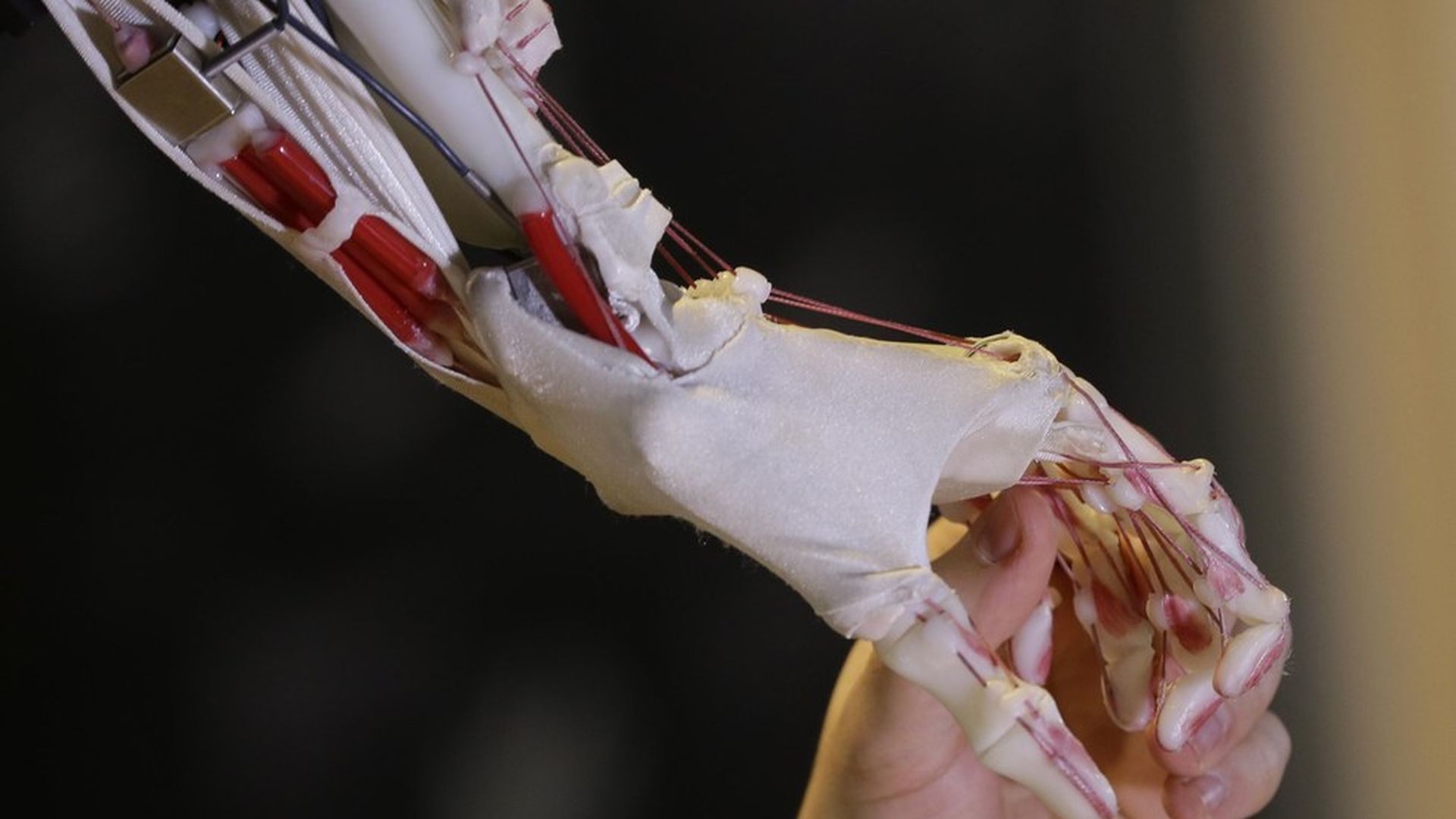
Robert Atkinson, president of the Information Technology and Innovation Foundation, co-authored a new report published Monday that contrary to widespread popular opinion, the adoption of new technologies is displacing fewer workers than ever before in American history. The data he presents shows that:
- Technology always directly kills more jobs than it creates, though it is doing so at a lower rate today than at any point since 1850.
- The true engine of job creation is that technological displacement of labor makes those who still have a job richer, and therefore creates demand for more already existing occupations. For example, the societal wealth that is created by no longer needing movie projectionists has created the wealth to support many more teachers.
Why it matters: This study could cause policymakers to reevaluate the public fear of coming waves of automation, and instead focus on the threat of overreacting rather than underreacting to these changes. Axios talked with Atkinson to get his take on the implications of his research:
Were you surprised by your results?Yes, totally. Part of what we wanted to do was just look at the changing nature of the labor market. Were there a lot of blue-collar jobs being destroyed and when, and things like that. When we really started looking at the overall amount of churn and occupation loss, we said, "wow, that's amazing," because the narrative you hear all the time is that the period we're in is this unprecedented period of occupational disruption. I expected today's numbers to be on par with the past, but it's actually a lot lower, and that's a big surprise. What's the reason for this gap between perception and the evidence?The labor market is complex and opaque. People tend to think about technology and jobs from their own very direct, personal experiences. The major one they think about nowadays is Uber, and they see taxi drivers losing their jobs. What people forgotten is that if you go back to the 1970s, for example, there was this huge decline in farm workers. 400 or 500 thousands workers lost their jobs, telephone operators lost their jobs. There was this occupation called 'file clerks," that don't exist anymore. What is your opinion of economist Robert Gordon's thesis that the real danger is that technological innovation is actually on the decline, and that we should prepare for very slow economic growth?I agree with Gordon that we're currently in a period of low productivity growth, but I don't buy into this notion that we've run out of important innovations. Using the example of autonomous cars, I think the most disrupted job in coming years will be auto-body repairman, as that technology will dramatically reduce the number of accidents. But there are also many, many jobs that won't be destroyed in coming years. What the techno-optimists would say is that the economy of the future is fundamentally different because we are entering an age in which we are inventing technologies that will actually further their own development. Does this prospect mean we have to rethink our assumptions about technology, or are these people underestimating how transformative previous waves of innovation were?People really do forget how mind-blowing technologies of the past were. It's easy to be ahistorical and say that the things we're inventing are bigger than those of the first industrial revolution. People also tend to overestimate the reach of the technologies to come. I've talked with a lot of AI scientists, and one thing they all said to me is that it's not as if you are going to create machines that have anything close to human capabilities. It will have better than human capabilities in a lot of areas, but doing things like writing a complex legal brief, it. won't be able to do.Many of the jobs you argue will be irreplaceable by AI are those in the public sector like teachers, fireman, and police officers. Doesn't this mean that we'll have to become more comfortable with the public sector being a more important source of employment?We shouldn't set a goal of how much money we want to spend on education or safety. We should have goals in terms of output. And what people forget is that if we automate and become richer as a result—and we're able to distribute those gains equally—then people will have more disposable income and can tolerate higher taxes to pay for public goods.Is the media overhyping this issue?A lot of people are. The media is often a reflection of who's giving them stories, and a lot of people feeding stories are snake oil salesman. The more outrageous your prediction, the more likely you are to get quoted, so they put these very inflammatory predictions out there.What are the dangers of overreacting to this issue?Bill Gates recently argued that we should tax robots, and [Nobel Prize winning economist] Robert Shiller has argued that automation technology is like alcohol—it has negative externalities and therefore should be taxed. I could see just some guy saying that, but for a respected economist, that is a fundamental change in how economists have historically looked at technology. We've always looked at it as a net positive, and this attitude will be harmful to the economy.

The 3D-printed homes people can actually live in

Over the past few years, designers and construction companies have experimented with using large, 3D printers to build homes, offices and other structures.
- The old thing: "Printing" building blocks and parts of homes, which are then assembled on-site.
- The new thing: Using 3D printers to print an entire building on site.
Pros: 3D printing would help eliminate waste in construction and can use recycled materials as building materials. Homes eventually could be easily personalized, and could provide cheap, safe housing in the wake of natural disasters.
Cons: There's still a long way to go with 3D technology and building printers that are large enough to build these structures. It's difficult to meet the intricacies of building code requirements while programming the printers, and most homes that have been built are tiny and not particularly stylish.

Why Fox lost out to Sinclair on buying Tribune Media

When Tribune Media announced yesterday that it had agreed to be acquired by Sinclair Broadcasting for $3.9 billion (not including assumed debt), I had two initial thoughts:
- Conservative-leaning Sinclair will now own a national cable network (WGN) that it could use to launch a Fox News rival (albeit with a massive HR insurance policy);
- What happened to 21st Century Fox, which was said to be working with The Blackstone Group on a rival bid?
I'm totally unqualified to deal with #1, but I did speak with a bunch of people familiar with #2. Notes:

Pandora raises money to explore sale

The music streaming company announced Monday a $150 million investment by private equity firm KKR. On an earnings call with investors, board member James M. P. Feuille said the company is positioned to evaluate any potential strategic alternatives, "including a sale," in the 30 days before the financing is set to close.
Why it matters: While revenue was up 6% year over year, and subscribers up 20%, the company barely gained in advertising, its net loss grew. Most of its earnings come from its ticket vendor business, TICKETFLY. Investors are hopeful that Pandora's premium subscription model will help create a new revenue stream.
Country music could save Pandora: Per Marketwatch, 56 million of Pandora's 81 million active users subscribe to its "Today's Country" station. Country songs accounted for roughly 6% of the total streams on paid streaming services over the past two years.

Coach acquiring Kate Spade for $2.4B
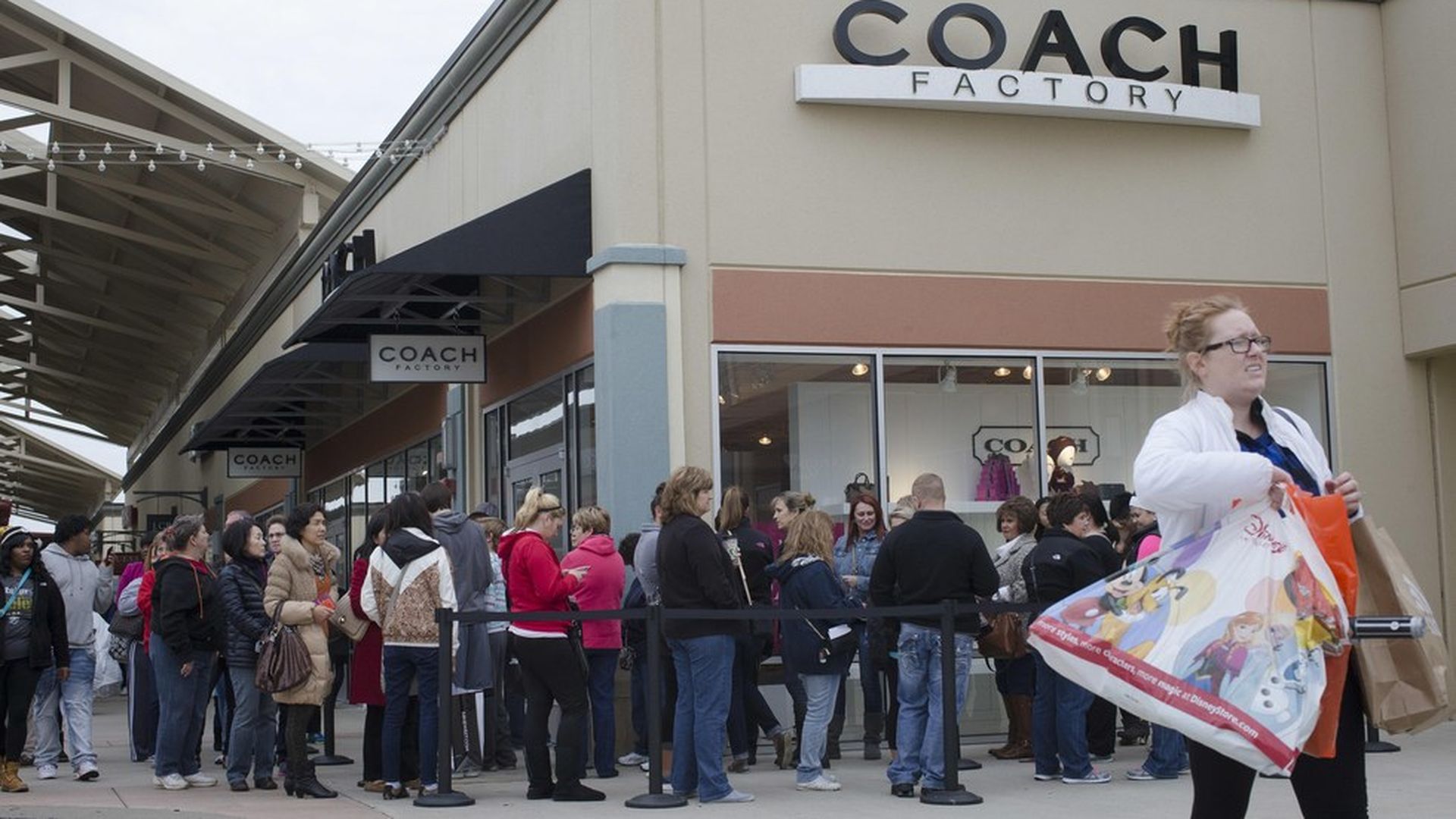
Coach Inc. is buying Kate Spade for $2.4 billion, per Reuters.
- The deal: Kate Spade announced it was considering a sale in February since it wasn't achieving competitive profit margins. Coach said it expects to work out $50 million in savings over three years from the deal.
- The millennial appeal: Kate Spade's brightly colored handbags are popular with millennials, which could help Coach's position in the crowded market.
- The trend: Coach bought luxury shoe brand Stuart Weitzman in 2015 after a failed attempt to create a new brand, Reed Krakoff. Coach reported strong earnings in Q3 of 2016, indicating this strategy of acquiring luxury brands might be working (compare that to Michael Kors, which decided to sell higher quality bags to remedy its dip in sales). Analysts are saying Coach's next move could be a buyout of Burburry or Jimmy Choo.
Why the EU is forcing AI to explain its behavior
By May of next year, artificial intelligence algorithms in the EU will be legally required to provide users an explanation "every time it uses [their] personal data to choose a particular recommendation or action," writes AI lawyer John Frank Weaver :
- For example: Weaver gives us Amazon's usually reliable Alexa, which recently cued up Sir Mix a Lot, to the befuddlement of its owner.
- Why AI owes an explanation: Weaver says the U.S. should follow suit, in order to promote transparency and greater user control over the technologies that play an increasingly important role in their lives.
- Why we should tread carefully: Thomas Burri, an assistant professor of international and European law at the University of St. Gallen, told Weaver "If the first thing you need to consider when designing a new program is the explanation, does that stifle innovation and development? . . . Some decisions are hard to explain, even with full access to the algorithm...."
Chinese e-commerce boom — bigger than US, UK combined
Last year Chinese consumers spent about $750 billion online, outspending both U.S. and UK consumers' online purchases combined, and beyond that, China has been a standout in adopting e-commerce as a driving habit in retail, according to Boston Consulting Group. The rate of growth of e-commerce as a portion of retail in China is particularly striking; it's going to grow twice as fast as the U.S. and UK at about 20% annually.
Why it matters: Retailers dealing with the impending death of the U.S. mall could take a hint from the Chinese marketplace and the habits of its consumers.
Why China is outspending: Digital shopping hit the internet in the 1990s, which coincided with a growth in disposable income in China, whereas in the U.S., shopping in brick-and-mortar stores had already been ingrained as a habit. BCG posits that's why e-commerce habit adoption has been slower in the U.S.
Reality check: Technology is killing fewer jobs than ever
Despite widespread fears that artificial intelligence and automation will create mass unemployment, job losses due to technology are at historic lows, according to an analysis published Monday by the Information Technology and Innovation Foundation.
The stats: Levels of occupational churn in the United States — defined as the rates at which some occupations expand while others contract — are lower during this decade than at any point since the 1850s.
Sound smart: Despite the potential for unprecedented labor-market displacement brought on by recent developments in artificial intelligence, a central problem of the economy today is actually too little displacement, as evidenced by statistics showing slow productivity growth. Without gains in productivity that result from the application of new technologies to business, the value an individual worker produces can't rise significantly, and that means that his wages likely won't rise, either.
Jeff Bezos on using AI to power government and small business
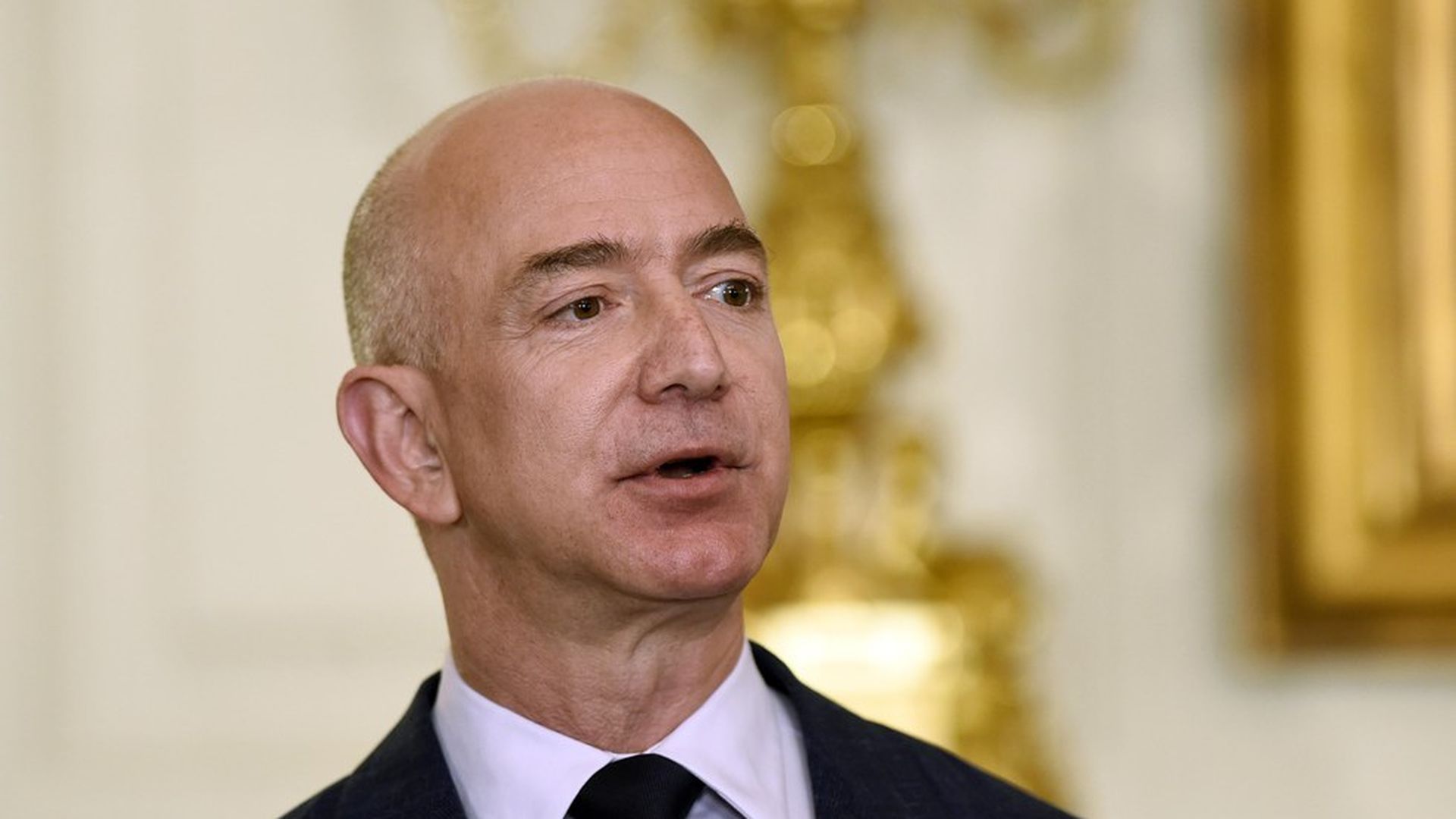
Jeff Bezos said last week that the "golden age" of artificial intelligence and machine learning had enabled new products like Amazon's Alexa and sharpened the company's core businesses by improving search results, product recommendations, and inventory management.
Bezos now wants to bring techniques enabled by AI to businesses large and small, as well as nonprofit and government institutions. "Right now, deploying these techniques . . . is difficult," he said. "It takes a lot of expertise, and so you have to go compete for the very best PhDs in machine learning and it's difficult for a lot of organizations to win those competitions."
Why it matters: AI is the latest front in the "cloud wars," with Amazon, Google, Microsoft, and IBM competing for market share in the rapidly growing market for leased computing infrastructure and services that enable businesses to manipulate and leverage data stored there. The first-mover advantage in this space is mind-bogglingly large, as these firms effectively compete to own what will be the most important infrastructure in the 21st-century global economy.

Tech's biggest companies shy away from going public

Though more companies are choosing to IPO, tech's biggest startups are holding off on going public as they fear that their sky-high valuations from private funding rounds might dip on the open market, per the Wall Street Journal.
- "A slew of companies are preparing to go public later this year."
- "Conspicuously missing ... are some of the highest-profile private companies, such as Uber Technologies Inc. and Airbnb Inc., which aren't expected to come to market before 2018."
- Be smart: "[S]ome investors and underwriters say there's concern that the public markets are being used as a last resort..."
- Why it matters: "It's symptomatic of a decades-long trend that's seen the total number of public companies in the U.S. decline sharply as more entrepreneurs and others choose to avoid the increased disclosure and other perceived drawbacks of broad ownership."
Deloitte CTO Bill Briggs is bullish on human workers

The promise of artificial intelligence and machine learning has kept management consultants like Deloitte Chief Technology Officer Bill Briggs busy as companies race to try to make their operations more efficient with these powerful new technologies. Axios sat down with Briggs to learn how we can expect our workplaces to change as a result.
How work will change: The accelerating pace of technological change has forced businesses to adopt tools like artificial intelligence faster than ever before. "If your value is exercising a rote, prescribed job, and that's all you care to do, hopefully you're 60, and approaching a time you can gracefully tap out because not many jobs are going to look the same in a few years," he says.
NYC Media Lab chief: Investment in VR/AR is slowing

Axios spoke with Justin Hendrix, executive director of NYC Media Lab, which brings together universities, publishers, agencies and telecom companies to test media and digital innovation. Per Hendrix, AR/VR investment is slowing:
"I do think we're seeing a little bit of a wobble in the kind of commercial enthusiasm around AR and VR," Hendrix said. "The dip suggests investors have cooled since realizing emerging area market adoption not there. Investment should bounce back in 2018."
Per Crunchbase, the first quarter of 2017 marks the lowest quarterly number of financings and investment total in AR/VR technologies in over a year.

Robot sales are just getting started

Robot sales are surging in North America, with automotive and other companies snapping them up at a record pace for a second straight year. According to industry figures, robotics companies made $516 million in sales in the first quarter, up by about 28% over the same period in 2016.
Between the lines: The report follows a record 2016 for robotics sales, and consensus forecasts of continued double-digit revenue increases for the industry for the next five years. This gives a hard foundation to projections of a vast robotization of industry and job categories over the coming years, with the potential for a massive impact on employment.