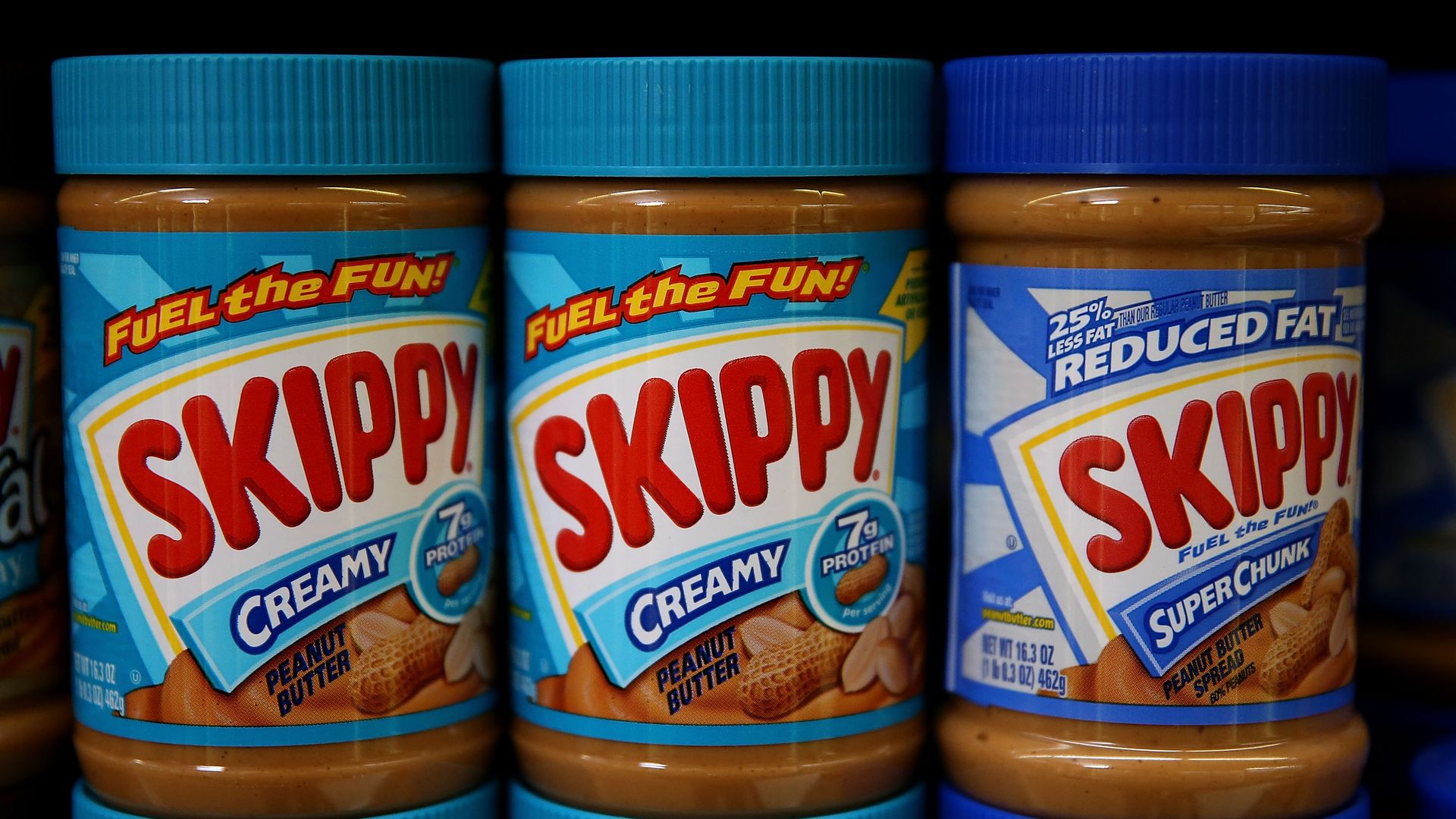
Several Skippy peanut butter products are being voluntarily recalled due to the possibility that they may contain steel fragments from a piece of manufacturing equipment, parent company Hormel announced Wednesday.
Driving the news: The recall affects 161,692 total pounds of Skippy products, which include Skippy's Reduced Fat Creamy Peanut Butter Spread, Reduced Fat Chunky Peanut Butter Spread and Creamy Peanut Butter Blended With Plant Protein.
The era of excess savings, one of several factors behind the U.S. labor shortage, may be coming to an end.
Driving the news: In a comprehensive study of the worker drought, labor market analytics firm Emsi Burning Glass found the decline in extra cash is a possible impetus for getting workers off the sidelines.
Two committees of the European Union Parliament today voted to move forward draft legislation to take all privacy out of cryptocurrency transactions.
Why it matters: The committees voted for rules that would ban transactions that state authorities can't readily tie to a person or an organization, striking a blow to the pro-privacy bent of so many crypto users.
What happens when people with an academic pedigree in management actually run a business?
Driving the news: Nothing great, according to new research that suggests that employees of firms run by people with a degree in business do worse — while the company as a whole doesn't necessarily do better.
There is a simple piece of advice that any capable financial adviser can offer to an investor who wants a portfolio combining reasonable safety with a reasonable chance of gains: 60% stocks, 40% bonds.
Why it matters: The confluence of high inflation, Federal Reserve tightening, and geopolitical instability is making a normally safe portfolio riskier than it has been, defeating a traditional investment approach that's offered safety in the storm.
Economists and financial types have gone wild over the last couple weeks debating the implications of the yield curve inverting — short-term interest rates rising above long-term rates.
Why it matters: It would be bad news if the Fed is steering the economy straight toward recession-ville. But bond market indicators so far are more consistent with a slowdown in activity that helps rein in inflation without slipping into an outright economic contraction.
Although Latinos and other people of color are avid moviegoers, they are deeply underrepresented on-screen, two recent reports show.
The big picture: The first year of the pandemic ravaged the movie industry, with a 72% drop in ticket sales, but research shows that Latino, Black and Asian Americans helped keep it afloat.
Russian President Vladimir Putin threatened on Thursday to cut gas exports to countries that do not open a ruble account with a Russian bank starting April 1, according to Reuters.
Why it matters: Russia holds significant leverage over some European countries because it is the source for a large percentage of their natural gas supplies, and any disruption to gas exports would make Europe's energy crisis much worse.
President Joe Biden will issue a directive Thursday to boost domestic production of metals and minerals used in large capacity batteries, electric vehicles and the energy sector, according to the White House.
Why it matters: Adding the materials under the 1950 Defense Production Act is part of the Biden administration's efforts to curb rising fuel prices from supply chain disruptions and Russia's invasion of Ukraine.
Canadian miner Kinross Gold is in exclusive talks to sell its Arctic Russian mine to Fortiana, a Cyprus-based investment firm controlled by Russian businessman Vladislav Sviblov, according to The Wall Street Journal.
Why it matters: Lots of Western firms announced plans to leave Russia after the Ukraine invasion, but this would be the first successful sale.
Google on Thursday said it's adding a new label to search results for news stories, interviews, announcements and press releases that are frequently cited by other media outlets in an effort to elevate original reporting.
Why it matters: Google's search algorithm is designed to prioritize pages that are the most relevant and useful for users based on their unique queries. Sometimes, the most relevant and useful pages aren't the source of original information, but they cite the pages that are. Google wants to help point users to those pages.
Driving the news: Prices for the goods and services Americans consume rose 6.4% in the 12 months ended in February, according to new government data, the highest since 1982 and up from 6% in January.
The S&P 500 is cruising toward a 5% gain in March, which would be its best month since October.
Why it matters: The turn higher for the market — after it was down by more than 10% — underscores what attentive investors have come to understand over the last couple of years. The stock market isn't the economy.
Thomas H. Lee Partners has agreed to acquire health care data enablement company Intelligent Medical Objects, the parties tell Axios exclusively.
Why it matters: Clinical data quality has long been a problem for different health care stakeholders, and the opportunity exists to tackle this problem for providers, life sciences companies, payers and public health entities.
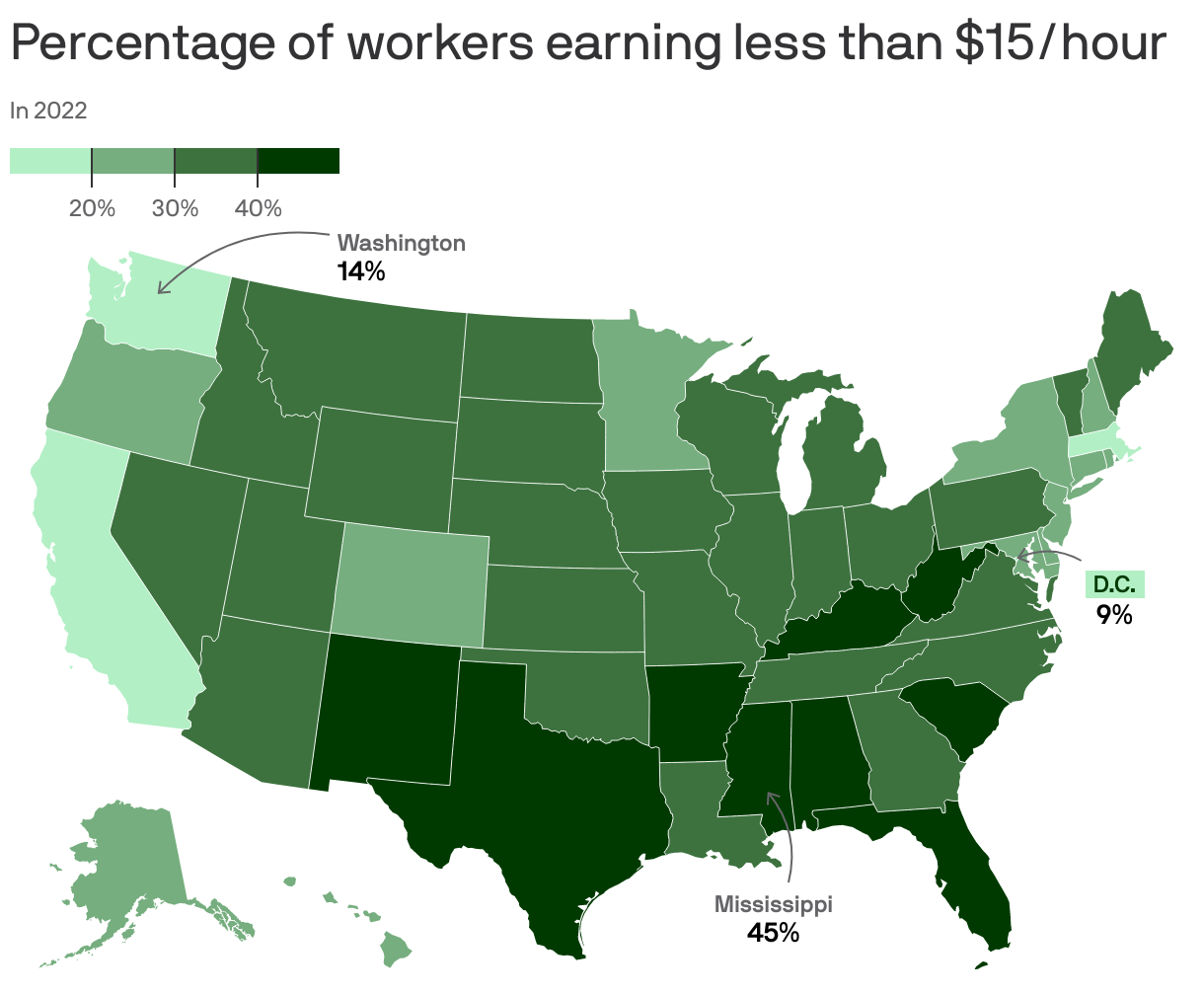
Reproduced from Oxfam America via Census Bureau. Map: Axios Visuals
Axios Local newsletters this week spotlighted this map, based on Oxfam America data aimed at showing where workers would benefit from a raise in the federal minimum wage, which has been $7.25/hour for 13 years.
PocketHealth, a medical image sharing startup, raised $16 million in Series A funding led by Questa Capital to expand its U.S. presence, cofounders Harsh and Rishi Nayyar tell Axios exclusively.
Why it matters: For decades, established tech giants and startups have been striving to shake up the electronic health record (EHR) industry, and recent anti-data-blocking legislation giving patients the chance to access their health information with apps has reinvigorated those efforts.
The Academy of Motion Picture Arts and Sciences launched Wednesday "disciplinary proceedings" against Will Smith and said it asked him to leave the Oscars ceremony after he slapped Chris Rock on stage, but he refused.
Driving the news: Smith apologized to the Academy and fellow nominees for the incident while accepting his Best Actor Oscar on Sunday, and a day later to comedian Rock, who had made a joke about the shaved head of Smith's wife, Jada Pinkett Smith. (She has alopecia, an autoimmune disorder that causes hair loss.)