Disney said on Thursday that it now has nearly 95 million subscribers for its streaming service Disney+, blowing past Wall Street expectations for growth for the company's Q1 earnings.
Why it matters: Disney's streaming success has helped the company offset losses from pandemic-related headwinds to its parks & resorts and studios businesses.
Why it matters: The projection doesn't include President Biden's proposed $1.9 trillion economic stimulus package and could reignite pushback from Republicans who'd prefer a smaller bill.
Chinese regulators banned BBC World News on Thursday, accusing the British broadcaster of a "slew of falsified reporting" on Beijing's coronavirus response and oppression of ethnic minorities in Xinjiang, according to Chinese state media.
Why it matters: The move was widely seen as retaliation against the U.K. after Britain's own broadcasting regulator withdrew the operating license for China Global Television Network, citing its control by the Chinese Communist Party.
The federal minimum wage has been $7.25 per hour since 2009, which works out to just about $15,000 per year at 40-hour weeks, without any vacation days. Congress is now debating an increase to $15 per hour as part of the next round of economic stimulus, but there is plenty of opposition.
Axios Re:Cap digs into the economics and politics of the federal minimum wage, on which it seems everyone has an opinion.
The current stratospheric levels of cryptocurrencies in general, and Dogecoin in particular, can make it a lot easier to spend money.
Driving the news: Another part of the thinking behind the Tesla cryptocurrency announcement is that for someone sitting on a lot of bitcoin, it's psychologically easier to transfer a single bitcoin to Tesla than it would be to try to write a check for $40,000.
Thanks to a quirk of the U.S. payments processing infrastructure, some taxpayers are getting thousands of dollars in cash back on their 2020 tax payments.
How it works: If you write a check to the IRS, you're never quite sure when they will cash it. There's a similar uncertainty if you allow the agency to debit your tax payments directly from your account — you don't know when that will happen. There's a little-known third option, however, which is entirely under the taxpayers' control.
The SPAC boom has acquired a reputation for democratizing investment, without the headline-grabbing volatility of last month's Reddit revolt.
Between the lines: It's a valid characterization. But it's also a complicated one, creating new opportunities for the "little guy" while further enriching those who already had swollen bank accounts.
The New York Times is in the early stages of developing a digital subscription product for families called NYT Kids, executives tell Axios.
Why it matters: Standalone digital subscription products are a key driver of The Times' growth and long-term business strategy. A kids-focused product is a departure from the adult-focused lifestyle apps it previously built, like Cooking and Crosswords.
SAG-AFTRA, the union that represents actors, plans to start representing online influencers as well.
Why it matters: A growing number of online content creators make their living promoting various products on social media. The union says the move will allow people to more easily make a career out of being an influencer and gain access to health care and other benefits.
Large companies' procurement deals for new renewable power capacity in the U.S. jumped last year to their highest level at 10.6 gigawatts, the Renewable Energy Buyers Alliance (REBA) said.
Why it matters: Big corporations have emerged as an important driver of new solar and wind power projects as costs have fallen and they look to meet sustainability pledges.
Hyundai's newly unveiled concept for a "ground excursion robot" operates without a driver — and can reach some very tight corners.
Driving the news: Hyundai said it's designed to access "remote" and "extreme" terrain for uses like delivery of goods, scientific missions, or emergency aid after a natural disaster.
Royal Dutch Shell said Thursday that its oil production peaked in 2019 and is expected to decline by roughly 1%-2% annually as the company diversifies into lower-carbon energy products and business lines.
Why it matters: It signals how some of the world's most powerful oil-and-gas companies are positioning themselves for a world taking climate change more seriously and responding to calls from investors and activists to do more.
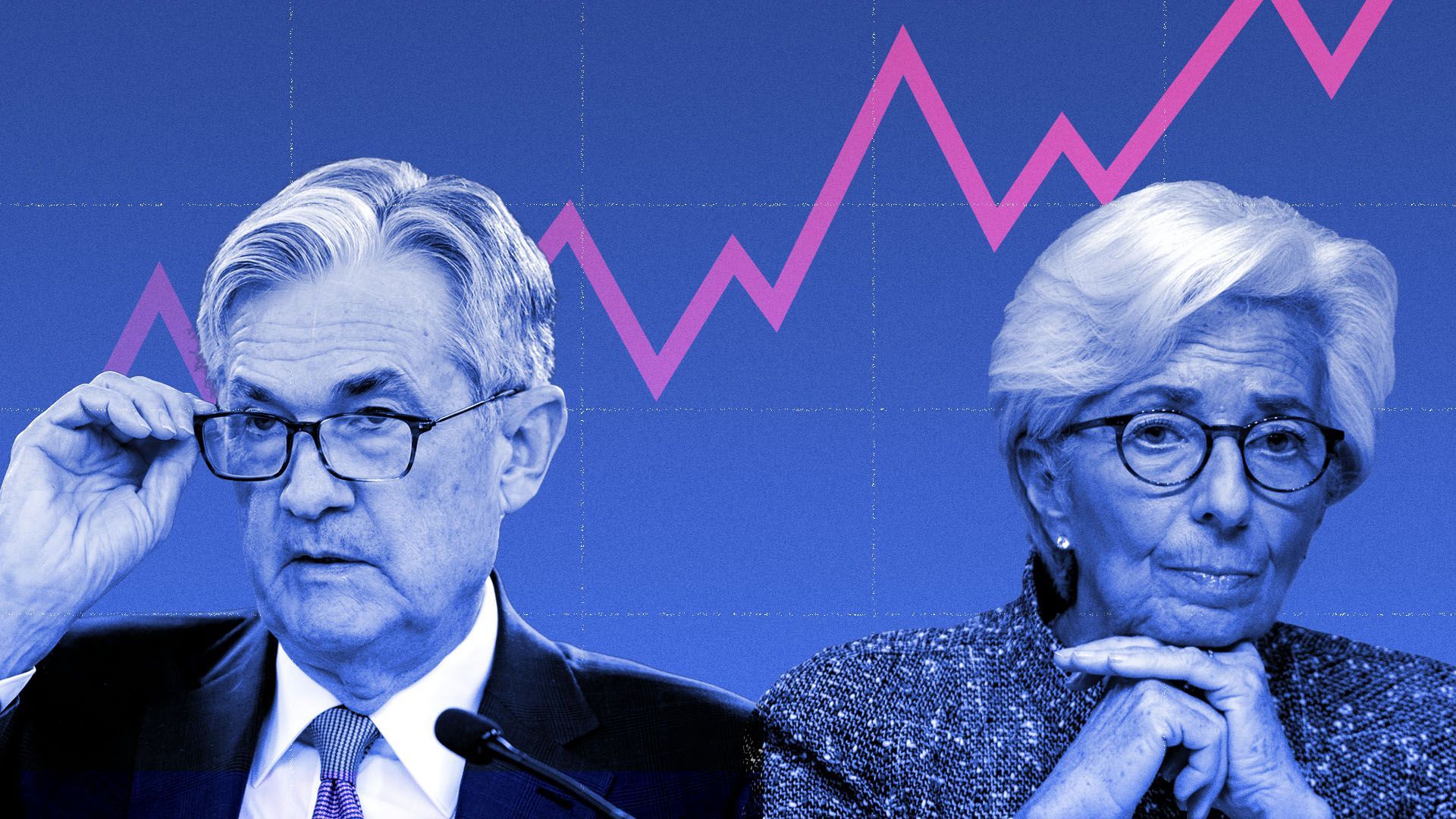
Two of the world's foremost central bankers reinforced their positions on the potential for damaging inflation in the wake of the coronavirus pandemic on Wednesday, saying in no uncertain terms that they simply don't see it.
Why it matters: This is exactly what former Treasury Secretary Lawrence Summers warned about in his recent op-ed in the Washington Post, citing the potential for "inflationary pressures of a kind we have not seen in a generation, with consequences for the value of the dollar and financial stability."
Prices for Chinese consumers in January declined by 0.3% from last year, while prices for producers, or businesses, rose by 0.3%, data showed.
Why it matters: Rising prices for producers in China, the world's No. 1 trading nation, are often the result of increasing commodity costs and typically mean prices will rise for the rest of the world.
Shares of medical cannabis company Tilray soared for the third straight day on Wednesday, jumping by 50.9% after a gain of 40.7% on Tuesday and 17% on Monday.
The big picture: While the entire cannabis sector is flying high thanks to expectations of U.S. legalization under President Biden, companies like Tilray and GW Pharmaceuticals, which are making major deals and acquisitions, are seeing their stock price soar to stratospheric levels.
Cities are rushing to replace their legacy streetlights with "smart" LED fixtures that could one day be able to find you a parking space, monitor air quality, and announce an oncoming thunderstorm.
Why it matters: Despite a bumpy and controversial start to some smart streetlight programs, cities are saving tons of money on energy by banishing traditional bulbs — and may soon be able to turn a profit by monetizing data from smart LED sensors or leasing space on light poles.
As Uber and Lyft look into 2021, both companies pointed to driver supply as a possible challenge when ride-hailing demand picks up again.
Why it matters: The companies delivered their 2020 Q4 earnings this week, with mixed results, and are hoping vaccination will boost their recovery later in the year as more people start to take rides again.
Can too much federal spending cause the economy to overheat? And is that a real risk of the Biden administration's $1.9 trillion economic rescue plan? The consensus answers to those questions are yes and no, respectively.
Why it matters: Fear of inflation has emerged as the single biggest reason for Democrats and Republicans to oppose the latest round of stimulus. For the time being, however, most economists expect that inflation will remain subdued, even if the full package is enacted.
President Biden is considering nominating Lisa Cook, an economist at Michigan State University, to fill an open seat on the Federal Reserve Board, people familiar with the matter tell Axios.
Why it matters: The appointment would be historic, since Cook would be the first Black woman to join the Fed. It also would reveal the new president's preferences for monetary policy and how he may reconstitute the Fed, including the chairmanship.







/2021/02/11/1613069308684.gif?w=3840)






/2021/02/11/1613055682855.gif?w=3840)