The State Department lifted its international travel advisory on Thursday, roughly four months after warning Americans not to fly abroad due to the coronavirus pandemic.
The big picture: American travelers are still barred from traveling to numerous countries, including European Union member states, because the U.S. has yet to control the spread of the virus.
Each day that goes by without a COVID-19 stimulus agreement is another day of worry for many in America's middle class, which was already shrinking before the pandemic began.
Axios Re:Cap digs into middle class myths and realities with Jim Tankersley, a New York Times economics reporter and author of the new book, "The Riches of This Land."
The extremely rich tend to think very highly of themselves, and of their ability to bend the world to their will. So when they start giving their money away, they tend to retain maximum control.
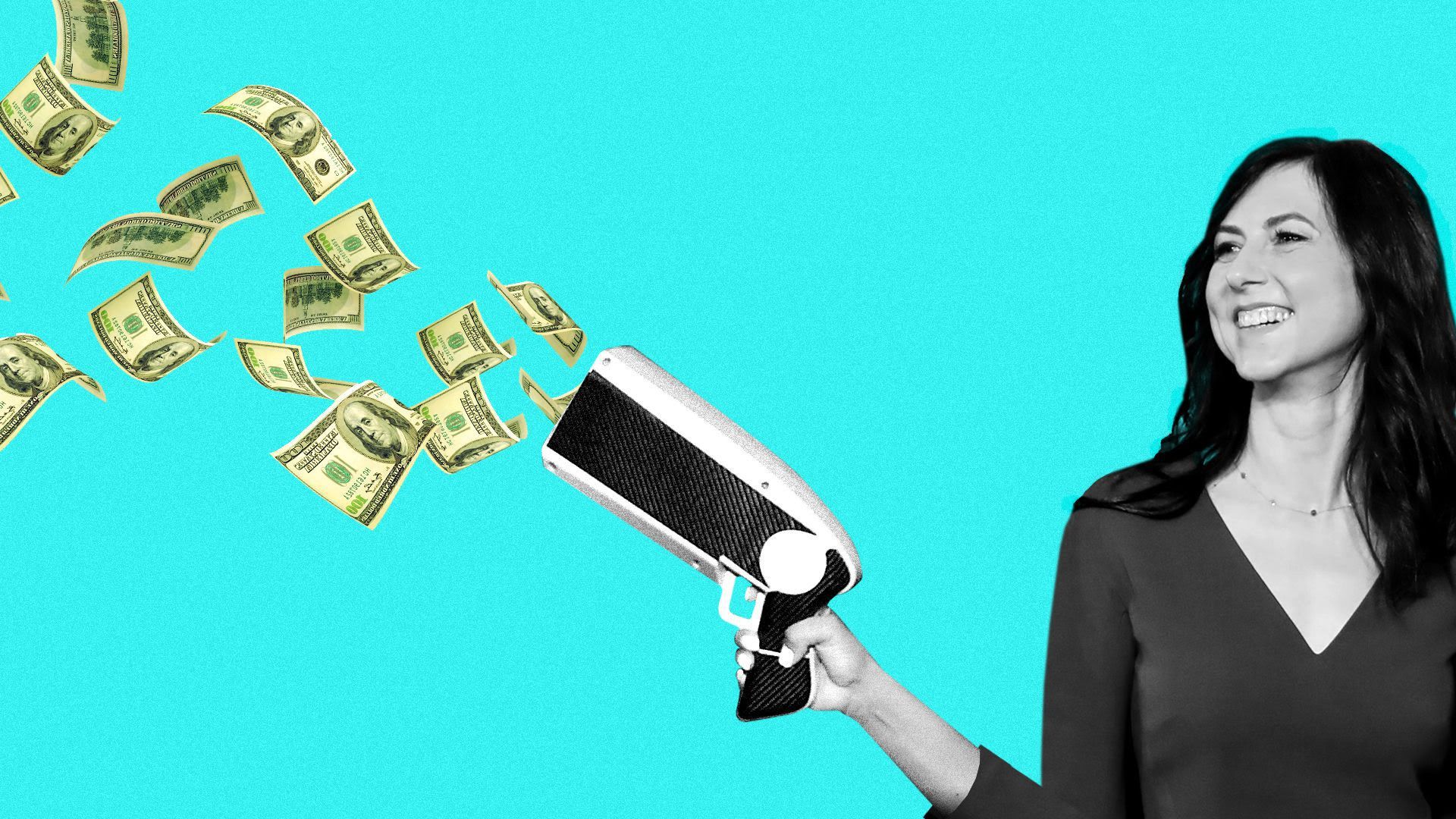
Why it matters: MacKenzie Scott, the ex-wife of Amazon founder Jeff Bezos, is worth about $60 billion. She pledged to give away substantially all of that money after she gained autonomy over her own wealth. Judging by her first 116 grants, she's doing so in a refreshingly radical — and humble — manner.
Small investors are playing a larger role in the stock market than at any time this century.
The big picture: Whatever the reason for small investors' rise — lots of free time thanks to the pandemic, zero-dollar commissions, addictive and gamified apps, enticing volatility — retail investors have become a driving force behind many individual stocks and maybe even the market as a whole.
The pandemic has been very good for health insurers — largely because they don't need to pay for procedures that haven't been happening.
By the numbers: The value of health care services performed in America in the second quarter plunged to $1.69 trillion, from $2.26 trillion in the fourth quarter of 2019. The unprecedented drop was enough on its own to account for 9.5 points of the 32.9% annualized fall in second-quarter GDP.
The travails of TikTok are the most visible example of how the rapidly deteriorating relationship between the U.S. and China can evaporate tens of billions of dollars of corporate value.
Why it matters: When corporations find themselves at the mercy of politicians flexing their geopolitical muscles, they generally end up ruing the encounter.
More farmers are declaring bankruptcy, despite a $7 billion injection from the Department of Agriculture to mitigate losses caused by the coronavirus pandemic, the Wall Street Journal reports.
Why it matters: Farmers found themselves at the center of industries hardest-hit by the crisis as the pandemic slashed commodity values, cut off supply chains and closed markets around the globe.
Varo Money, one of many upstart challenger banks, received its bank charter effective Aug. 1.
Why it matters: The benefits for Varo Bank (as it can now officially be called) are obvious. Varo now controls its own deposits, and can use them to fund loans; it also has a lot more freedom to innovate, now that it doesn't need to work within a partner bank's APIs.
Twitter will begin labeling accounts belonging to state-affiliated media outlets from countries on the U.N. Security Council, it announced Thursday.
The big picture: The new policy will affect “outlets where the state exercises control over editorial content” in China, France, Russia, the U.K., and the U.S., according to the announcement.
The technology sector increasingly underpins the U.S. economy, with signs of its growth becoming more woven into local economies far outside iconic innovation hubs like Silicon Valley and New York.
Why it matters: A new district-by-district report out today from the Information Technology Industry Council makes the case that an economy infused with high-tech workers, startups and exports is a more resilient one, with higher wages and productivity.
What's new: Drilling into the data by congressional district yields some surprising findings:
The average congressional district now has about 400 high-tech startups employing around 3,400 workers.
Texas and Florida are home to four times the number of high-tech startups as the average U.S. state.
In Alabama, startups make up 16% of high-tech employment — the highest share in the country.
In Vermont, high-tech manufacturing exports make up 5.5% of the state economy — the largest share in the country.
"There is demand for skilled STEM workers, there is demand for public R&D funding, and even for high-tech startups in states across the country — not just in states we hear so much about," said ITI President and CEO Jason Oxman. "Companies are looking for opportunities to find good people in new geographies."
Yes, but: Despite shoots of green sprouting up across the country, many districts are still struggling to find a solid foothold.And there's concern that the COVID-19 pandemic will stunt some areas' tech-related growth even more.
For example, the Heartland region lags far behind coastal markets when it comes to attracting entrepreneurs and startups, according to a May report from Heartland Forward.
This is where skilled workers are key: "Knowledge-intensive young firms have a higher probability of achieving middle-market status where they can generate rapid job gains for their communities," per Heartland Forward.
The ITI data shows a strong correlation at the district level between employment in computer and math occupations and employment in science and engineering occupations — indicating that a density of high-skilled labor makes a region more attractive for skilled workers in other sectors.
This can impact wages.
In the median congressional district, average annual wages for high-tech workers in the median state were nearly $79,000. That's more than double the median U.S. personal income, which is around $31,000 annually.
There's a clear correlation at the congressional district level between the prevalence of high-tech and STEM workers and federal R&D funding, ITI's data analysis found.
The catch: The decades-long slide in public R&D funding has accelerated since 2009, according to the Information Technology & Innovation Foundation, which analyzed the numbers last year.
As of last summer, the federal government invests about $125 billion per year in R&D on everything from agriculture to manufacturing to energy. But that investment as a share of overall U.S. GDP has continued to decline. Meanwhile, countries including China have increased this spending.
By the numbers: In the last two fiscal years, 250 out of 435 congressional districts got at least $50 million in federal R&D funding.
14 states did not get any public R&D funding.
The bottom line: The tech economy isn't a one-size-fits-all proposition, and regions should build on their strengths.
Smaller markets have managed to capture pieces of the innovation infrastructure needed to drive high-tech ecosystems, but many have a long way to go.
"It is really important for states and congressional districts to focus on what they're good at and not try to be the next San Francisco," Oxman said.
Rocket Companies, a Detroit-based mortgage lender operating under the Rocket Mortgage and Quicken Loans brands, raised $1.8 billion in an IPO that had been expected to raise upward of $3.3 billion.
Why it matters: This was a stunning flop, or at least so far as any $1.3 billion IPO can be deemed a flop. Not only because it came amidst a broad-based IPO surge, but also because it followed the IPO overperformance from insurance upstart Lemonade.
Last month I wrote that SPACs are the new IPOs. But I may have understated it, because SPACs are also becoming the new private equity.
By the numbers: Short for "special purpose acquisition company," SPACs have raised $24 billion so far in 2020, with a loaded pipeline of upcoming offerings. U.S. buyout firms raised nearly $102 billion through the end of June — a much larger amount, but not so much larger that the two can't play on the same field.
Apple's market cap is screeching toward $2 trillion, less than a year after rising above the $1 trillion mark again in September 2019.
What happened: The company first gained 13-figure status in early August 2018 but saw its valuation sink to a mere $709 billion following the market downturn of late 2018.
Even if Friday's jobs report shows a big number, it is becoming clear hiring slowed and likely even reversed course in July and real-time indicators suggest the employment situation worsened into August.
Driving the news: Payroll processor ADP's monthly jobs report showed private companies added 167,000 jobs last month, well below the 1.2 million expected by economists and far below June's 4.8 million jobs added.
Call it the great retail wash. A wave of defaults, bankruptcies and evictions expected in cities across the U.S. is poised to remake the retail landscape across the country, but there may be some upside for consumers and small businesses.
Why it matters: Rather than an overnight descent into a collection of urban wastelands full of Starbucks, Amazon fulfillment centers, Chase bank branches and nothing else, the coronavirus pandemic and resulting retail apocalypse may just mean that, in major U.S. cities, less is more.
Uber has agreed to acquire U.K.-based taxi and private for-hire car technology company Autocab, the two said Thursday.
Why it matters: The acquisition should help Uber expand to U.K. markets where it doesn't currently operate by enabling its customers to book cars available through Autocab, though the latter will remain largely independent.
Phin Barnes, a general partner at First Round Capital, is leaving the firm. There's no word yet on his next professional move, though he will remain a board partner at First Round.
Why it matters: Barnes is the latest partner at the firm, known for seeding companies like Uber and Square, to step back. Rob Hayes and Chris Fralic made similar moves in 2018. Barnes joined the firm in 2008 as a summer apprentice.