Uber beat revenue expectations in the first quarter but faced heavy losses stemming primarily from write-downs as it girded for the full impact of the coronavirus pandemic, the company reported Thursday.
Why it matters: Uber is among the companies significantly impacted by measures to curb the current virus spread as people stay home as much as possible, though its food delivery business is seeing a huge boost for the same reason.
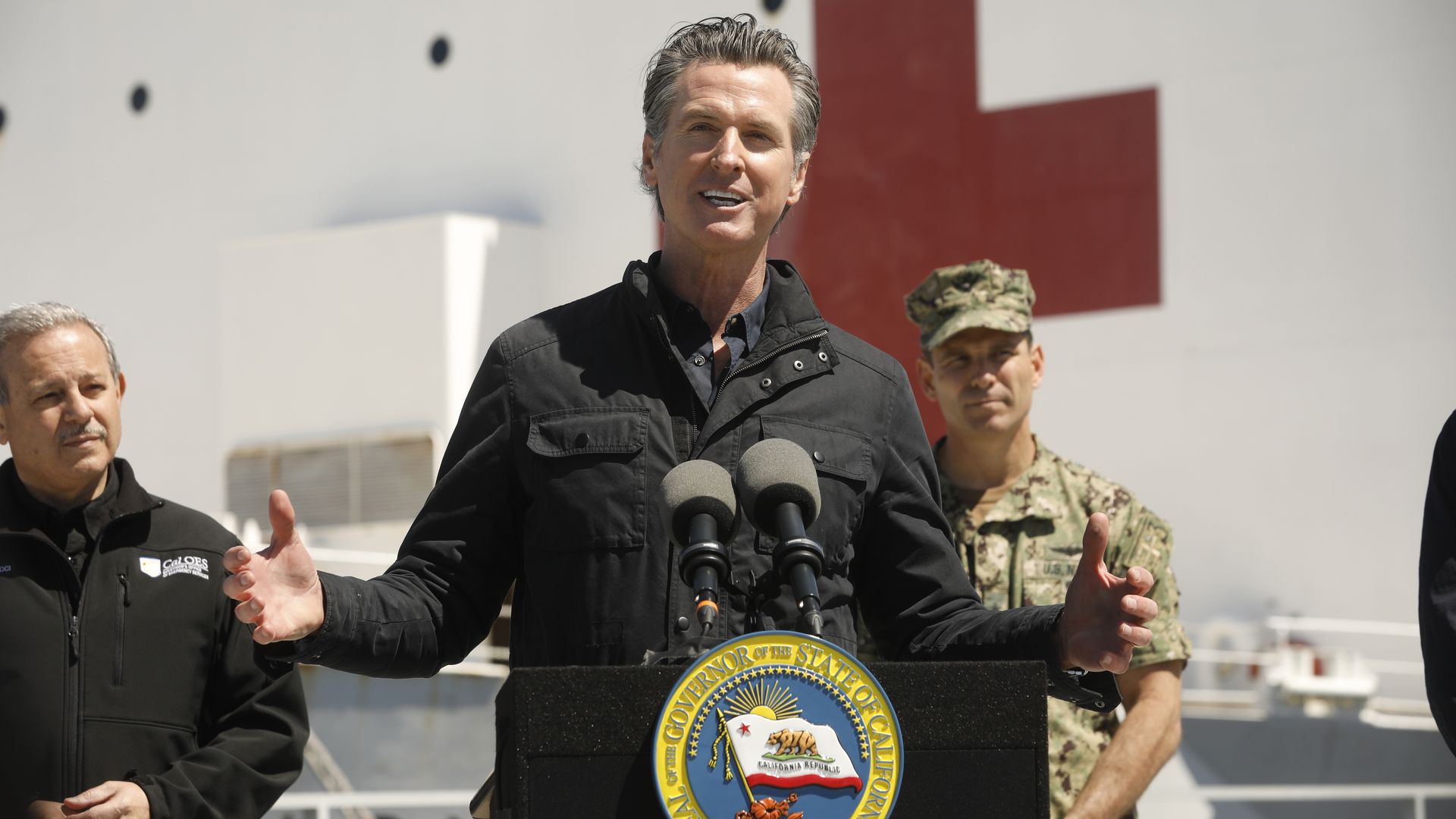
California projects it will face a $54.3 billion deficit as a result of the economic damage caused by the coronavirus, Gov. Gavin Newsom’s administration announced Thursday.
Why it matters: It's a sign of the massive economic devastation caused by the coronavirus and the stay-at-home orders that have followed, especially when compared to the $21 billion surplus that California ran a year ago, per CNBC.
When Jeffrey Epstein was barred from donating money to MIT, a university development officer suggested that "the Leon Black route" be used instead. As I reported back in September, Epstein engineered donations to MIT from Black, the chairman and CEO of private equity giant Apollo. Now it looks like he did something very similar at Harvard.
Driving the news:Harvard's official report on its Epstein connections has now been published, showing how professor Martin Nowak was funded after Epstein was convicted of sex crimes in 2008.
Most people should and will accept free money from the government whenever it's offered. The CARES Act was designed to funnel trillions of dollars into workers' bank account and was written with the expectation that few people or businesses would say no to such a gift. Then the messaging changed.
Why it matters: Politicians lost no time in ratifying the anger and resentment aimed at some of the recipients of government-backed funds. The result has been a slew of businesses voluntarily rejecting government assistance.
Forgoing public funding is a lot easier if you can tap private markets to get the money — which is exactly what a lot of troubled companies have been able to do.
Why it matters: In the early days of the crisis, while markets were plunging, strong companies borrowed billions of dollars in cash just because they could. Now, with markets looking much healthier, weaker companies are finding themselves able to issue new debt and equity in an attempt to avoid bankruptcy.
Sidewalk Labs, the urban tech segment of Google parent Alphabet, is pulling out of its long-planned smart city project for Toronto's waterfront, citing "unprecedented economic uncertainty."
Why it matters: The move suggests pursuing futuristic transformations may take a back seat as already strapped cities focus their resources on managing the coronavirus pandemic and its economic impact.
The April jobs report comes tomorrow. It will be almost incomprehensibly grim.
Why it matters: The report will tell us a lot of what we don't know about the coronavirus-ravaged job market: how widespread the job losses are by industry and demographic, how many layoffs are temporary, and whether worker pay has been cut.
The XFL has launched a Hail Mary to find a new owner, one month after the filing for Chapter 11 bankruptcy protection.
Driving the news: Investment bank Houlihan Lokey is managing the process, with letters of intent due by June 12, according to a pitch deck obtained by Axios. Formal bids are due on July 6.
Liberty Global (Nasdaq: LBTYA) agreed to merge its Virgin Media broadband provider with Telefonica's (Madrid: TEF) O2 wireless carrier in a deal that would value the combined company at around $38 billion.
Why it matters: It's the largest U.K. telecoms deal in years, and creates a viable rival to market leader BT.
Another 3.2 million Americans filed for unemployment last week, the Labor Department said Thursday.
Why it matters: Jobless claims have swelled to roughly 33.5 million in the past seven weeks since coronavirus-driven lockdowns began — and, even as states begin to open back up, workers are still losing their jobs at a staggering rate.
Federal Reserve Bank of Dallas President Robert Kaplan told Yahoo Finance Wednesday that he expects a substantial number of bankruptcies in the U.S. oil sector despite the recently expanded access to Fed's Main Street Lending Facility.
How it works: "[T]hat program will be designed for companies that would be already be creditworthy," said Kaplan, whose district has a large number of energy companies.
U.S. pension plans already were above their target allocation to fixed income before the coronavirus pandemic, and the outperformance of fixed income during the first quarter has further shifted the tide, a new report from eVestment shows.
Why it matters: Fewer people are participating in the stock market's gains and losses.
In the short term, the coronavirus pandemic is reducing global emissions and helping clear out smog around the world, but it may end up doing more damage to the environment in the long term.
The big picture: The pandemic is helping reduce the use of fossil fuels, but it is decreasing investments in things like wind and solar power and financial assets like green bonds, says Jessica Ground, global head of stewardship at Schroders.
"The monetary policy response to COVID-19 has been massive," Bank of America Global Research analysts write in a recent note to clients.
What's happening: Led by the Federal Reserve, which has added $2.5 trillion to its balance sheet in less than two months, all of the world's major central banks have taken extreme policy action.
With U.S. sports nearly two months into their indefinite hiatus, leagues have finally begun updating their ticket refund policies, directing teams to decide for themselves how they'd like to proceed.
Why it matters: This should give fans struggling financially amidst the pandemic a clearer path towards recouping cash in the short term.
U.S. stocks fell sharply in the final hour of trading Wednesday after President Trump seemingly reignited the trade war, telling reporters the U.S. would be evaluating whether China has complied with the "phase 1" trade deal to buy an extra $200 billion a year of U.S. goods.
Why it matters: As the coronavirus pandemic continues to choke the U.S. and global economy, Trump is threatening to tighten the vice.
Now that the federal government is allowing the emergency use of remdesivir for coronavirus patients, and as the world awaits final clinical data on the drug's effectiveness, a giant question looms: What will the price be?
Why it matters: Gilead's pricing decision is important on its own, but it also will set the bar for how all coronavirus treatments that come after remdesivir will be priced.







/2020/05/07/1588860889996.gif?w=3840)