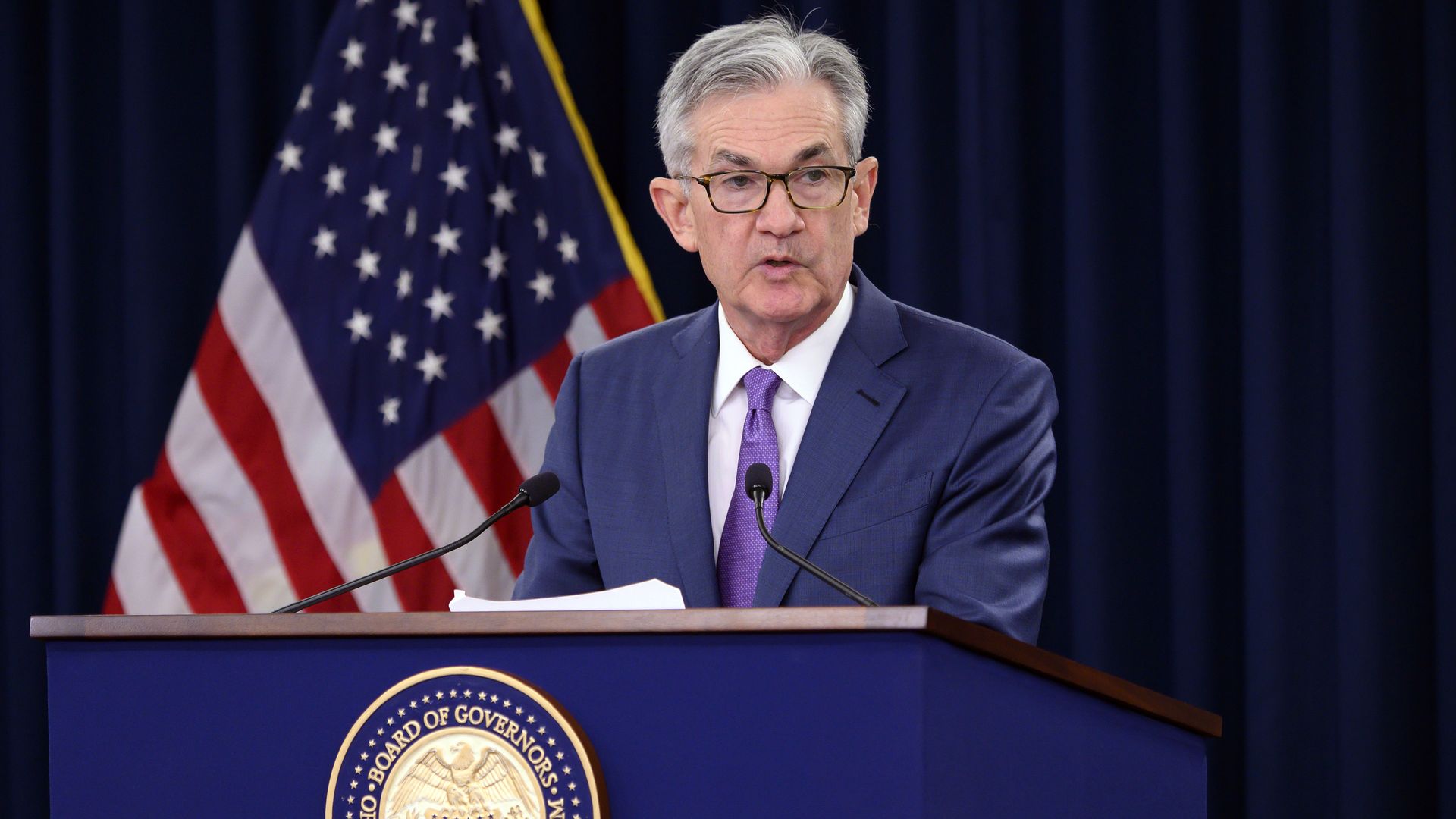
Speaking on a panel in Zurich on Friday, Federal Reserve chairman Jerome Powell remained optimistic about the state of the U.S. economy — including the labor market, despite the morning's softer-than-expected jobs numbers. Still, he hinted that another interest rate cut could be coming later this month.
Why it matters: Powell said the Fed is not "forecasting or expecting a recession," but noted there are significant risks, including slowing global growth and uncertainty around trade policy which is "causing companies to hold back on business investment decisions." Powell also said that lowering "the expected path of interest rates" has also supported the U.S. economic outlook.
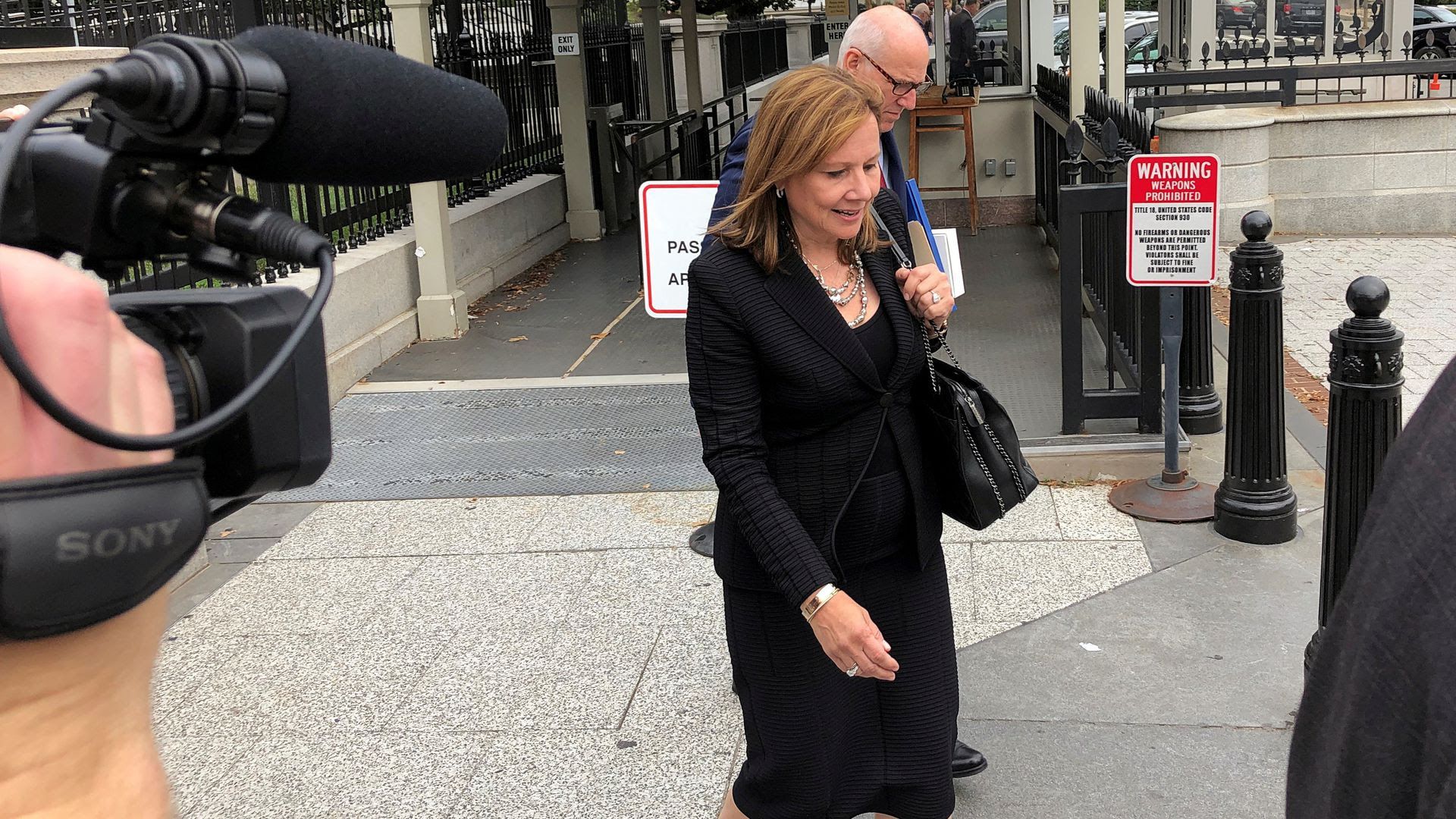
GM CEO Mary Barra paid a visit to the Oval Office Thursday, no doubt an awkward meeting after the pounding the automaker has taken from President Trump on Twitter lately.
The big picture: GM is facing intense pressure from the White House to bring jobs back from China and Mexico after announcing plans to idle 4 U.S. factories in important swing states.
There is lots of WeWork IPO buzz after the WSJ reported that the company may go public at a valuation at less than half its most recent private mark of $47 billion.
Driving the news: It also revealed that CEO Adam Neumann recently met in Tokyo with SoftBank CEO Masayoshi Son to discuss either a cornerstone IPO investment or a private capital infusion that would allow WeWork to delay its IPO until next year.
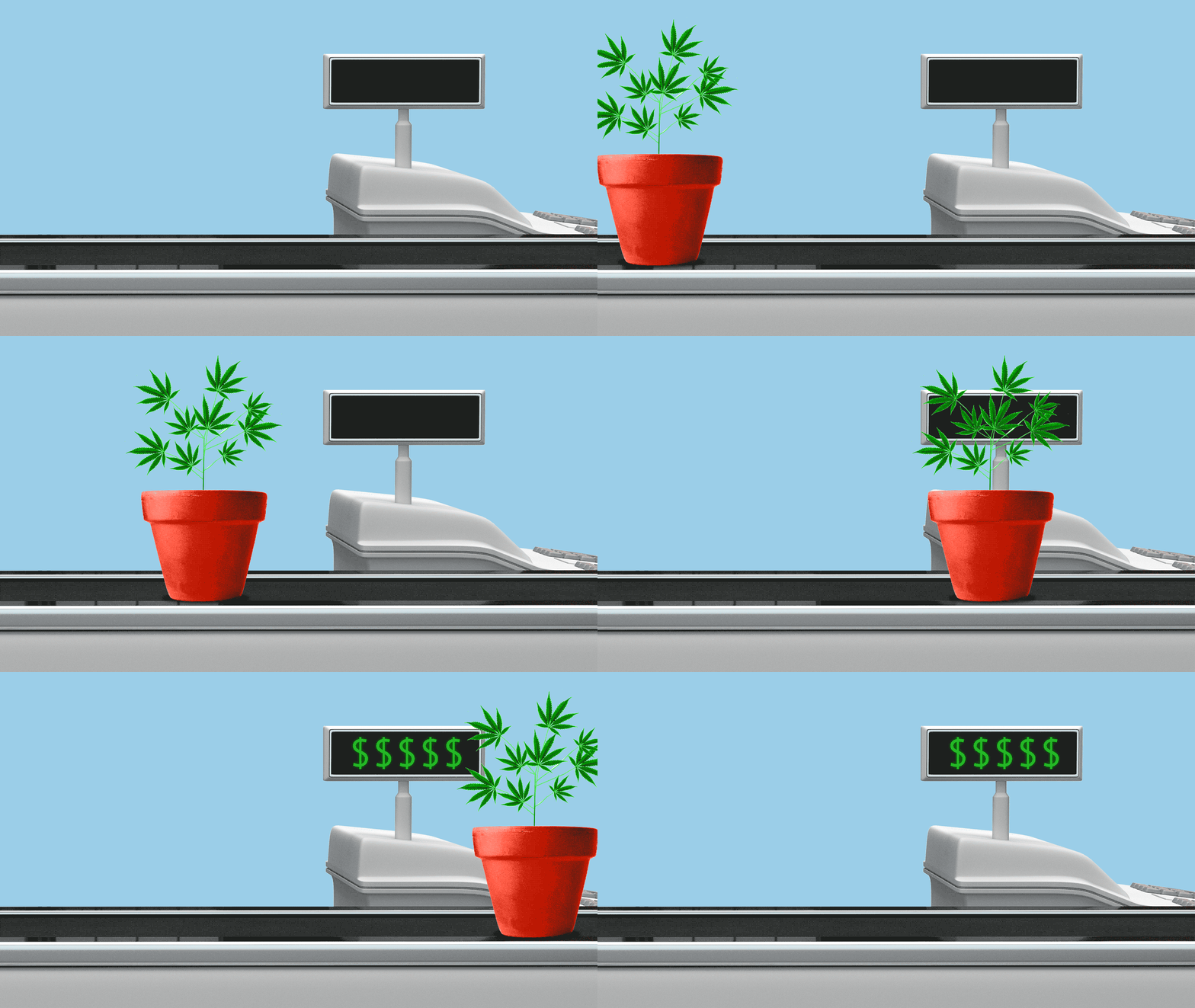
Brendan Kennedy, the head of one of the world's largest cannabis investment firms, says he's mostly seeing recycled business plans but believes the industry's next phase of startup innovation will be around everyday products sold by mainstream retailers.
Thesis: Kennedy says that Cannabis 1.0 related directly to the flower, while Cannabis 2.0 was about beverages. He believes Cannabis 3.0, which is just beginning, will be in all sorts of consumables (shampoos, lotions, cookies, etc.) that will sit alongside more "traditional" versions at places like Walgreens and Target.
The U.S. economy added 130,000 jobs in August — less than the 150,000 economists expected — while the unemployment rate held at 3.7%, the Labor Department said on Friday.
Why it matters: The slowdown could be the first sign that companies may be beginning to pull back on hiring, after the economic uncertainty from the U.S.-China trade war that's put a dent in business spending.
U.S. companies issued $74 billion of investment-grade bonds this week, between Tuesday and Thursday, the most for any comparable period since records began in 1972, Bloomberg reported on Thursday. That nearly doubled the previous record of $40 billion set in 2013.
What happened: Issuers were able to sell into a historically thirsty market, with 30-year bonds from companies like Disney, Deere and Apple carrying record low coupons, and investment-grade bond yields dropping to a 3-year low of 2.77%.
Big tech companies like Google and Facebook, as well as newer direct-to-consumer (DTC) tech upstarts like Away and Peloton, are driving advertising growth for legacy industries, like traditional television and out-of-home (billboard) companies.
Why it matters: The very industry that's upending legacy media companies is also the one that's keeping their ad businesses afloat.
CEOs, central bankers and money managers say they're operating in a world where they have no idea what's coming next, leaving them with few options but to prepare for the worst.
Why it matters: Uncertainty about a handful of unprecedented phenomena — like the grinding trade war with China, the peripatetic Brexit debate, and President Trump's government-by-tweet — is inflicting pain on the global economy.
CVS and Walgreens both announced Thursday that they are asking customers to no longer openly carry firearms in their stores.
The big picture: The changes follow a mass shooting last month that killed 22 at a Walmart in El Paso, Texas. Earlier this week, Walmart ended sales of ammunition for handguns andshort-barrel rifle ammunition that can be used with military-style assault weapons. Walmart also asked customers to no longer open carry in their stores, which was followed by a similar request by Kroger earlier this week.
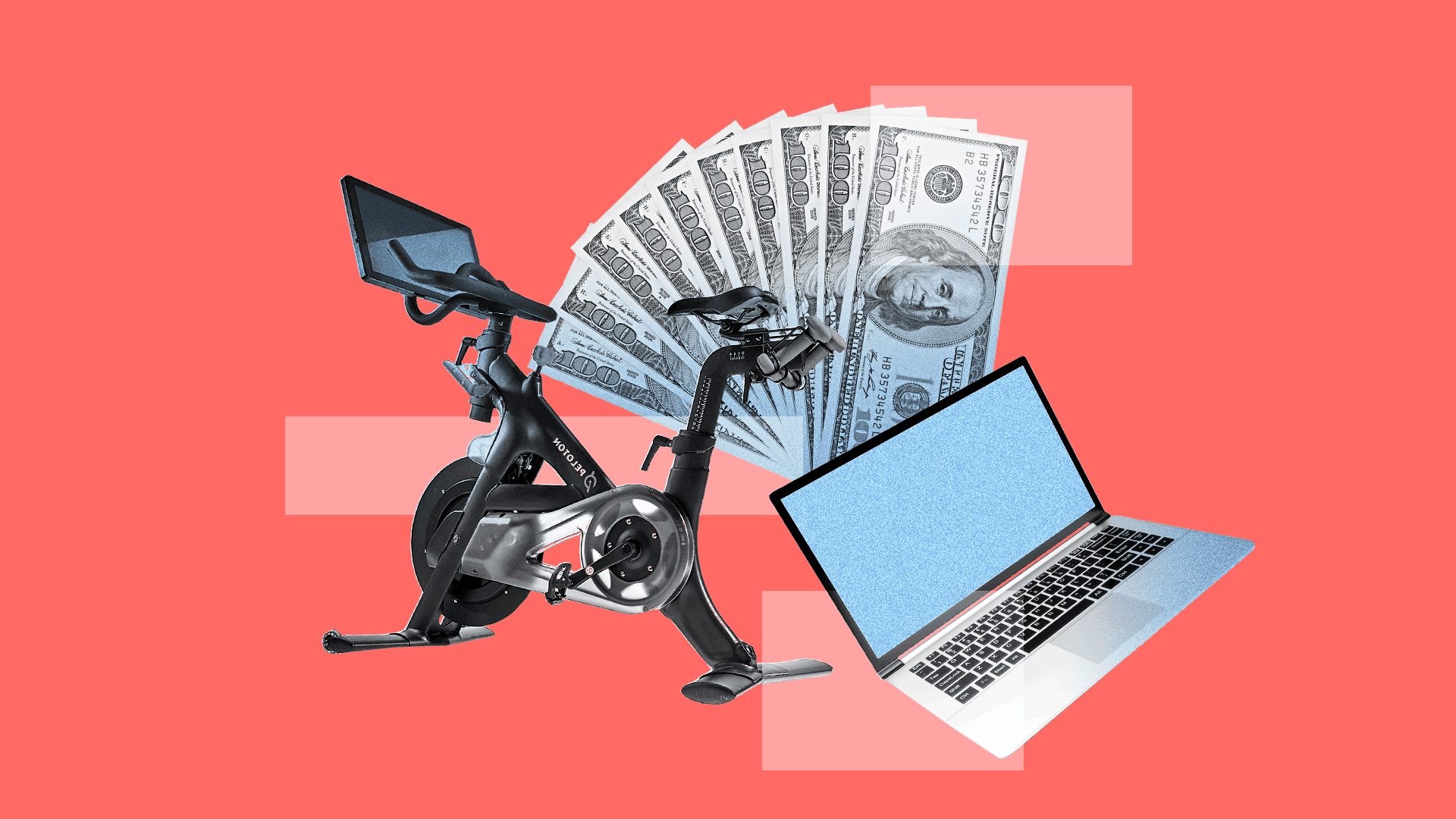
Apparently investors love to read IPO prospectuses in August, because both Peloton and WeWork unveiled their S-1 filings last month.
The big picture: The two companies are similar in that they both spend a lot of money on sales and marketing, which they then attempt to recoup over time with monthly payments from their customers.
We've all pulled out folding chairs to watch the post-Labor Day IPO parade. In particular, the floats from high-fliers like WeWork, Peloton, Cloudflare, DataDog, and SmileDirectClub.
Yes, but: Perhaps the most interesting IPO will take place 4,400 miles south of New York, in the tiny South American country of Guyana. The issuer is Pomeroon Trading, an upstart coconut and spice farm co-founded by a Stanford Business School graduate named Duncan Turnbull.
The private sector added 195,000 jobs in August, surpassing economists' expectations of 140,000 jobs, according to a report released Thursday by ADP and Moody's Analytics.
Why it matters: The labor market — largely viewed as the steadiest part of the economy — appears to remain intact. The ADP report, which doesn't include government jobs, is viewed as as a tee-up of what's to come from the official jobs release from the Bureau of Labor Statistics on Friday.
Walmart's decision earlier this week to stop all sales of handgun and short-barrel rifle ammunition — as well as prohibiting open carry in its stores — was met with positive reviews on Wall Street, where its stock climbed more than 1% on Wednesday, and data suggests it may have more room to run.
By the numbers: Research firm CivicScience's survey of 1,986 U.S. adult Walmart shoppers found that under the open carry changes, 29% are more likely to shop in Walmart stores and 22% are "much more likely" to shop there.
Fears of a global recession are scaring U.S. companies, pushing them to use excess capital to reduce debt and add to cash reserves, rather than levering up and making risky bets as they have in the past.
Why it matters: This newfound corporate responsibility, motivated largely by fear, could help insulate the economy from another damaging recession.
The majority of U.S. adults in a new poll by Edelman Intelligence would feel more favorably toward a company whose CEO backs tougher background checks for gun purchases.
Why it matters: CEOs traditionally were reluctant to wade into polarizing issues, but they face pressure from shareholders, employees and customers to show their values.
A new report funded by the American Hospital Association claims hospital mergers result in better care and savings for patients. But every other independent study shows the exact opposite — that hospital mergers lead to less competition and higher prices.
Why it matters: Hospitals represent the largest chunk of U.S. health care spending. And hospitals are acquiring more market power and commanding higher prices — bills that every American pays for in some part.
China’s Commerce Ministry said in a statement Thursday that its trade representatives will fly to Washington, D.C., in early October to resume stalled trade talks with the United States, the Washington Post reports.
Why it matters: Per Axios' Neal Rothschild, President Trump's trade war has led to bigger trade deficits with China, even though it was intended to improve the trade balance. It's dented consumer sentiment, and the International Monetary Fund has said the prolonged trade tensions were weighing down the global economy.




/2019/09/06/1567769421722.gif?w=3840)









/2019/09/04/1567629311793.gif?w=3840)