The United Steelworkers (USW) union on Monday ripped U.S. Steel and its proposed acquirer, Nippon Steel, for agreeing to a $15 billion deal without its approval.
Why it matters: The USW's responsesets the stage for a fight over the transaction. The union has said previously that its contract with U.S. Steel requires any prospective buyer to agree to a new labor deal before a sale can be finalized.
Driving the news: On Monday,Japan-based Nippon announced a deal to acquire U.S. Steel — an iconic American company that powered the nation's building boom in the 1900s, but later became a symbol of industrial decline.
However, the deal is likely to attract tough regulatory scrutiny, especially given the prospective buyer is not US-based.
Anti-trust scrutiny is not a concern "because they have very little footprint in North America," CFRA Research's Matthew Miller tells Axios.
But, he adds, the deal could face scrutiny from the U.S. government over the fact that a foreign company would be acquiring critical American assets.
What they're saying: USW President David McCall hammered the deal as "greedy" and "shortsighted" and pledged to "exercise the full measure of our agreements to ensure that whatever happens next with U.S. Steel, we protect the good, family-sustaining jobs we bargained."
"Neither U.S. Steel nor Nippon reached out to our union regarding the deal, which is in itself a violation of our partnership agreement that requires U.S. Steel to notify us of a change in control or business conditions," McCall said.
"Based on this alone, the USW does not believe that Nippon understands the full breadth of the obligations of all our agreements, and we do not know whether it has the capacity to live up to our existing contract."
He also criticized U.S. Steel for arranging a deal to "sell to a foreign-owned company."
Flashback: Earlier this year, U.S. Steel rejected a bid by U.S.-based Cleveland-Cliffs, and said it would explore strategic alternatives.
Potential rival bids by Esmark and ArcelorMittal never came to fruition after the USW said it had transferred its bidding rights to Cleveland-Cliffs.
The Cleveland-Cliffs deal also faced opposition from the auto industry, one of the steel sector's biggest clients.
The other side: Representatives from U.S. Steel and Nippon Steel did not immediately respond to Axios' requests for comment on the USW's statement.
The big question: Whether U.S. Steel get this deal across the finish line amid opposition from the USW and political scrutiny.
2024 "is a presidential election year, and this is going to be a political lightning rod," Miller says. "You don't want to be on the wrong side of that."
Years before Ozempic became all the weight loss rage, two private equity firms bought a commercialized anti-obesity drug out of bankruptcy and formed a new company around it called Currax Pharmaceuticals.
Driving the news: Tennessee-based Currax now is locked in an unusual fight with European regulators, and alleging a possible conflict of interest that's tied to Ozempic.
Adobe and Figma have terminated their $20 billion merger agreement, the companies announced on Monday, citing regulatory hurdles that the two companies could not overcome.
Why it matters: The agreement to combine the two design software giants shows that the antitrust regime in both the U.S. and abroad continues to loom heavy over corporate acquisitions.
Flashback: The California companies announced the deal in September 2022 as a mix of cash and stock. Publicly traded Adobe agreed to buy privately held Figma. Regulatory scrutiny surrounded the agreement from the start.
What they're saying: "Adobe and Figma strongly disagree with the recent regulatory findings, but we believe it is in our respective best interests to move forward independently," Adobe CEO Shantanu Narayen said in a statement on Monday.
"It's not the outcome we had hoped for," Figma CEO Dylan Field said in a separate statement, "but despite thousands of hours spent with regulators around the world detailing differences between our businesses, our products, and the markets we serve, we no longer see a path toward regulatory approval of the deal."
The companies said that there is no clear path to receive necessary regulatory approvals from the European Commission and the UK Competition and Markets Authority.
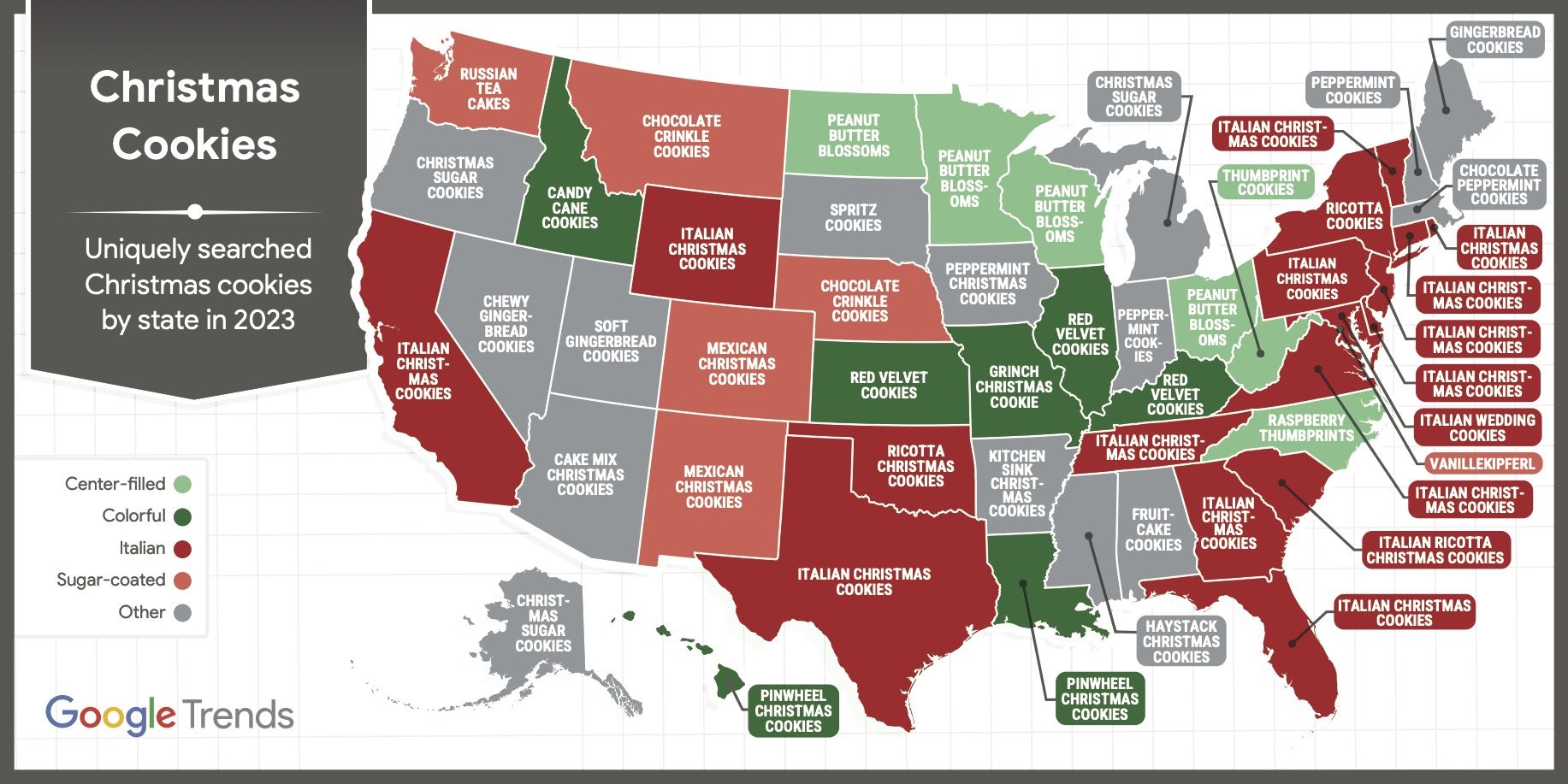
Google Trends Christmas cookies map shows each state's most searched for cookie. Illustration courtesy of Google
America's most popular Christmas cookies for 2023 are a festive mix of cultural and colorful varieties, according to Google Trends data.
Why it matters: Buying or baking Christmas cookies to serve at holiday celebrations — or to leave for Santa — is a longstanding tradition for many families.
An insurance brokerage called USI borrowed $600 million from investors in the high-yield bond market last week.
Why it matters: It's Wall Street's first bond deal with a "CCC" credit rating since all the way back in April, per Pitchbook LCD. The CCC designation is the worst, most risky rating — and the market for these bonds has been effectively dead.