What we know about Trump's medical history


Add Axios as your preferred source to
see more of our stories on Google.
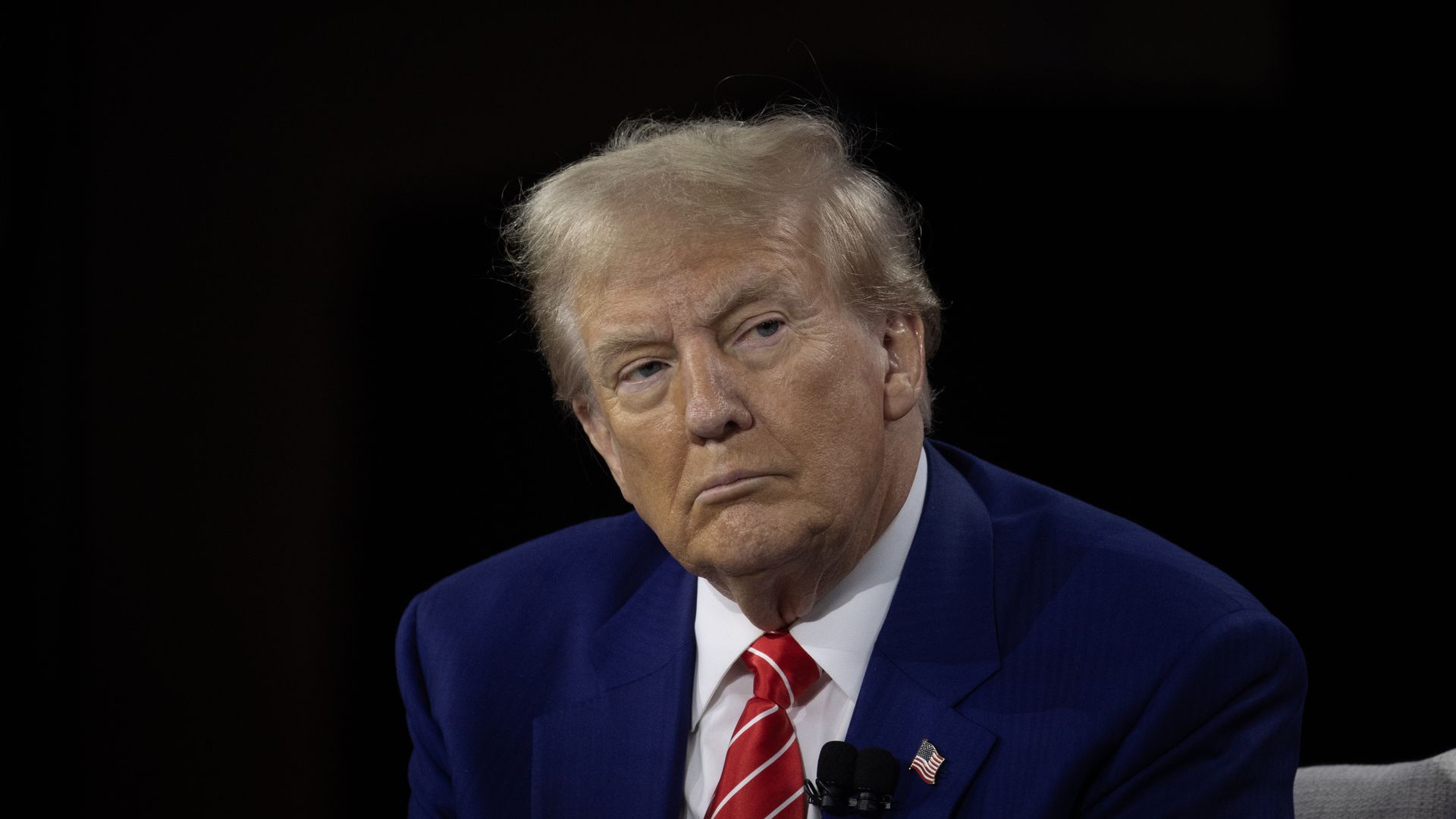
Republican presidential nominee former President Trump in Chicago, Illinois, on Tuesday. Photo: Scott Olson/Getty Images
Former President Trump said in August he'd "gladly" release his medical records. But with less than three weeks to go until Election Day, his campaign has yet to release any basic health data.
Why it matters: Vice President Kamala Harris has released detailed health records and called for the 78-year-old who'd be the oldest president inaugurated if he wins in November to do the same, as questions about his physical and cognitive health mount.


- There's no mandate for a presidential candidate to publicly disclose medical details, but a large group of medical professionals joined Harris this week in calling for Trump to be "transparent" about his health and said he's "displaying alarming characteristics of declining acuity."
The big picture: Former White House physician Jeffrey Kuhlman said Wednesday that as "an overweight ... never smoker," Trump "appears in good health" for his age, but he raised concerns about his cognitive ability for critical decision making.
- "He exhibits cognitive decline in reasoning, memory, and processing speed, consistent with his advanced age," added Kuhlman, who worked with former Presidents Clinton, George W. Bush and Obama but has never examined Trump, over email.
- The Trump campaign responded to questions from Axios and others about whether it would release updated medical records by issuing a statement saying the Republican presidential nominee has "voluntarily released updates from his personal physician."
- It linked to two July accounts from Rep. Ronny Jackson (R-Texas), who served as physician to the president in the Obama and Trump administrations, regarding the GOP leader's recovery from a bullet wound to his ear following an assassination attempt on him.
- The campaign also shared a note from Trump's personal physician issued last November describing the ex-president's overall health as "excellent."
The intrigue: Kuhlman, author of the upcoming book "Transforming Presidential Healthcare," said the information released thus far is "general and vague."
- Online records indicate that Trump has not released details about his physical health, such as weight and blood pressure, since 2020, when a White House medical report showed he weighed 244 pounds, making him medically obese as defined under the Body Mass Index.
- Trump self-reported that he weighed 215 pounds when he was booked at the Fulton County jail in his Georgia 2020 election indictment.
State of play: Trump offered scant information on his health during the 2016 campaign, except for a note from his personal doctor claiming he would be "the healthiest individual ever elected to the presidency." The doctor later said Trump "dictated the letter."
- The most in-depth account about Trump's health occurred after his first physical examination at Walter Reed Medical Center in 2018.
- Jackson detailed to reporters Trump's high cholesterol and a weight of 239 pounds.
- That increased to 243 pounds at Trump's physical in 2019 — putting him at a BMI considered obese. His cholesterol levels had dropped by 2020, according to that medical report.
- When Trump was hospitalized with COVID that year while running for re-election, his medical team offered conflicting accounts about the status of his health.
Zoom out: The former president's father, Fred Trump, was diagnosed with dementia in 1991, at the age of 86, and was later found to have Alzheimer's disease.
- Kuhlman said a parental history of dementia is associated with roughly a twofold increase in relative risk for dementia.
- "Age remains the strongest risk factor for dementia." One in six Americans in their 80s has it, Kuhlman said. "The leading cause of death for a senior citizen (over the age of 65) is heart disease."
What they're saying: In 2020, Trump publicly talked about taking a "very hard" cognitive test as he sought to prove his mental soundness.
- More recently, Trump and his campaign have responded to accusations that his speeches can be rambling and incoherent by framing it as a "weave," where he'll "talk about like nine different things and they all come back brilliantly together."
Between the lines: Ben Michaelis, a clinical psychologist who's previously carried out cognitive assessments for the New York Supreme Court, said there's been "a notable decline" in Trump's speech and quality of thinking — though it's unsurprising, given his age.
- "However, Trump's consistent inconsistency and difficulty staying on track may be suggestive of some form of further cognitive decline," he said in an email on Wednesday.
- "In total, he appears as the portrait of someone who is compromised by significant cognitive decline, but his showmanlike instincts and skill at being compelling to watch is such that many people focus on the entertainment value of his presence, not what his speech suggests about his limited functioning," he added.
Flashback: Trump mocked octogenarian President Biden's age and questioned his fitness to serve when the two were competing in the 2024 presidential race, making age a key theme of the campaign.
- Several polls at the time suggested most Americans believed both men were too old for another term, though more voters were concerned about the president's age.
Flash forward: Trump's cognitive health was again questioned this week after two medical events involving attendees at a town hall prompted him to call for over 30 minutes of music, during which he danced and swayed along.
Go deeper... Harris responds to Trump's town hall-turned "music fest": "Hope he's okay"
