How the shooting changed Trump — and how it didn't

Add Axios as your preferred source to
see more of our stories on Google.
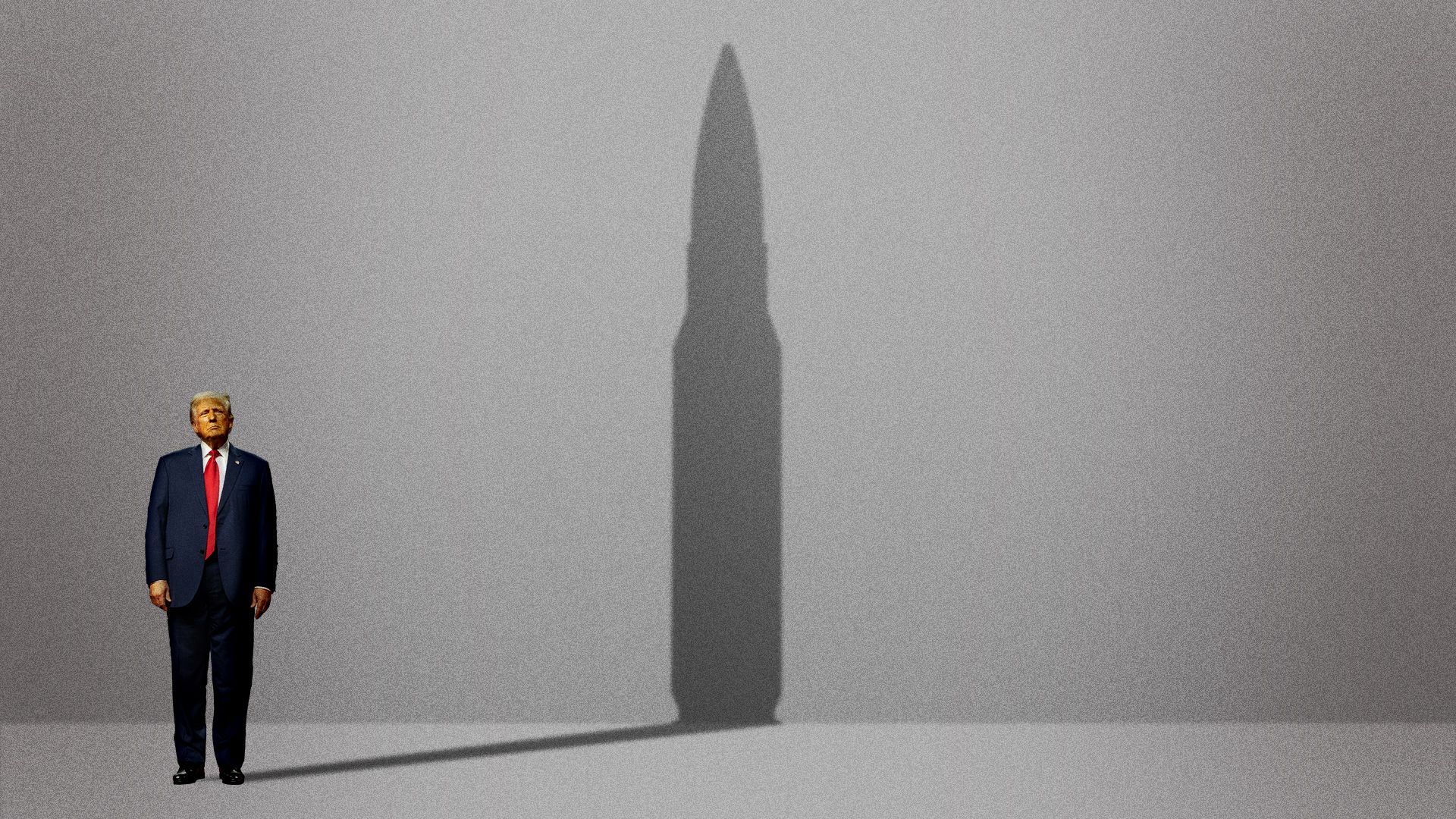
Photo illustration: Maura Losch/Axios. Photo: Rebecca Noble/Getty Images.
At Donald Trump's rally in Uniondale, N.Y., last month, a movement in the crowd led him to suddenly stop speaking and whip his head to the right. There wasn't a threat. But Trump acknowledged that after two attempts on his life, he has a "yip problem."
Why it matters: As Trump returns Saturday to the site in Butler, Pa. — where he was shot in an assassination attempt in July, and hit in his right ear — the attack still weighs on the former president.
- Trump's response to his near-death experience has been a mix of open personal reflection that's unusual for him — and the not-so-unusual approach of dramatically retelling the story with himself as hero.
Zoom in: Trump has always been focused on presenting an image of strength and vigor — evident when he implored supporters to "Fight!" moments after the bullet grazed him.
- But in recent weeks, he's publicly acknowledged his heightened awareness when he's in public spaces as a "yip" — a golfer's term for anxiety that leads you to tense up while putting.
- Trump told the Uniondale crowd that when he saw someone stirring, "I thought this was a wise guy coming up. ... I've got a little bit of a yip problem here ... I was all ready to start duking it out."
- "It's the first time it's ever happened, I think," he added.
Trump now delivers speeches indoors or surrounded by bulletproof glass on three sides, a fixture at his outdoor rallies.
- His traveling entourage now includes additional security, leaving fewer seats on his jet for aides and family members.
Between the lines: Trump, whose references to religion typically have come in the context of politics, claims he's "more of a believer" in God since the Butler shooting. In several speeches, he's seemed to grapple with his mortality.
- "A lot of people ask me ... have you developed any fear of doing this?" Trump told "Dr. Phil" McGraw, who'd asked whether the assassination attempt in Butler had changed him.
- Trump didn't answer directly: "Look, being president is a dangerous job. It's probably the most dangerous profession, if you think about it. So you have 46 [U.S. presidents] and numerous left early or got hit."
- "I never realized how dangerous," Trump added.
Reality check: For all his newfound introspection, Trump in many ways hasn't changed.
- He still can't grasp losing the 2020 election, and focuses on personal grievances much more than his aides would like.
- He also has fed into the anxiety that's hung over his campaign since it went from seeing the election as a slam dunk win over President Biden to a tight race against Vice President Harris.
From the moments after he was shot and played to his supporters by clenching a fist and calling on them to fight, Trump has recognized the political potency of the incident and has sought to use it to his advantage.
- "You'll never hear it from me a second time because it's actually too painful to tell," Trump told Republican convention delegates a few days after the shooting, sporting a large white ear bandage.
- But since hitting the campaign trail shortly afterward, he's frequently recounted the shooting.
The big picture: Trump casts the shooting as part of his claim that he's the only one who can save America from its demise. "I took a bullet for you," is a common refrain at his rallies.
- His campaign also has frequently accused Democrats of setting the stage for attempts on Trump's life — in Butler and in an alleged attempt at Trump's golf club in West Palm Beach, Fla., that was thwarted by the Secret Service.
- Steven Cheung, the campaign's communications director, said in a statement to Axios: "The only people trying to take political advantage [of] the attempted assassination are Democrats who continue to use loaded and dangerous rhetoric that have emboldened those who threaten the safety of President Trump."
Security concerns after the incidents in Pennsylvania and Florida also have rippled through Trump's campaign.
- Junior and mid-level campaign aides have been particularly on edge after the Republican National Committee's office in Palm Beach was on lockdown after the incident at the golf club.
Behind the scenes, Trump sometimes has made light of the shooting in Butler.
- The first time Trump spoke to his son Don Jr. after the shooting, Trump teased him: "I bet you're pissed because I got shot first!"
- Trump later would claim publicly that "only consequential presidents get shot at."
