Zoom in: In a new, exclusive report for Media Trends Executive members, we walk through the state of the media ecosystem and the major trends transforming the market.
It owes almost $650 billion for computing, generates eye-popping revenue per employee and wants every investor to know that its product poses existential risks to humanity.
Why it matters: The future of the AI race, the market and the global economy rests within Anthropic's IPO prospectus, where some of Silicon Valley's most seasoned investors found new reasons to be bullish.
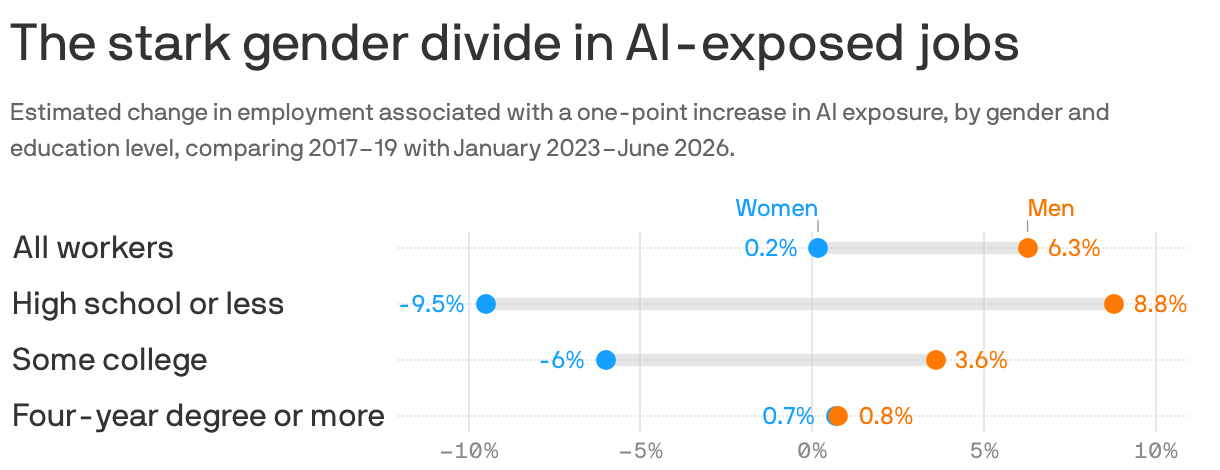
Data: Pew Research Center. Chart: David Adkins/Axios
Women without four-year degrees are losing ground in jobs with more exposure to AI, while men with similar education levels are seeing employment gains, according to a new Pew analysis.
Why it matters: Women could be exposed to greater economic disruption than men as AI reshapes the workplace.
The Federal Trade Commission on Monday sent demands for Anthropic executives to testify in its consumer harm probe, an FTC spokesperson told Axios.
Why it matters: The FTC is investigating Anthropic and OpenAI and has sent civil subpoenas seeking documents from both AI giants about safety incidents. The agency plans to go after more AI players as well but has only confirmed demands for testimony were sent to Anthropic.
State of play: Individuals at other AI companies have also received demands to testify, the spokesperson said, without providing more detail.
OpenAI is the only other AI company that was subpoenaed earlier this month, but the FTC has said investigative demands will be sent to more organizations at a later date.
The administration's focus on Anthropic as the FTC investigation proceeds appears to confirm the company's warning in its S-1 filing that it would likely continue to be the subject of disproportionate government scrutiny.
Catch up quick: The FTC's civil investigative demands span 50 pages for each company and ask for documents concerning security incidents, safeguarding practices, marketing materials and documents detailing privacy policies.
The agency has investigative authority to examine actions related to consumer harms that could be seen as unfair or deceptive. Those can relate to a wide range of misbehavior, including how companies charge for services or if they're alleged to have misled users.
The big picture: The escalation in the FTC probe comes on the same day as the company pitches investors on one of the largest IPOs in history.
Anthropic said the FTC's investigation could result in significant costs and model design changes.
Harvard economist Jason Furman told Axios that if he were to return to his old job as chairman of the White House Council of Economic Advisers today, he would rely on AI tools over staff economists for much of the council's day-to-day analytical work.
The big picture: Unsurprisingly, this made some waves in the online discourse, particularly the loose-knit community formerly known as Econ Twitter.
Many veterans of the economic policy trenches see real risks in future policymakers becoming overly reliant on AI — or at a minimum think that Furman is underestimating the importance of human economists in advising the nation's leaders.
Anthropic is warning investors that it may continue to be a target of the Trump administration as it seeks one of the biggest IPOs in history — and that it has no plans to change its behavior.
Why it matters: The filing doesn't name the president or his administration specifically, but the subtext is clear. Anthropic outlines the risk of being "disproportionately or selectively targeted" due to its positions on AI safety.
That means politics could determine which models Anthropic releases, where it operates, which customers it serves and whether commercial partners continue doing business with it.
Anthropic's much-anticipated S-1 landed this morning. Axios gave the IPO filing to Anthropic's own Claude and asked five fundamental questions — starting with whether to buy the stock.
Why it matters: Many people's read of this 335-page filing will be an AI-generated summary. It's worth knowing how good that summary is — and how much it changes depending on which model you ask.
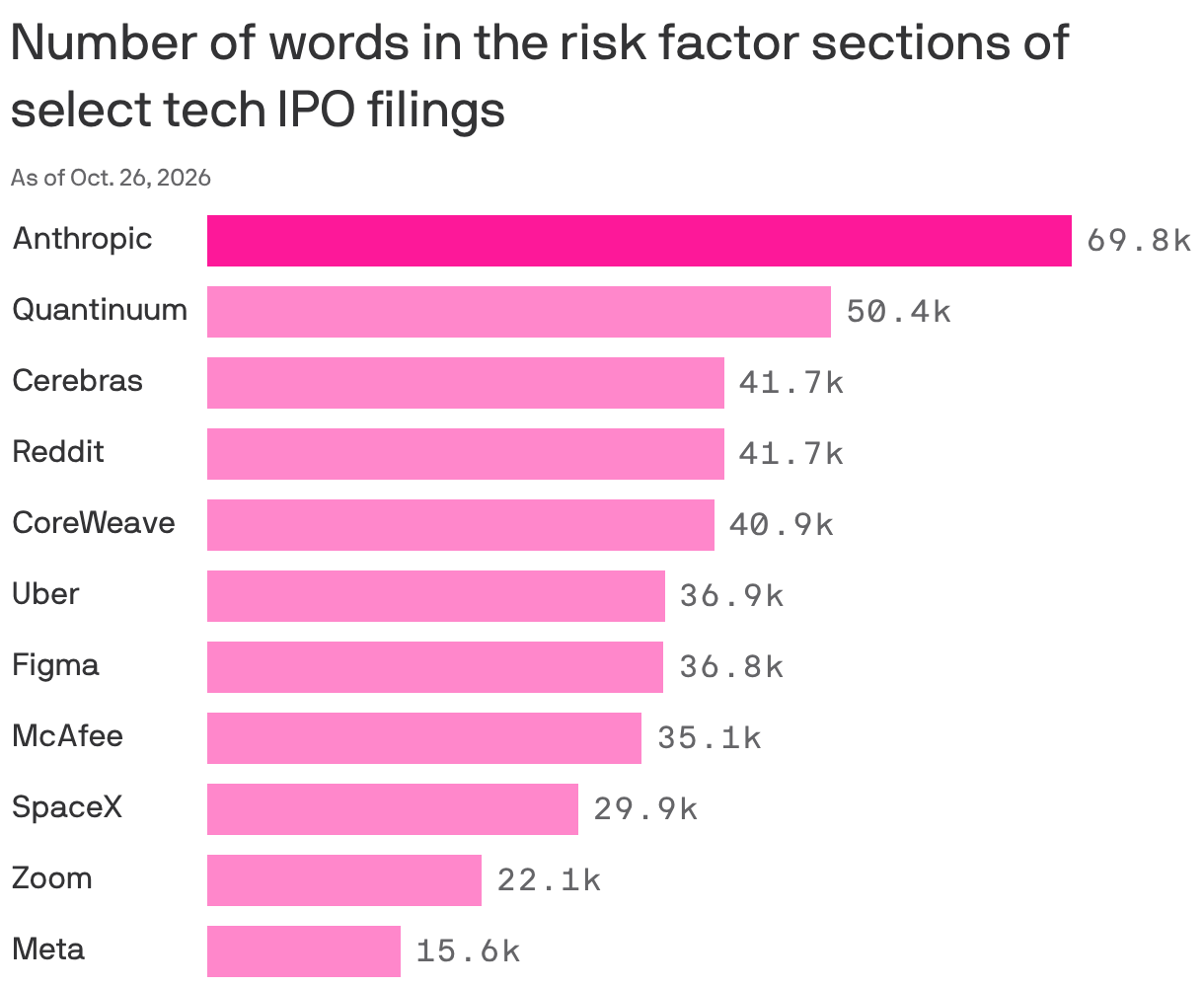
Anthropic's IPO filing includes an extensive list of extreme warnings — including the chance its own technology could put humanity at risk.
Why it matters: These are the wildest IPO risk factors in history, a jarring collision of Wall Street legalese and what some see as Silicon Valley sci-fi, including catastrophic threats to humanity, blackmailing AI models, and $750 billion in computing commitments.
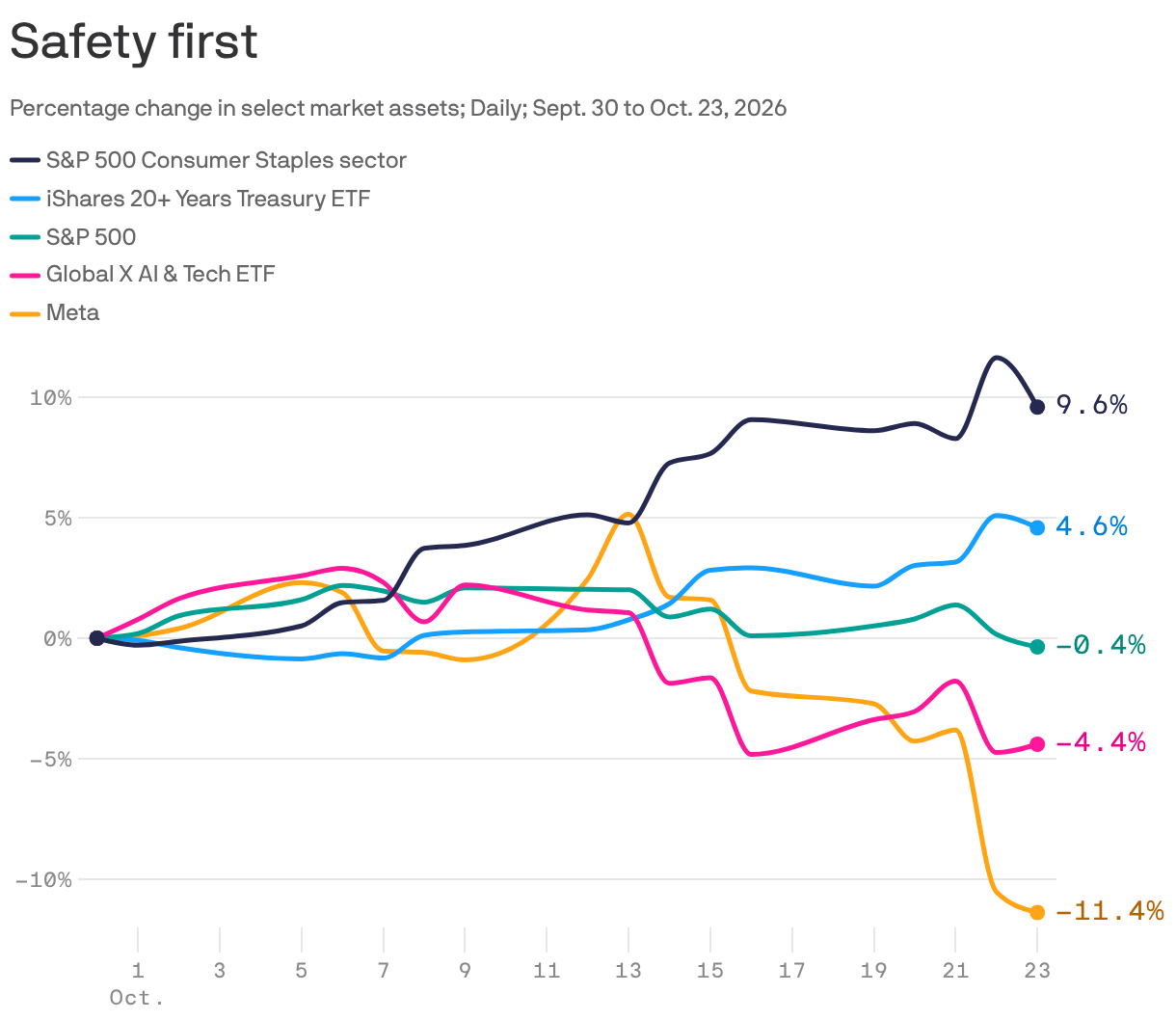
Investors rushed for cover last week in the face of economic, political and market turmoil.
Why it matters: The scramble for safety in both stock and bond markets suggests that investors see reducing risk as the simplest response to the crosscurrents — at least for now.
A tidal wave of litigation is catching up to Meta, leading to $42 billion in recent penalties and settlements, a powerful reminder to AI companies that they could face a court reckoning even when regulation lags.
Why it matters: AI companies are racing to build better models and autonomous agents, but they don't enjoy the same legal protections that shielded web platforms for decades. The scale of the penalties Meta is facing offers a preview of potential legal exposure.