Women's jobs show greater vulnerability to AI than men's

Add Axios as your preferred source to
see more of our stories on Google.
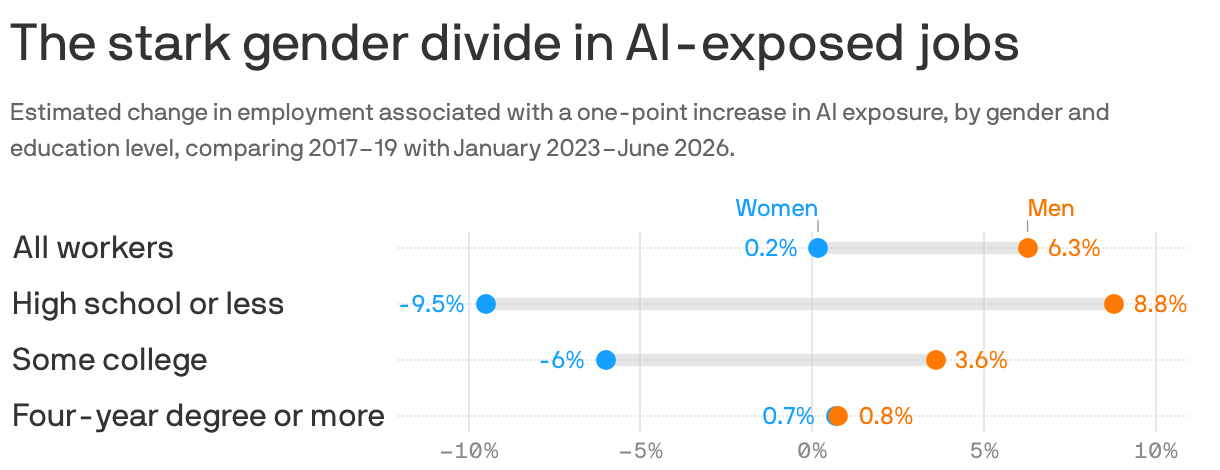
Women without four-year degrees are losing ground in jobs with more exposure to AI, while men with similar education levels are seeing employment gains, according to a new Pew analysis.
Why it matters: Women could be exposed to greater economic disruption than men as AI reshapes the workplace.
The big picture: For workers without four-year degrees, the gap in employment growth between men and women widened as AI exposure increased, Pew found.
- High school diploma or less: For each one-point increase in AI exposure, men's employment grew 8.8%, compared with a 9.5% decline for women.
- Some college, including associate degrees: Men's employment grew 3.6%, while women's declined 6%.
- Bachelor's degree or higher: Neither group saw a significant change.
What's happening: Men and women without four-year degrees tend to work in different occupations, leaving them with different levels of AI exposure.
- Men without four-year degrees are more concentrated in jobs with low AI exposure, including truck driving, construction and freight moving. Their employment gains in highly exposed jobs apply to a relatively small share of men without bachelor's degrees.
- Women at comparable education levels are more likely to work as secretaries, receptionists and customer service representatives — jobs where AI can perform a greater share of workplace tasks.
Zoom out: Women are underrepresented in the growing AI workforce, even as the technology threatens to disrupt jobs they already hold.
- Women accounted for just 26% of U.S. hires into AI occupations in 2025, according to LinkedIn research.
- Across 27 countries, women held just 13% of C-suite AI leadership positions at AI companies, the research found.
Worth noting: Women expressed more negative views of AI than men in a Morgan Stanley poll released in September.
Methodology: Pew used Department of Labor data to score 480 occupations based on their exposure to AI, then compared employment trends before the generative AI boom (2017–2019) with those from 2023 through June 2026.
- The analysis does not establish whether AI actually caused the employment changes.
