Meta outperformed Wall Street expectations with its Q2 earnings report, sparking an aftermarket rally of as much as 11%.
Why it matters: The company's massive continued investments in AI infrastructure and talent — including a high-profile, big-ticket hiring spree poaching some top researchers from competitors — haven't dented Meta's numbers or investors' enthusiasm.
The U.S. Army rescinded a job offer to a top Biden administration cyber official at the U.S. Military Academy at West Point after public criticism from far-right activist Laura Loomer.
Why it matters: Loomer, a prominent conspiracy theorist and self-appointed enforcer of loyalty to Trump, has a remarkable level of influence over hirings and firings inside Trump 2.0.
Leading tech and health companies including Amazon, Apple, Google, and OpenAI committed on Wednesday to working with the Trump administration to make electronic patient records more accessible across the health care system.
Why it matters: Patient health information is now scattered across multiple disconnected systems, leading to inefficiencies, medical errors and wasted time and money.
Why it matters: The letter from the ranking member of the Joint Economic Committee could put Amazon in a tight spot — forced to talk about tariffs' impacts on prices just months after the White House threatened the retailer over sharing tariff costs.
Palo Alto Networks on Wednesday said that it's agreed to buy Israeli cybersecurity firm CyberArk for around $25 billion in cash and stock.
Why it matters: This is a reminder that the AI gold rush is as much about supporting services as it is about foundational models, with CyberArk building tools that secure AI agents' identities.
Firms in the financial sector were more likely to face an AI-powered cyberattack in the last 12 months than any other sector, according to new research from Deep Instinct.
Why it matters: Financial services companies are ripe targets for cyber criminals because of their vast customer networks, from everyday consumers to major corporations.
The current military model for trying and buying weapons and technology is the "biggest risk" to the U.S. and its friends abroad, according to Portal Space Systems CEO Jeff Thornburg.
"The allied nations, Five Eyes, AUKUS, NATO, take your pick — the acquisition process is too slow and broken. Requirements development process? Broken," he told Axios in an interview.
"It's taking too long to field systems the warfighters need right now, or they needed years ago."
Why he matters: Thornburg is an industry veteran. He led development of SpaceX's Raptor engine and has ties to Stratolaunch, Ursa Major and Amazon's Kuiper.
The U.S. Space Force will experiment withlaser communications and quantum sensing aboard a secretive Boeing-made spaceplane slated for launch this summer.
Why it matters: Much of the work executed by the X-37B Orbital Test Vehicle is classified.
A single photo of the Earth from space taken by an onboard camera caused a defense-media frenzy in February.
The U.S. Navy needs sixth-generation fighter jets to remain relevant and avoid retrofitting and buying additional older aircraft, like the F-35, according to President Trump's pick to be chief of naval operations.
Why it matters: Trump's fiscal 2026 budget blueprint iced such a warplane, the F/A-XX, in favor of the Air Force counterpart, the F-47.
This looks like a split between the White House and a top nominee, Adm. Daryl Caudle, over a multibillion-dollar endeavor.
China-specific national-security concerns were a big reason the Justice Department decided last month to allow Hewlett Packard Enterprise to take over rival Juniper Networks, Trump administration officials tell Axios.
Why it matters: Axios has learned that the U.S. intelligence community intervened to persuade the Justice Department that allowing the merger to proceed was essential to helping U.S. business compete with China's Huawei Technologies, among other national-security issues.
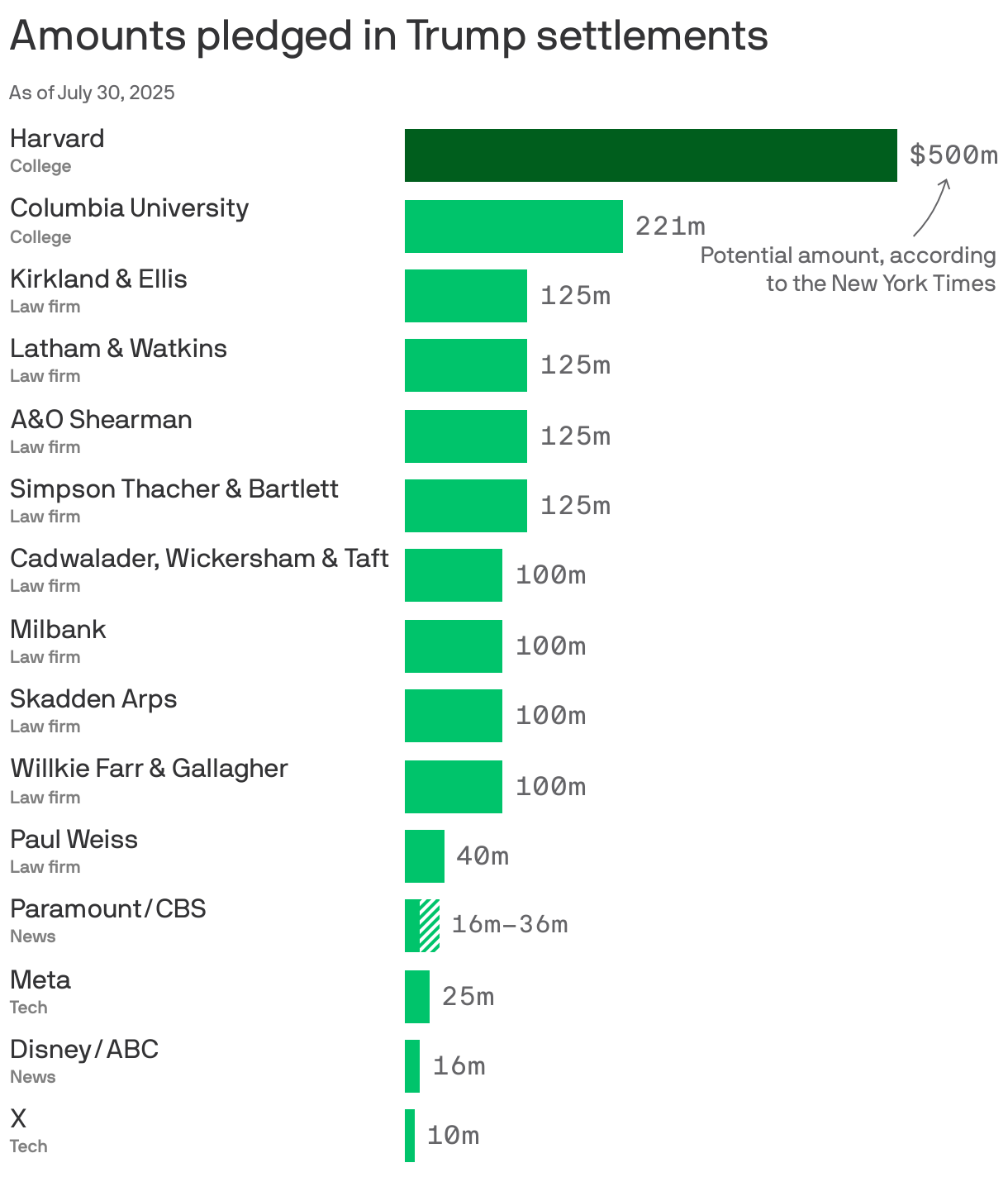
President Trump has extracted more than $1.2 billion in settlements from 13 of the most powerful players in academia, law, media and tech, according to an Axios analysis.
If finalized, a potential $500 million deal with Harvard would represent his largest trophy to date.
Why it matters: America's most elite institutions have largely succumbed to the Trump administration's cultural crackdown, opting to pay up — often to the tune of tens or even hundreds of millions of dollars — rather than fight back.