Why Trump's F-35 offer signals closer U.S.-India ties

Add Axios as your preferred source to
see more of our stories on Google.
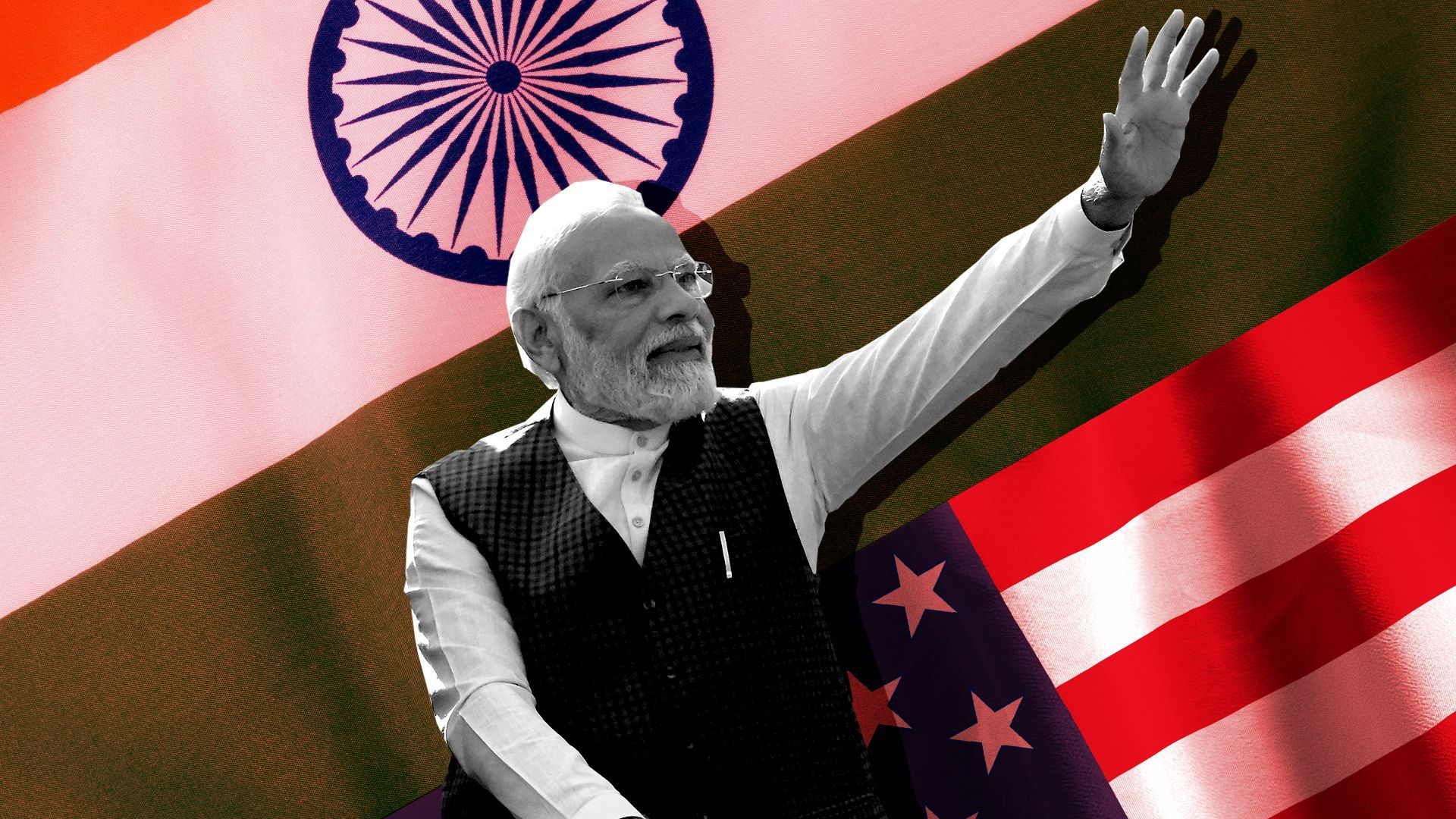
Photo illustration: Annelise Capossela/Axios. Photo: Prakash Singh/Bloomberg via Getty Images
What can a potential arms sale portend?
- Well, in the case of the F-35, one of the most coveted, costly and complex weapons on Earth, it's more intimate ties between the U.S. and India.
Why it matters: For all the chaos President Trump is injecting into U.S. foreign policy — trade wars with allies, aligning with Russia on a UN vote — a focus on the Indo-Pacific remains steady.
- In that calculus, New Delhi is priceless.
Driving the news: A meeting this month of President Trump and Indian Prime Minister Narendra Modi produced a handful of defense commitments, including "paving the way" to share Lockheed Martin's stealth fighter.
- That remark alone caught people by surprise. It's no simple, speedy task.
- Also on the schedule (and worth closely monitoring) are coproduction of Javelin anti-tank missiles and Stryker combat vehicles; the launch of the Autonomous Systems Industry Alliance; and closer-knit intelligence sharing.
What they're saying: The U.S.-India relationship has been in "hyperdrive," according to Lindsey Ford, former deputy assistant secretary of defense for South and Southeast Asia.
- A "serious dustup" between India and China along the Line of Actual Control years ago propelled the former "to think much more seriously about the nature of its security partnership with the United States," she told Axios.
- It also coincided with an American reassessment of Chinese ambitions.
- "The U.S. and India working together — and, in particular, through the Quad [grouping of the U.S., India, Australia and Japan] — is something that Beijing is watching very closely."
Yes, but: India has long relied on Russian arms.
- That includes the S-400 air-defense system, which earned Turkey the boot from the F-35 coalition. There's also the BrahMos cruise missile joint venture and T-90 tank production, among other examples.
- Another complicating factor is India's own fifth-generation push, the Advanced Medium Combat Aircraft. A full-scale AMCA model was displayed at Aero India 2025, Defense News reported.
Zoom out: Personal relationships can make a difference at a time when allegiances are changing and limits — off Alaska's coast, across Europe, in the South China Sea — are tested.
- Former Defense Secretary Lloyd Austin and former national security adviser Jake Sullivan worked the Indo-Pacific circuit.
- "The leader-level friendship is everything when it comes to driving the U.S.-India partnership forward," said Ford. "With two mammoth bureaucracies, it is very, very easy for both systems to fall back to a sort of stasis."
The latest: Shield AI co-founder Brandon Tseng huddled with Indian officials last week. The company began exploring the country and its massive markets in 2021; late last year, it announced a $90 million deal with JSW Group.
- 'There's a sentiment in India that they want to increase their levels of defense spending. It's critically important for the country. They're in a very dangerous neighborhood," Tseng said in an interview.
- "This was my conversation with the commerce minister: There's a lean toward working with the United States."
Other defense firms are playing ball, too.
- Anduril Industries is collaborating on software and autonomous tech with Mahindra Group.
- AM General is working with Kalyani Strategic Systems on artillery.
The bottom line: Even if the F-35 deal falls through, Trump's offer "shows a new approach, especially in the signal it sends about the president's willingness to share cutting-edge technology with India," Capstone analysts Alexander Slater and Michael Wang said in commentary shared with Axios.
