Monday's technology stories

What to know about DeepSeek

Chinese AI startup DeepSeek has rattled Silicon Valley, potentially disrupting the nascent industry with an inexpensive and accessible alternative to the technology U.S. giants have poured hundreds of billions of dollars into already.
Why it matters: Nvidia's stock closed almost 17% lower Monday, wiping out more than $600 billion in market capitalization, as investors worldwide grapple with the prospect that the market-sustaining AI spending boom might have been overdone.

Nvidia shares plunge as DeepSeek promises new AI path

Nvidia Monday complimented a new Chinese AI model whose emergence is prompting investors to question the boom narrative surrounding the darling of American AI.
Why it matters: Nvidia's heliocentric position in the AI universe has been taken as gospel truth until now, delivering immense stock gains and serving as a bellwether stock for the AI economy.

Agentic AI is a "big next step" in AI's evolution, SAP CEO says
DAVOS, Switzerland – SAP is launching two AI agents this year – a sales AI agent and a supply chain AI agent, CEO Christian Klein said.
Why it matters: SAP's move to use these two AI agents underscores just how close agentic AI is to being deployed in the real world at scale.
Axios' Ina Fried moderated the conversation with Klein in Davos. The Jan. 23 discussion was sponsored by Mubadala and MGX.
How it works: Sales AI agents will recommend the best price and how to bundle products to "hit the consumer at the right point in time" while communicating with a supply chain AI agent to determine if the product is in stock and if it will be delivered on time, Klein said.
- The two AI agents will communicate "so that the sales agent is not making any kind of promises, which the supply chain can't fulfill," Klein said.
What they're saying: An important part to make agentic AI successful is being able to contextualize data, Klein said.
- "SAP is investing in a knowledge graph … to contextualize the data. Now that you can set it in context, that is very, very important. And then we need to bring it to adoption."
Caveat: About 80% of SAP's customers don't have the infrastructure, team or investment to do the work to implement AI agents – but that is where SAP plans to fill the gap, Klein said.
- "We have all the predictions, all the automation, it's coming with the software because oftentimes customers just don't have the team, also the investments to take a piece of AI and bring it into the context of the business," Klein added.
Sponsored content:
Mubadala Investment Company deputy chief strategy and risk officer Marc Antaki spoke in a View from the Top sponsored segment, along with MGX chief investment officer of technology Ali Osman, who said he believes the application of AI will "become very material in 2025."
- Antaki said Davos reinforced his belief that partnership will be "critical" for AI's complex world "because it's very clear that nobody can do it alone."

DeepSeek hit by cyberattack, limits new registrations
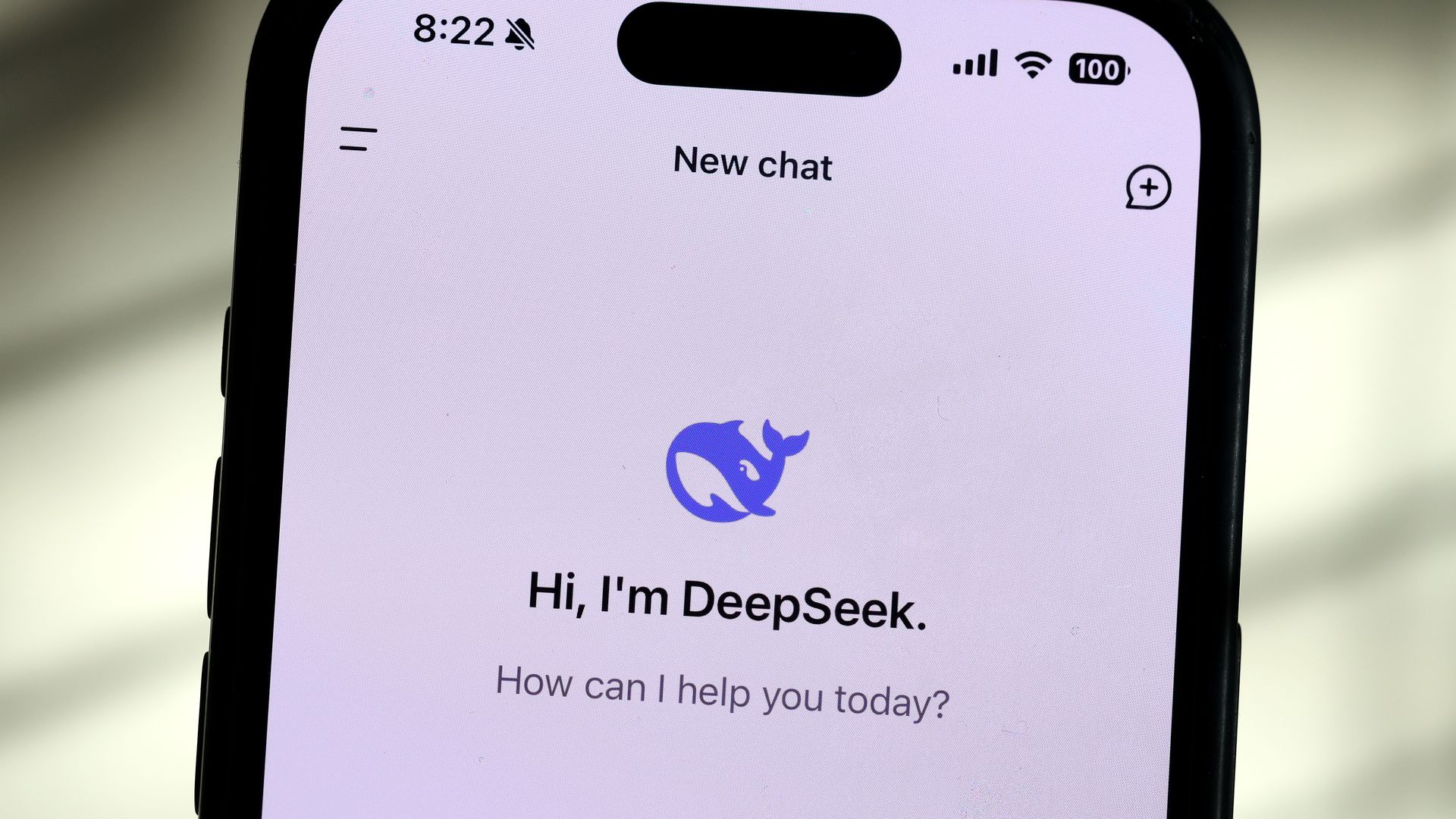
Chinese AI company DeepSeek was forced to limit new user registrations Monday after "large-scale malicious attacks" hit its services, the company said.
Why it matters: DeepSeek's latest models demonstrated capabilities that rivaled those of its U.S. competitors while being built at a fraction of the cost — alarming investors and prompting a global sell-off of tech stocks.
Navigating new and traditional media as AI advances
DAVOS, Switzerland – Communication leaders should look at new media platforms – like podcasts, influencers and social media – when considering how to get their message out, DoorDash chief corporate affairs officer Liz Jarvis-Shean said.
Why it matters: New media has a "connection to their audience" and is a "source they can trust," Jarvis-Shean said.
Axios' Eleanor Hawkins moderated conversations with Jarvis-Shean and Pfizer EVP and chief corporate affairs officer Sally Susman in Davos. The Jan. 23 discussion was sponsored by Weber Shandwick North America.
What they're saying: "Fundamentally, it is about respect for the audiences that you're trying to reach. And … they trust different things today," Jarvis-Shean said.
Yes, but: New media doesn't replace traditional media entirely, Jarvis-Shean added.
- "So much of the content that comes out [of new media] is built off of something that is talked about in traditional media. So it is a 'yes, and' you need to continue to have relationships with all kinds of traditional media."
Caveat: New media can be transactional since "for many of those people, it is their business, Jarvis-Shean said.
- She added that new media platforms are not "effective if it also isn't authentic to the story that you're trying to tell."
As the media landscape evolves, so does technology. With AI's rapid advancements, communications leaders must adapt their workflows or they could risk feeling "FOBO," or the fear of being obsolete, Susman said.
- "I have, really, to think about what is going to be [the] upskilling that I need to do, that my team needs to do to live in that world," Susman added.
Sponsored content:
In a View From the Top sponsored segment, Weber Shandwick North America CEO Jim O'Leary said despite CEOs having renewed economic optimism, company leaders are concerned about the increased volatility in the world and many are less confident that their communications teams can navigate it.
- "Certainly there's an opportunity for communications, public affairs, corporate affairs [and] government relations teams, to help CEOs [and] other leaders, kind of predictively or proactively navigate all of that volatility," O'Leary said.

DeepSeek resets the board

Davos consensus last week was that the U.S. had a giant lead in the AI race, with the only real question being if there would be enough general contractors to build all of the needed data centers.
- Ummm ... maybe not.

The anatomy of a bubble bursting

When lots of people are worried about bubble valuations in stocks or a specific sector, all it takes is a small poke to make the whole thing wobble precariously.
Why it matters: That can cost investors $1 trillion or more in a single day, as happened Monday with the global AI rout.
Hybrid human and AI workforce is coming, CEO says
DAVOS, Switzerland – Today's CEOs will be the last to lead an all-human workforce as businesses look to integrate AI agents, Salesforce CEO Marc Benioff predicted.
Why it matters: The use of AI agents, also known as the digital labor force, has slowly been on the rise as companies look for ways to increase productivity and solve issues, like labor shortages.
Axios' Ina Fried and Dan Primack moderated conversations with Benioff, IBM vice chairman Gary Cohn, The Carlyle Group co-founder & co-chairman David Rubenstein and Snowflake CEO Sridhar Ramaswamy in Davos. The Jan. 22 discussions were sponsored by Lightspeed Venture Partners.
What they're saying: "We are really moving into a world now of managing humans and [AI] agents together," Benioff said.
- Salesforce gets 36,000 support inquiries every week, Benioff said. By implementing AI agents – or what he calls "Agent Force" – they were able to resolve 5,000 more inquiries than normal. "I just have that much more productivity."
- Ramaswamy said separately that no one knows what agentic AI's capabilities will be over the next 12 months, calling this a "time of a lot of change."
- Private equity will also be impacted by AI by helping investors make "core decisions" that are "quicker" and "hopefully better," Rubenstein said
Regulating AI and all its capabilities have been a focal point of many governments and critics, but Cohn warns against overregulation that could harm competitiveness.
- Cohn hopes President Trump's AI czar, David Sacks, continues "to allow the U.S. to be the dominant creative force in AI."
- "Our competitive and comparative advantages in the United States is we've got capital and we've got creativity, and we've got entrepreneurial spirit. We want to continue to thrive with that. … We want to continue to have all of our smart minds contribute to the AI world. We don't want to let someone else win," Cohn added.
Yes, but: Industries or activities that are regulated should also have their AI regulated too, Cohn said.
- "If you used a mapping program to get here today … and the map took me five steps out of my way, I don't think that needs to be regulated," Cohn said.
- "If some doctor is putting your symptoms into an AI machine and they're diagnosing your illness, I think we should regulate that because that's a regulated industry," Cohn added.
Sponsored content:
In a View From the Top sponsored segment, Lightspeed Venture Partners partner and global leader Bejul Somaia said people have to change their mindset when they approach AI and rethink how businesses operate.
- "There's going to be this massive market expansion because technology is no longer just going to automate workflows, it's gonna automate work," Somaia said.
Social media threatens teen mental health, expert says
DAVOS, Switzerland – Prioritizing youth mental health instead of social media growth in the U.S. could impact GDP, but is vital for the health of society, said Center for Humane Technology co-founder Tristan Harris.
Why it matters: Harris likens society to a body with an inside that's "deteriorating," as more government officials and critics increasingly warn against social media's negative impact.
- "It's almost like on the outside [of tech-enabled countries] you see these bigger muscles … [but] on the inside you have lung failure, heart failure, and brain failure because the inside health of our society is deteriorating," Harris said.
Axios' Sara Fischer moderated a conversation with Harris in Davos. The Jan. 22 discussion was sponsored by Pinterest.
Big Tech's current profit models rely on endless scrolling, leading to teens getting addicted, Harris said.
- Harris said there's a lack of incentives for Big Tech companies to improve youth mental health.
- "You can have all the content moderation you want. [But if tech companies] still have business models that maximize for engagement, they're going to find infinite new design patterns that keep people addicted, scrolling, posting content, with maximum reach regardless of whether it's good or bad," Harris said.
Regulation and lawsuits could help incentivize tech companies to not release AI chatbots to minors in a time where AI has been shown to sometimes exacerbate vulnerabilities among teens.
- Harris said safety-focused lawsuits, such as those against companion app Character.AI, could help incentivize companies to not market to teens, which can create "digital attachment disorders."
- "I would say that this actually has bipartisan appeal. … We have to actually have this change happen because I'm telling you our societies will not be able to survive otherwise," Harris added.
Friction point: Regulation for tech companies has been an ongoing point of contentious debate, partly because of the desire for the U.S. to maintain competitiveness against China, Harris said.
- "If we regulate our biggest tech companies, we're going to lose to China. But we have to see that to the degree we're in a race [with China], we're [also] in a race for the holistic health and long-term survival of our societies, not for just having the biggest muscles," Harris said.
Sponsored content:
In a View From the Top sponsored segment, Pinterest's chief legal and business affairs officer Wanji Walcott announced that they are going to be the first tech company to support phone-free schools.
- Pinterest will have a pop-up on their platform for teens when they're on the app during the school day to remind them that they're in school and to put the phone down,Walcott said.
- "We certainly want to do our part as we think about, 'how do we ensure better youth mental health outcomes? How do we ensure that this next generation is not just kind of stuck to the phone and kind of scrolling and scrolling,'" she added.
Magnificent 7 stocks set for $1 trillion rout on DeepSeek panic

Investors worldwide stand to lose more than $1 trillion on Monday because of the sudden fear that the market-sustaining AI spending boom might have been for nothing.
Why it matters: The so-called Magnificent 7 stocks are heavily leveraged to hundreds of billions of dollars in planned AI investment — and the entire market, in turn, hangs on their performance.

Stunning breakthroughs from China's DeepSeek AI alarm U.S. rivals

Breakthroughs from Chinese AI startup DeepSeek have stunned Silicon Valley and could bring turbulence to Wall Street, as they were accomplished at a fraction of what the U.S. giants are spending and despite export bans on top-of-the-line chips.
Why it matters: China's rapid advances suggest America's strategy of withholding technology from China might just be speeding up the evolution of its rival's AI knowhow.

Fierce debate at Davos over AI's business value
Artificial intelligence was once again the talk of global leaders at Davos this year — but their sentiment was decidedly more mixed, with some eagerly anticipating the arrival of AI agents and others bemoaning that AI hasn't yet boosted their bottom lines.
Why it matters: Business leaders have been trying to make sense of AI ever since ChatGPT arrived on the scene, with many launching pilot programs only to find companywide value elusive.