Fierce debate at Davos over AI's business value

Add Axios as your preferred source to
see more of our stories on Google.
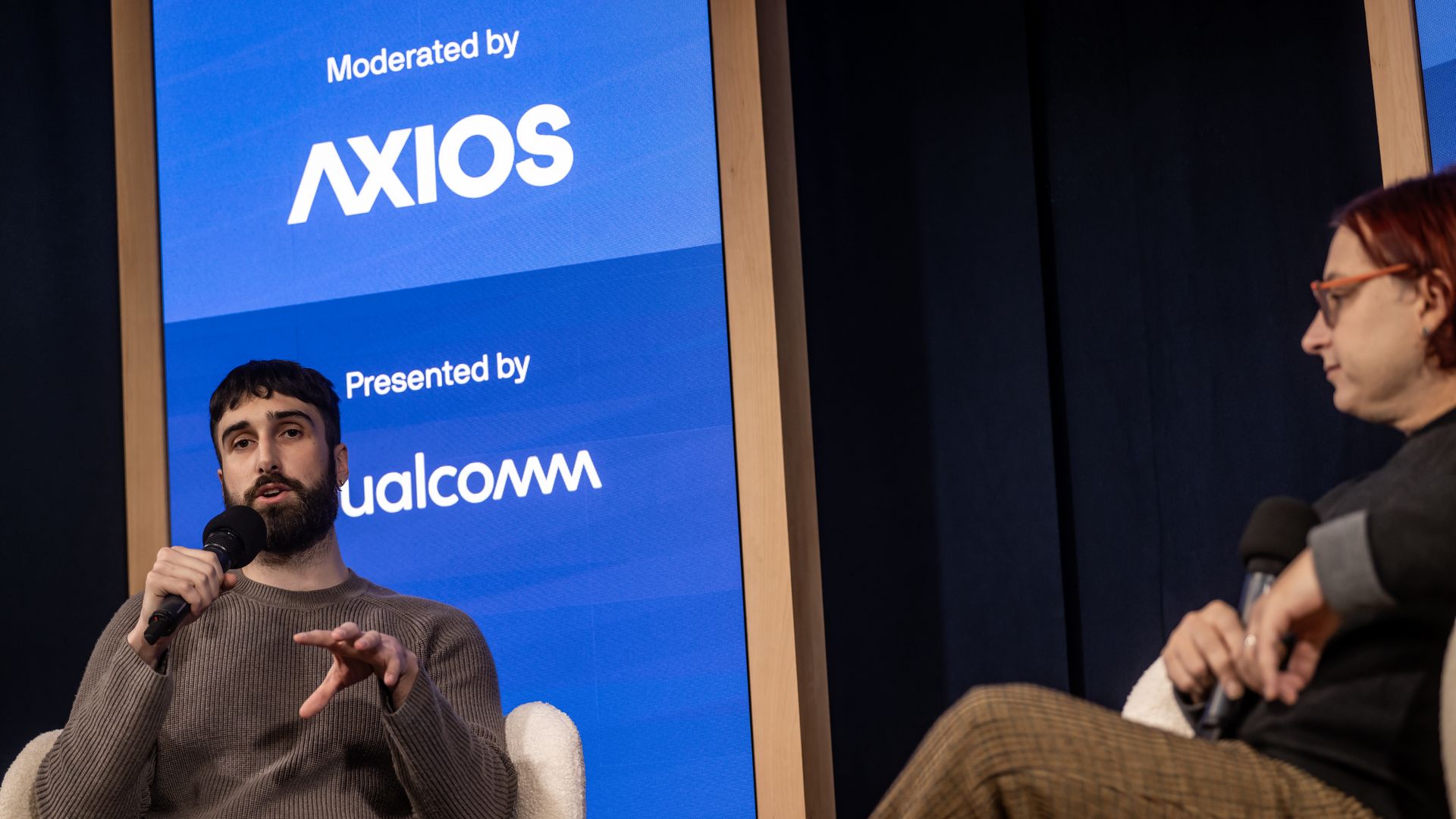
Cohere CEO Aidan Gomez speaks to Axios' Ina Fried during an event on the sidelines of the World Economic Forum in Davos. Photo: Dani Ammann Photography on behalf of Axios
Artificial intelligence was once again the talk of global leaders at Davos this year — but their sentiment was decidedly more mixed, with some eagerly anticipating the arrival of AI agents and others bemoaning that AI hasn't yet boosted their bottom lines.
Why it matters: Business leaders have been trying to make sense of AI ever since ChatGPT arrived on the scene, with many launching pilot programs only to find companywide value elusive.
The optimistic case
- Much of the hopeful talk at Davos was about the arrival of semi-autonomous AI agents that can go beyond providing information to workers and take actions on their own.
- Today's CEOs are likely the last who will "manage a workforce of only human beings," Salesforce CEO Marc Benioff promised during an on-stage interview with Axios' Ina Fried.
- OpenAI's Kevin Weil offered a similarly rosy forecast. "I think 2025 is the year that we go from ChatGPT being this super-smart thing that can answer any question you ask to ChatGPT doing things in the real world for you," he said in a separate on-stage interview with Axios.
- SAP CEO Christian Klein talked about how his company has used generative AI to automate compliance checks and close thousands of contracts, among other uses. This year, he said, the company will mandate that its developers produce 30% more code by using AI, up from the 5-10% gains achieved in early pilots. "It's absolutely doable," Klein said in another on-stage interview with Axios.
- Meanwhile, Google DeepMind CEO Demis Hassabis told Axios' Alison Snyder that he expects clinical trials to start this year for the first drugs designed with the aid of generative AI.
The pessimistic case
- Even those within the AI industry acknowledged that businesses were struggling to make use of the technology, especially beyond areas such as coding, marketing and customer service.
- In recent weeks, both Microsoft and Google have made significant price cuts to their business-related chatbots, finding corporations unwilling to pay an extra $20 or $30 per employee per month for yet-to-be-fully defined gains.
- AI Fund's Andrew Ng said large companies are often bogged down by necessary but cumbersome bottlenecks. "When companies have too much protective DNA and every innovation needs marketing review, legal review, PR review, ethics review, then it just takes forever to do anything," he said.
- Ng said on stage in another Axios interview that smart companies are building sandboxed prototypes to show what can be done — and then implementing the ones that show the most promise.
- Stanford professor Erik Brynjolfsson, who runs an AI company himself, acknowledged that many businesses are struggling. But he also noted that big technology shifts can be the hardest to capitalize on quickly.
- "Sometimes it even gets worse before it gets better," he said during an Axios interview. "We saw it with electricity, the steam engine, early computers. We're seeing it now."
Between the lines: Both realities are existing simultaneously.
- The technology continues to advance at a furious pace at the same time that businesses are struggling to integrate AI into their operations. And human workers are often the bottleneck to change.
Cohere CEO Aidan Gomez says businesses are often spreading themselves too thin when they should instead make a handful of big bets. His on-stage recommendation in Davos was for "having a strong strategy and leadership mandate to say, 'These are the top three projects that if we succeed on these, it makes or breaks us.' "
- The technology is ready, he said, but companies haven't given it the right challenges. "I think overwhelmingly right now in enterprise, the tasks are too easy," Gomez said. The harder tasks, he said, are the ones that will deliver the value, he said, "but they require that focus."
Even when individual workers are increasing their own productivity using AI, the gains don't always reach the bottom line — especially since AI is often aiding certain tasks rather than replacing entire jobs.
- Accenture CEO Julie Sweet told Axios that without close management, AI is providing more "coffee time."
- At the DLD conference in Munich, McKinsey Digital's Rodney Zemmel joked that the biggest beneficiary of generative AI in 2024 were the dogs belonging to software programmers — because the coders are getting home earlier.
What's next: The rush to release AI agents is in full force. Just last week, OpenAI added Operator, which can take action within its own web browser,
- That follows in the footsteps of OpenAI rival Anthropic, while Google has also demonstrated a similar capability, dubbed Project Mariner.
