A new survey offers some evidence that most artificial intelligence experts are positive or neutral when it comes to working with the Pentagon on AI-enabled projects.
Why it matters: Employee concerns have led some tech companies to pull back from working on defense-related projects in the past, but for many in the AI world, the chance to work on intellectually challenging projects — and the Pentagon's not insignificant budget — seems too good to pass up.
For all our fears about Terminator-style killer robots, the aim of AI in the U.S. military is likely to be on augmenting humans, not replacing them.
Why it matters: AI has been described as the "third revolution" in warfare, after gunpowder and nuclear weapons. But every revolution carries risks, and even an AI strategy that focuses on assisting human warfighters will carry enormous operational and ethical challenges.
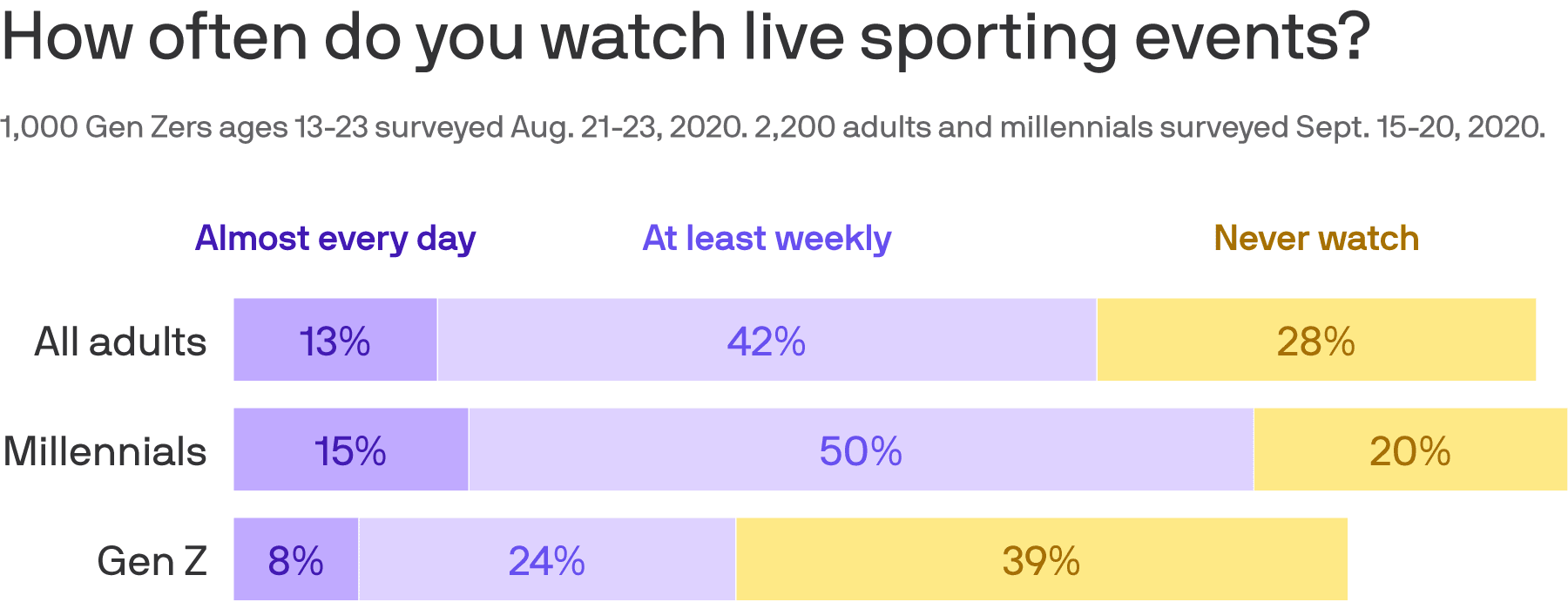
Reproduced from Morning Consult; Note: Gen Z survey margin of error ±3%, adults and millennials ±2%; Chart: Axios Visuals
Endless articles have examined how young sports fans consume content. But here's the real question we ought to be asking: What content do they consume?
Driving the news: Young sports fans don't follow sports the way their parents did. And that change in fandom gets more extreme with each generation.
Cable TV is dying a slow death, and after years of mostly denying that reality, America's major media companies are beginning to hedge their bets and prepare for what comes next.
By the numbers: 25 million homes have cut the cord since 2012, and another 25 million are expected to do so by 2025.
America's electoral infrastructure survived and thrived last week, despite pandemic complexities and President Trump's unfounded claims of widespread fraud. Yes, including software and machines made by Dominion Voting Systems.
Axios Re:Cap goes deeper with Mike Hanmer research director for the University of Maryland's Center for Democracy and Civic Engagement.
Massachusetts, Colorado and California top a list of U.S. stateswith the greatest "capacity for achieving prosperity through scientific discovery and technological innovation," according to the Milken Institute's 2020 State Technology and Science Index released today.
Why it matters: Addressing the factors that allow states to create more jobs and economic growth could help them recover from the pandemic's economic fallout and adapt to future downturns and disruptions.
Microsoft said Friday it has detected at least seven attacks on companies working to develop a COVID-19 vaccine or treatments.
Details: The company said attacks by three nation-state actors — two from North Korea and one from Russia — have targeted companies in Canada, France, India, South Korea and the United States.
President Trump is pushing the Senate to confirm his hand-picked nominee for a seat on the Federal Communications Commission, but people familiar with the state of play on Capitol Hill don't expect him to get his wish.
Why it matters: The FCC oversees broadband internet rules, media ownership regulation and other policies that hold special importance to the president. A Trump-aligned commissioner could likely agitate for greater agency involvement in how online platforms moderate speech and otherwise extend Trump's influence into the Biden administration.