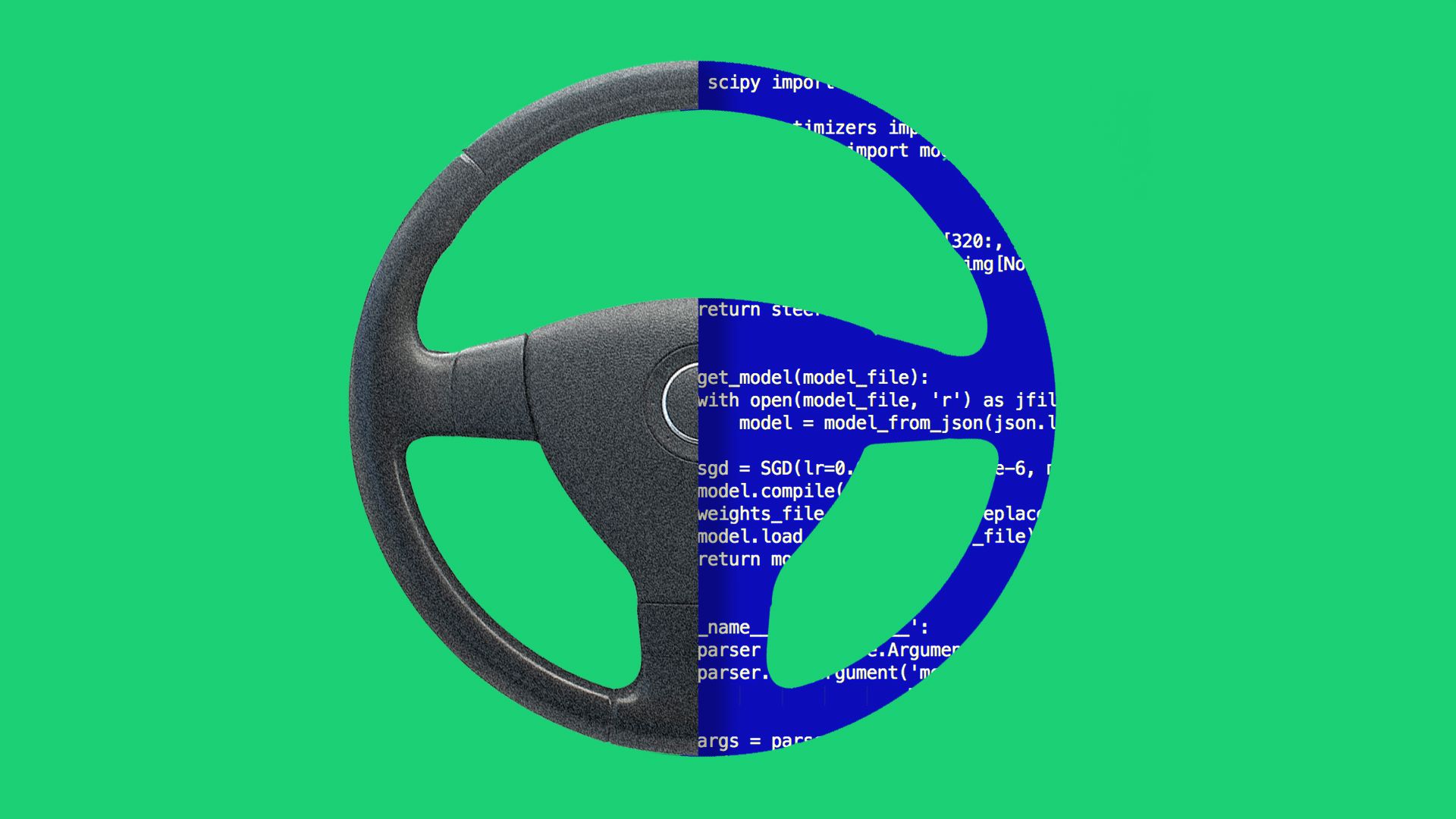
Self-driving test vehicles can’t possibly log enough real-world miles to ensure they are safe under every circumstance, but new tools allow manufacturers to test more of the rare but still possible scenarios they might encounter.
Why it matters: Extensive simulation is critical if autonomous vehicles are to be ready any time soon. Real-world testing on public roads is slow and limited — AVs could drive around for decades waiting for challenging conditions or interesting anomalies that would help train themto handle those so-called edge cases.
Blockchain, a nascent technology that offers highly secure digital data tracking, has caught the interest of AV companies and automakers, who are exploring how it can be used to track components in supply chains and protect valuable data.
Why it matters: More complex cars will generate more data and as blockchain technology develops, it could offer a secure way to manage that data while providing additional benefits to passengers.
For the first six decades of AI's development, the biggest question facing researchers was whether their inventions would work at all. Now, the field has entered a new stage of introspection as its effects on society — both positive and damaging — reverberate outside the lab.
In this uneasy coming of age, AI researchers are determined to avert the catastrophic mistakes of their forefathers who brought the internet to adulthood.
Just days after Walt Disney Co. officially finalized its acquisition of most of 21st Century's entertainment assets, layoffs have begun at Fox properties, The Los Angeles Times reports. Roughly 3,000 layoffs are expected.
Why it matters: This is a big shakeup amid an already tumultuous time in Hollywood. Disney purchased Fox assets — much like AT&T purchased Time Warner last year — in an effort to compete with entertainment tech giants like Netflix and Amazon.
Ride-hailing giant Uber plans to list its shares on the New York Stock Exchange, according to Bloomberg.
The bottom line: Uber is getting closer to publicly filing papers for its IPO, which is expected to occur next month. Smaller rival Lyft is expected to IPO next week on the Nasdaq.
One of the oddest ways that an AI system can fail is by falling prey to an adversarial attack — a cleverly manipulated input that makes the system behave in an unexpected way.
Why it matters: Autonomous car experts worry that their cameras are susceptible to these tricks: It's been shown that a few plain stickers can make a stop sign look like a "Speed Limit 100" marker to a driverless vehicle. But other high-stakes fields — like medicine — are paying too little attention to this risk.
Americans are expecting the worst of the future, with the country rapidly changing. They also agree that politicians likely won't know how to handle the new world, according to a new survey by Pew Research Center.
Data: Pew Research Center; Chart: Lazaro Gamio/Axios
For years, Facebook has been storing hundreds of millions of users’ passwords exposed in plain text in an internal database that is searchable by tens of thousands employees, Brian Krebs of KrebsOnSecurity reports.
Why it matters: Although Facebook says it has no evidence that the database was abused by employees, this is just the latest example in a string of controversies over the company's handling of users’ information and privacy. In the last few months alone, Facebook has come under fire for sharing user data — including private messages — with other businesses and allowing users to be looked up by their phone numbers.
Rep. Devin Nunes' defamation suit — the one pitting him against Twitter, a conservative pundit and a fake cow — is not an easy case for the California Republican to win on any count. But it will be particularly difficult to win against Twitter.
The big picture: Legal experts Axios spoke to do not think Nunes will be able to show that any of the insults on Twitter were defamation; hyperbolic trash-talking is already exempt from defamation. But there's a second level of difficulty with suing Twitter: the federal code known as Section 230.
Google has so far refused to take down an app, already barred by Apple, Amazon and Microsoft, that aims to convince people that their same-sex sexual attractions are both sinful and changeable.
Why it matters: The app, from Living Hope Ministries, amounts to a form of conversion therapy, say LGBTQ rights groups that have urged Google to change its stance.
As real world harms triggered by digital activity multiply, technology companies are scrambling to avoid being a conduit for deceit.
Why it matters: As the digital realm becomes more intertwined with our lives, big companies are under increasing pressure to help mitigate offline harm caused by technologies like automated advertising, social algorithms, artificial intelligence and digital editing tools.




/2019/03/21/1553205618028.gif?w=3840)



/2019/03/21/1553205725025.gif?w=3840)




/2019/03/21/1553133036053.gif?w=3840)