Wednesday's politics & policy stories

New poll: Trump’s strengths and weaknesses
Over the weekend we did a piece on what Trump gets right and what he gets wrong, according to aides and insiders. Today, Quinnipiac released a national poll asking American citizen what they think Trump's strengths and weaknesses are. Here's what they found.

How Palantir and the NSA connect Peter Thiel to Snowden

The Intercept has a look at Palantir's deployment by world intelligence agencies, specifically its use with the NSA's XKEYSCORE, a tool unmasked by Edward Snowden's leaks that captures "nearly everything a typical user does on the Internet."
Palantir and XKEYSCORE: Back in 2014, Snowden described XKEYSCORE as "a one-stop-shop for access to the NSA's information," allowing the agency to read emails, track web traffic, and watch computer activity. But XKEYSCORE produces an incomprehensible amount of data, which is where Palantir's software (named Gotham) comes in handy. The Intercept uses the example of being able to pin down which IP addresses in specific locations visited a certain website at a given time.
The problem: Palantir, chaired by Trump supporter Peter Thiel, makes it so easy to visualize these data connections that British intelligence warned it gives analysts "too many analytical paths which could distract from the intelligence requirement." Privacy is a concern in any industry, but the clear implication is that analysts are then able to view the world's Internet traffic as they please. (The NSA declined to comment to Axios this story, while Palantir did not respond.)

The highlights from Spicer's Wednesday briefing
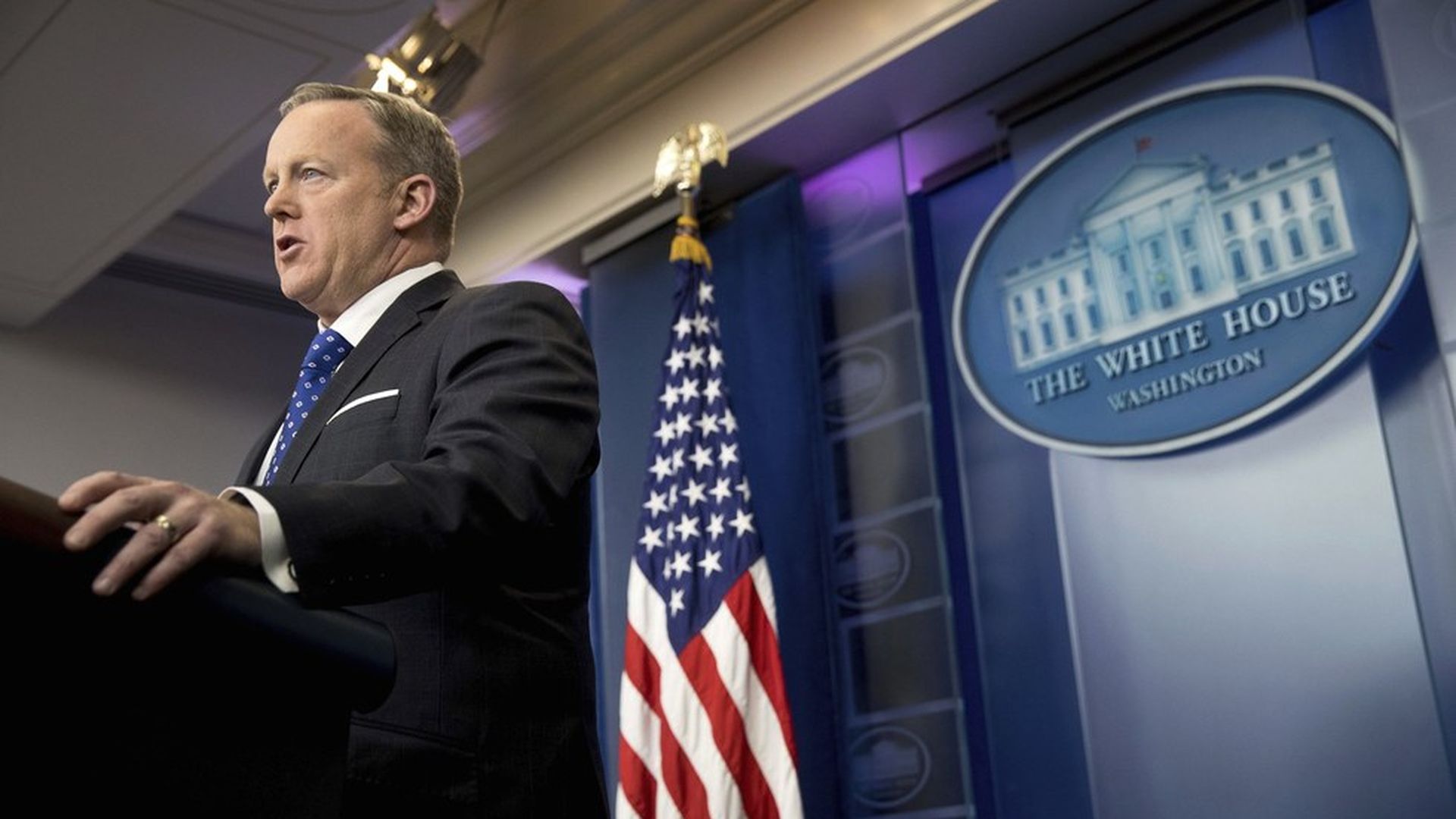
Spicer said that Trump wrapped up discussions on the federal budget — which will make sure that the government spends "more responsibly" — right before the start of the briefing. The administration expects to release the new budget plan to the public in mid-March.
Trump is about to cancel Obama's transgender bathroom rules
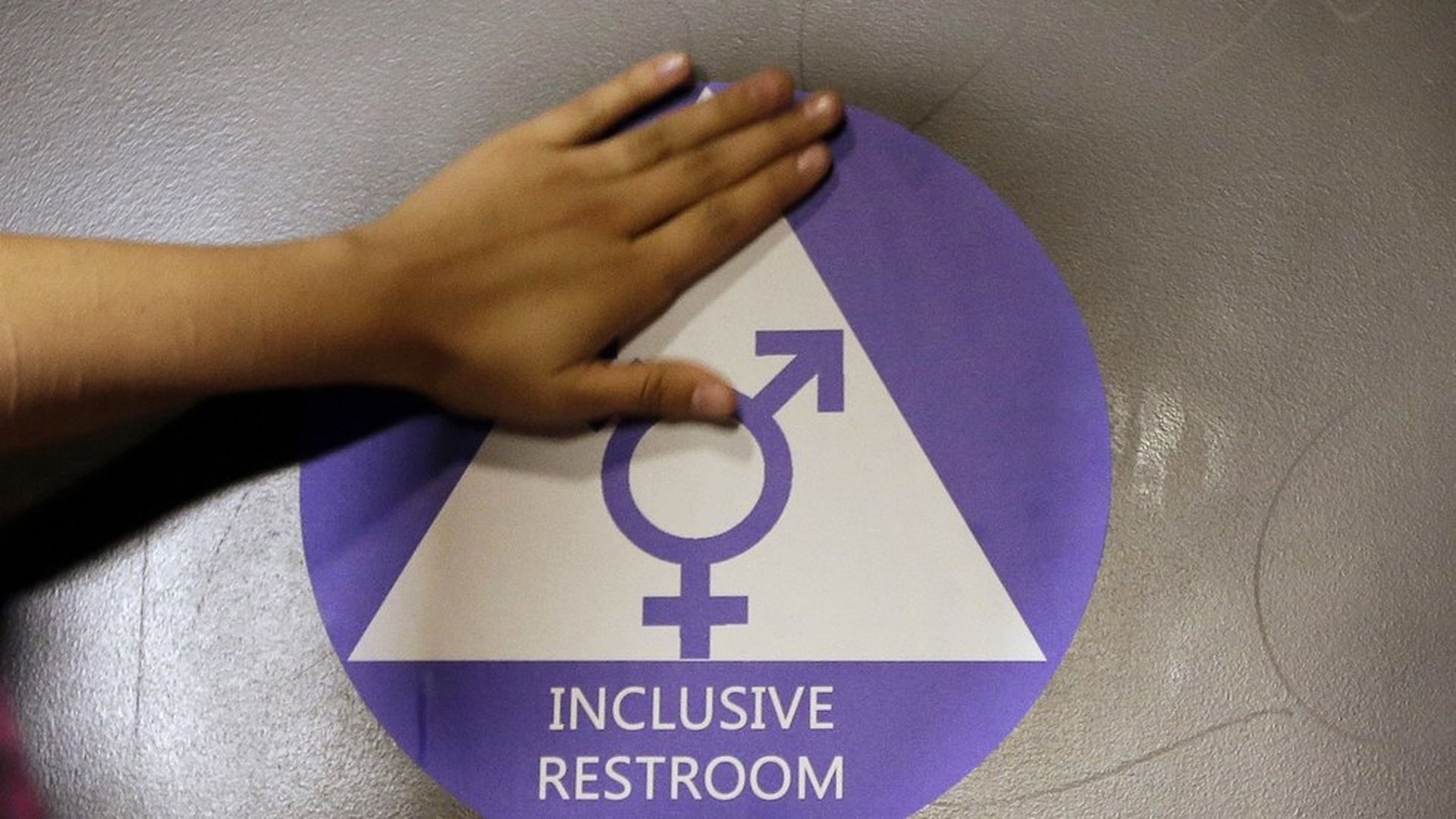
The Trump administration is expected to send a letter to U.S. schools today, instructing them to ignore Obama's guidance that allowed students to decide which bathroom to use based on their sexual identity, according to a draft obtained by the Washington Post.
The letter says it has been a struggle for schools "to understand and apply the statements of policy," but the removal of the policy "does not diminish the protections from bullying and harassment that are available to all students. Schools must ensure that transgender students, like all students, are able to learn in a safe environment."
Don't blame Devos: The new education secretary wanted to keep Obama's guidance intact, according to WaPo's sources.
To the states: Without federal guidance, the issue will be resolved on a state-by-state basis. This isn't a surprise. Trump and Spicer have often said, as recently as yesterday, that states should be able to decide what to do about transgender bathrooms.
Trump gives props to Keith Ellison for predicting his win
President Trump weighed in on the DNC chair race on Twitter at 7:20a.m. Wednesday morning:
"One thing I will say about Rep. Keith Ellison, in his fight to lead the DNC, is that he was the one who predicted early that I would win!"
His tweet is likely referring to Ellison's viral ABC interview where he told host George Stephanopoulos and NYT reporter Maggie Haberman that Trump could likely win the Republican nomination, drawing laughs from the rest of the panel:

The sunny side of Trump
We wrote yesterday what the president SHOULD do in his address to Congress next Tuesday, and got hit with calls and emails from top White House officials about what Trump WILL do.
The news: Officials swear the speech, written by Stephen Miller and others with heavy input from POTUS, is decidedly more upbeat than his inaugural address — "optimistic and uplifting."
What to know from the DHS immigration memos
Today the Department of Homeland Security released two memos, signed by Secretary John Kelly, which outline how the DHS will roll out President Trump's immigration executive orders from last month.
Spicer: deporting DREAMers isn't a White House "priority"
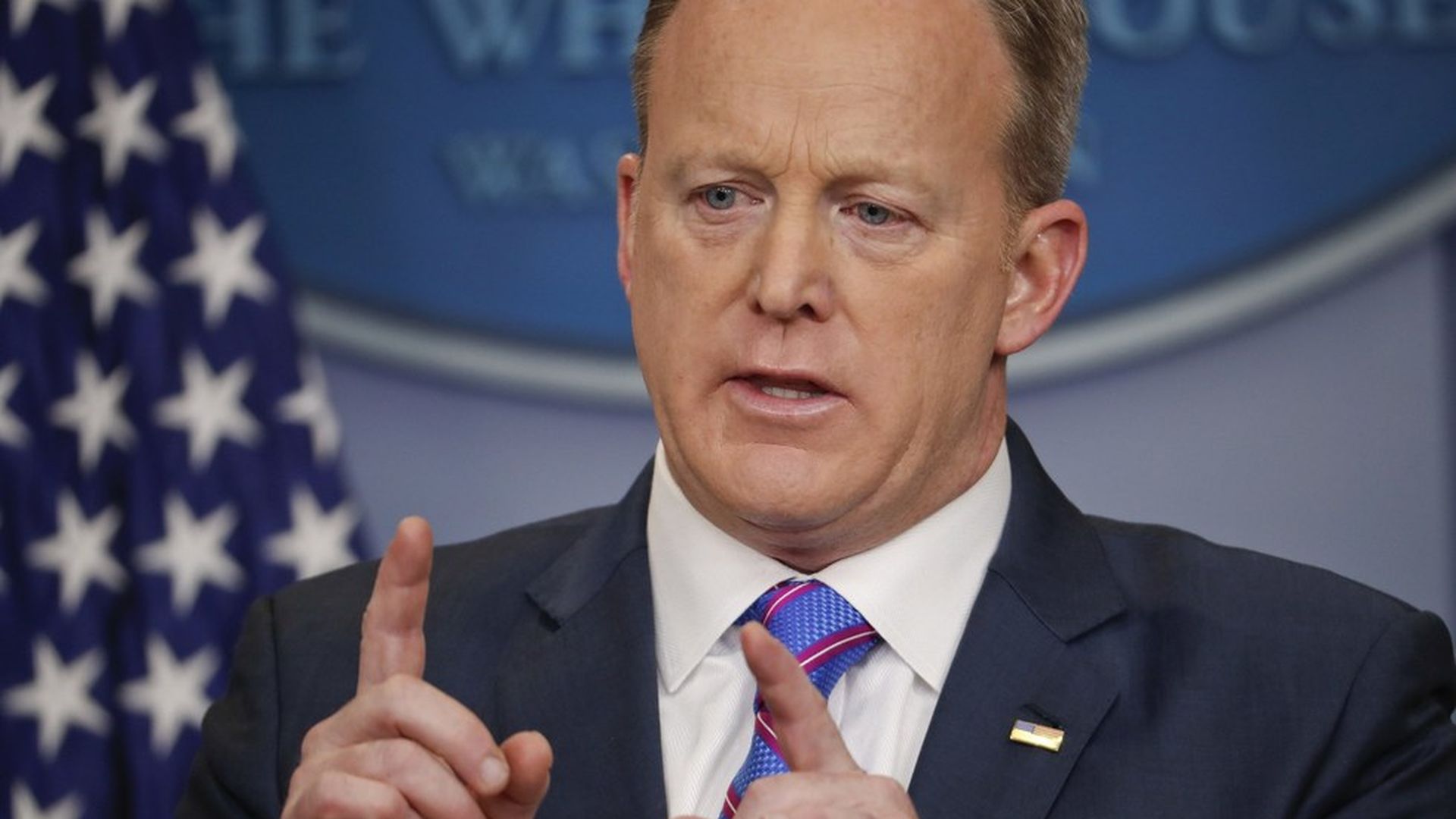
The top quote from Sean Spicer's press briefing today: "One of the beauties of history is that we don't repeat itself." (Has he ever watched one of his press briefings?) Today's highlights...
- Immigration executive orders: Spicer said that mass deportation is not the goal and that deporting criminals is "the number one priority." He said that with up to 15 million illegal immigrants in the United States, "the president wanted to take the shackles off individuals in the agencies [like DHS, ICE, and CBP]."
- McMaster: Spicer said that Trump's new national security advisor H.R. McMaster has "full authority to structure the office as he desires," insinuating Trump would even consider removing Steve Bannon from the NSC's Principals Committee if recommended.
- Obama administration's transgender bathroom guidance: "This should not involve the federal government. This is a states' rights issue."
- Trump's visit to the Museum of African-American History and Culture: Trump especially liked the Muhammad Ali exhibit, featuring the quote: "I shook up the world."
- On the Anne Frank Center's statement condemning the administration: ""I saw that statement. I wish they had praised the president for his leadership in this area...It's ironic that no matter how many times he talks about this that it's never good enough."
Meet H.R. McMaster, Trump's new national security adviser
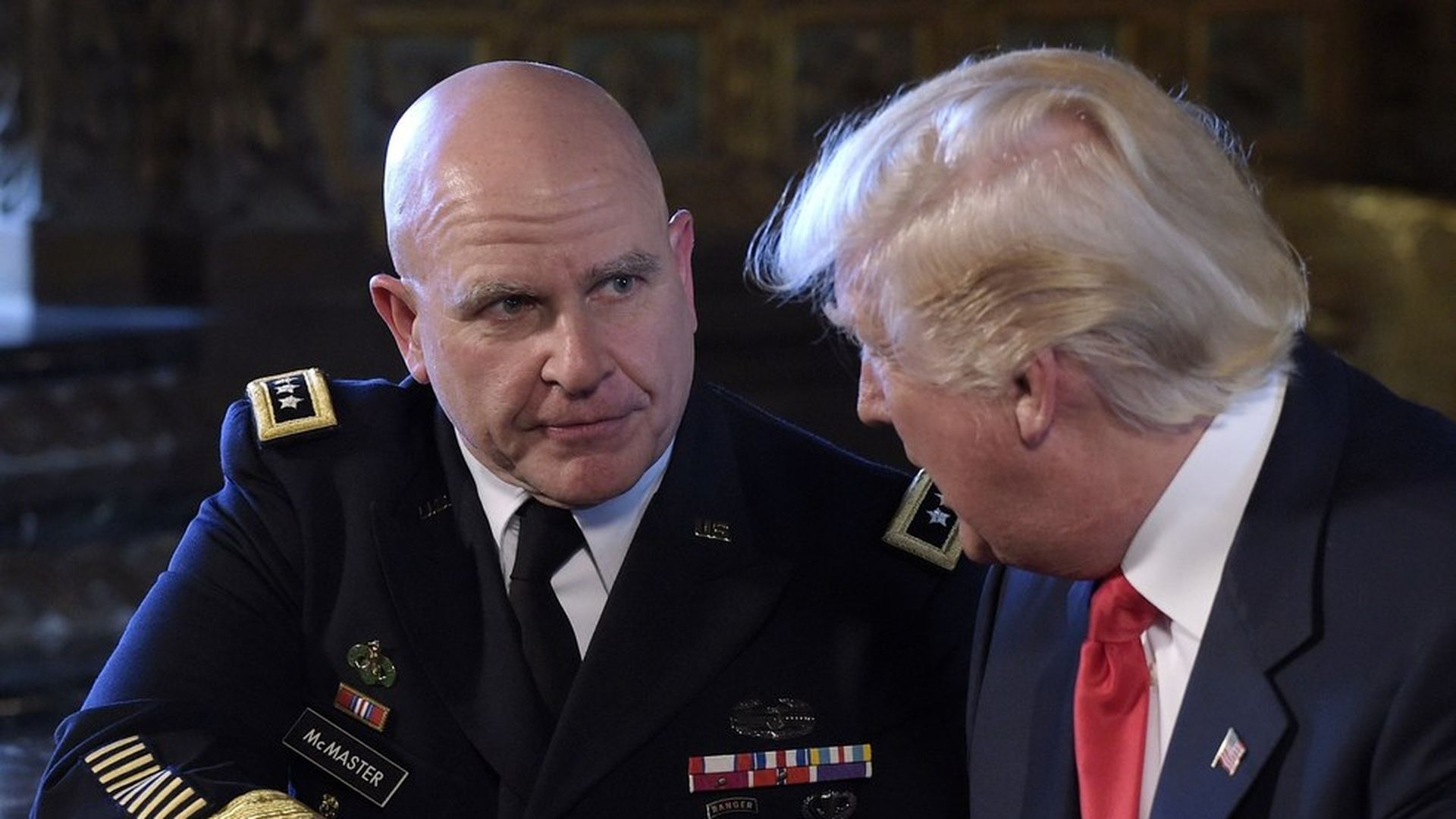
Trump has appointed General H.R. McMaster as his new national security adviser. The H.R. stands for Herbert Raymond, but the West Point grad with a PhD in American history just goes by H.R.
McMaster served with Secretary of Defense James Mattis in Iraq, and is now a three star General. He'll remain in the military while serving as Trump's national security adviser.
He wrote a popular book on the Vietnam War — Dereliction of Duty — which blamed the then-Joint Chiefs of Staff for not standing up to President Johnson and preventing the war. McMaster is known for being outspoken, and was listed as one of the 100 most influential people by Time Magazine in 2014.
How he differs from Trump: Compared to predecessor Michael Flynn, McMaster is much more moderate on his stance toward Islam, being careful to separate the religion from extremist groups. He also considers Russia a growing threat, according to Politico, and has focused on how to fight their tactics.
Why you should be depressed

David Brooks' latest column cites a Commentary magazine article and a Tyler Cowen book to point a finger at the foundation of our 21st century problems: declining economic growth.
- Slowing GDP: Between 1948 and 2000, the U.S. economy grew at a per-capita rate of about 2.3% a year. But from 2000 on per-capita growth has averaged less than 1%.
- Fewer hours of paid work: Between 1985 and 2000, the total hours of paid work increased by 35%. Over the next 15 years, they increased by only 4%.
- Declining employment: For every American man aged 25-55 looking for employment, 3 have dropped out of the labor force.
- More screen-time: Labor-force dropouts spend on average 2,000 hours a year watching some sort of screen.
- Increased drug use: About 50% of men who have dropped out take pain medication on a daily basis.
Trump denounces "horrible" anti-Semitic incidents
During a tour of the Smithsonian's new African American museum this morning, Trump gave a statement denouncing the threats targeting the Jewish community. He described the attacks as "horrible and painful," as well as a "sad reminder of the work that still needs to be done to root out hate, and prejudice, and evil."
His comments come after a series of anti-Semitic incidents over the weekend. Vandals destroyed about 100 headstones at a Jewish cemetery in St. Louis, and Jewish Community Centers in several U.S. cities received a number of bomb threats that were later determined to be hoaxes.
Though the White House released a statement on Monday condemning the bomb threats — stating that "hatred and hate-motivated violence of any kind have no place in a country founded on the promise of individual freedom" — many people, including Hillary Clinton, pressured Trump to personally speak out against the attacks.

Inside Trump's SCOTUS strategy
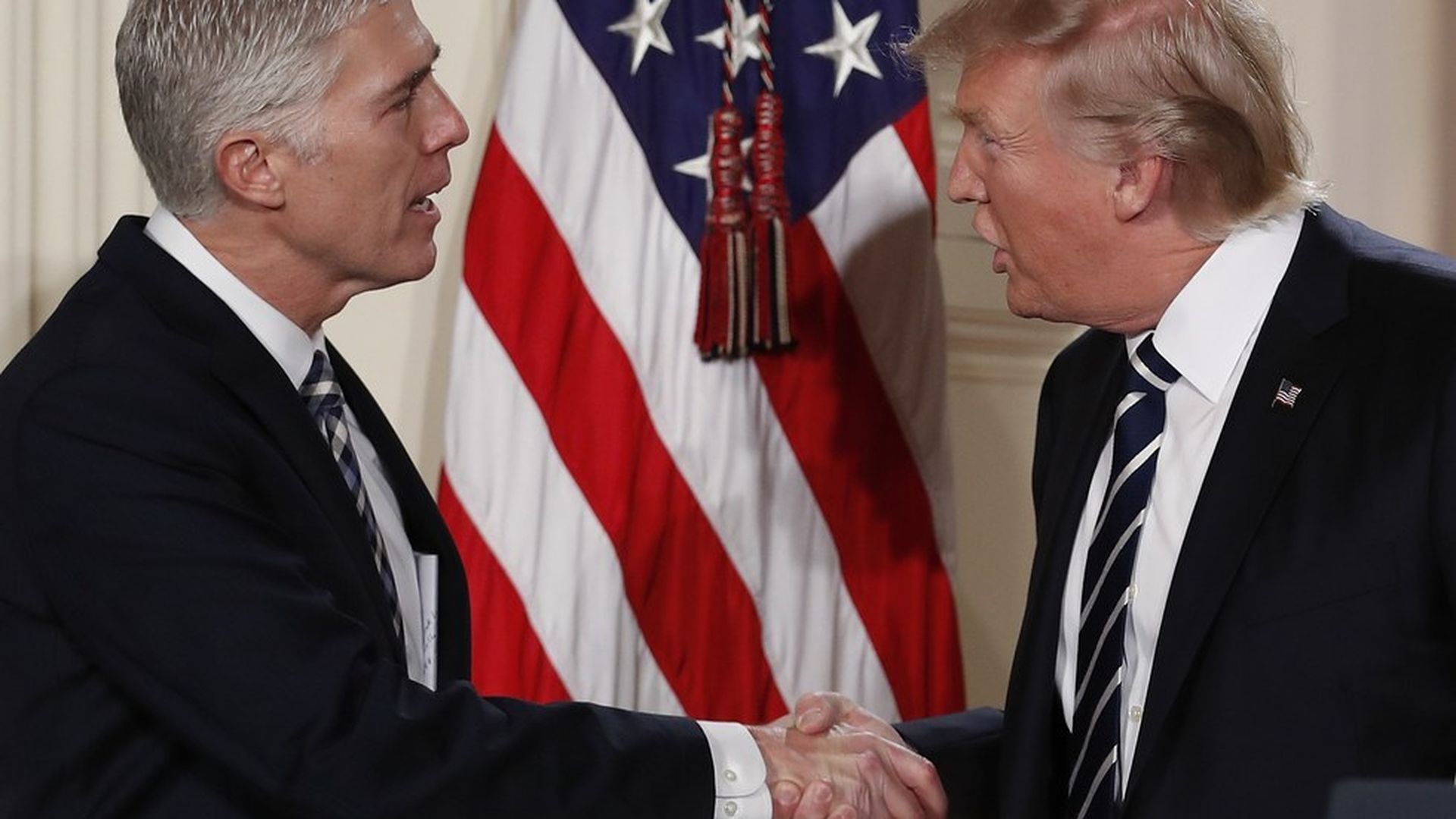
The Trump team's strategy to confirm Supreme Court Neil Gorsuch has boiled down to a single psychological advantage: They're betting Democratic Senate leader Chuck Schumer has more powerful incentives than Republicans to avoid the "nuclear option."
Trump's inner circle on the court fight doesn't view the nuclear option as a disappointing fallback. Far from it. They'd see its use now as a major strategic victory.
Why this matters: Democrats are in a tougher spot on the Supreme Court than many realize. The base is braying for total warfare, and Schumer is channeling that pressure. Red state Democrats, however, are concerned about their re-election chances in 2018, and some are telling their more bipartisan Republican colleagues that they're worried about facing primary challenges from the left.
Trump's one big chance for a reset
For all the talk of resets for President Trump, there's just one that matters, at least on Capitol Hill — one big chance to steady a wobbly agenda. A week from tonight, Trump addresses Congress for the first time — the ceremonial joint session known as State of the Union except in a president's first year.