
Axios Generate

August 14, 2023
🍳 Good morning! Today's newsletter has a Smart Brevity count of 1,276 words, 5 minutes.
🎵 This week in 1975, Linda Ronstadt released her beautiful take on a Neil Young-penned song that's today's intro tune...
1 big thing: Volcanic boost sparks a climate debate

Illustration: Allie Carl/Axios
A climate science debate is simmering over how much of 2023's record warmth is due to human-caused factors, and the role of other influences, Andrew writes.
Why it matters: It's critical to gaining a better understanding of what is driving the sudden spike in global average surface temperatures, accompanied by scorching and deadly heat waves, wildfires and flooding.
The big picture: July was Earth's warmest month on record, and the oceans are historically warm. Some of the summer's heat waves would have been "virtually impossible" without human-caused global warming, experts say.
- The combination of the burning of fossil fuels and an intensifying El Niño event in the tropical Pacific Ocean is widely viewed as the primary driver of 2023's extremes.
- However, climate scientists are looking at what is happening and observing shifts that are more sweeping and rapid than they expected, even though the overall warming trends, El Niño's arrival and associated impacts were well-forecast.
- "Despite this being anticipated, I think we're all having an instinctual reaction that we're in territory we've not seen before," said Michelle L'Heureux, who leads El Niño forecasting at the National Weather Service.
Zoom in: Some scientists are pointing to two other factors as potential explanations for this year's myriad climate extremes.
- One is a reduction in pollution from marine shipping vessels, via rules that went into effect in 2020. Fewer emissions of sulfate aerosols, which are tiny particles contained in ship exhaust and other sources, are thought to be unintentionally leading to more ocean warming.
- Berkeley Earth, an independent climate monitoring group, notes in a report out today that these effects are mainly confined to major shipping corridors and are relatively small in global impact — on the order of about 0.02°C (0.036°F).
Between the lines: Another suspected accomplice in 2023's record warmth is the 2022 explosive eruption of the Hunga Tonga-Hunga Ha'apai undersea volcano in the southern Pacific Ocean, which injected about 150 million metric tons of water vapor into the stratosphere.
- Water vapor is a powerful greenhouse gas, and computer model simulations show this stratospheric injection could enhance warming in some areas through the end of the decade.
The intrigue: Hunga Tonga's eruption boosted the stratosphere's water content by about 15%, according to Berkeley Earth, without adding larger amounts of cooling sulfur dioxide.
- However, the eruption alone cannot fully explain the record warmth of 2023, climate scientists told Axios.
What they're saying: Climate scientist Zeke Hausfather summarized the volcano's contribution to 2023's record high temperatures this way: "So, not nothing, but only a small part of the story in the exceptional warmth the world is experiencing," he told Axios via email.
2. Big Oil is getting more and more DAC-curious

Illustration: Sarah Grillo/Axios
Oil giants are increasingly testing the waters in the nascent direct air capture (DAC) industry, Ben writes.
Driving the news: Chevron will receive up to $3 million to help explore feasibility of a DAC project in California, the Energy Department revealed Friday.
- And Shell's part of a consortium with Louisiana State University and the University of Houston. DOE may provide them with $3 million to explore a DAC "hub" in the Pelican state.
- Both grants, which are subject to negotiation, are on the wider list of planned awards through the $3.5 billion DAC "hubs" program.
- Shell also revealed Friday that it's building a DAC demo facility in Houston, with planned startup in 2025.
State of play: That (relatively) minor funding came alongside DOE awarding up to $1.2 billion to two consortiums to build large-scale DAC "hubs."
- Occidental Petroleum — the petro-player most involved in DAC — leads one of them.
Catch up fast: Oil giants have already been making investments and working with DAC startups in recent years.
- Chevron's an investor in Carbon Engineering, which is part of the Occidental-led consortium.
- Shell, Equinor and Repsol are backing DAC startup RepAir.
- Exxon's working on a pilot project, per Energy Intelligence.
Quick take: Big Oil's DAC-curiosity dovetails with its longstanding work on carbon capture and sequestration.
- Chevron, in response to an Axios inquiry, noted it has deep experience with big projects and subsurface expertise.
Yes, but: Some environmentalists oppose DAC.
- It "allows polluting industries to live on when we should be focusing on a just transition to renewables," Marion Gee, co-executive director of the Climate Justice Alliance, said after DOE's funding announcements Friday.
The bottom line: It's still early days, but Big Oil wants to reserve a seat in case DAC truly takes off.
3. The new climate law is upending the solar landscape
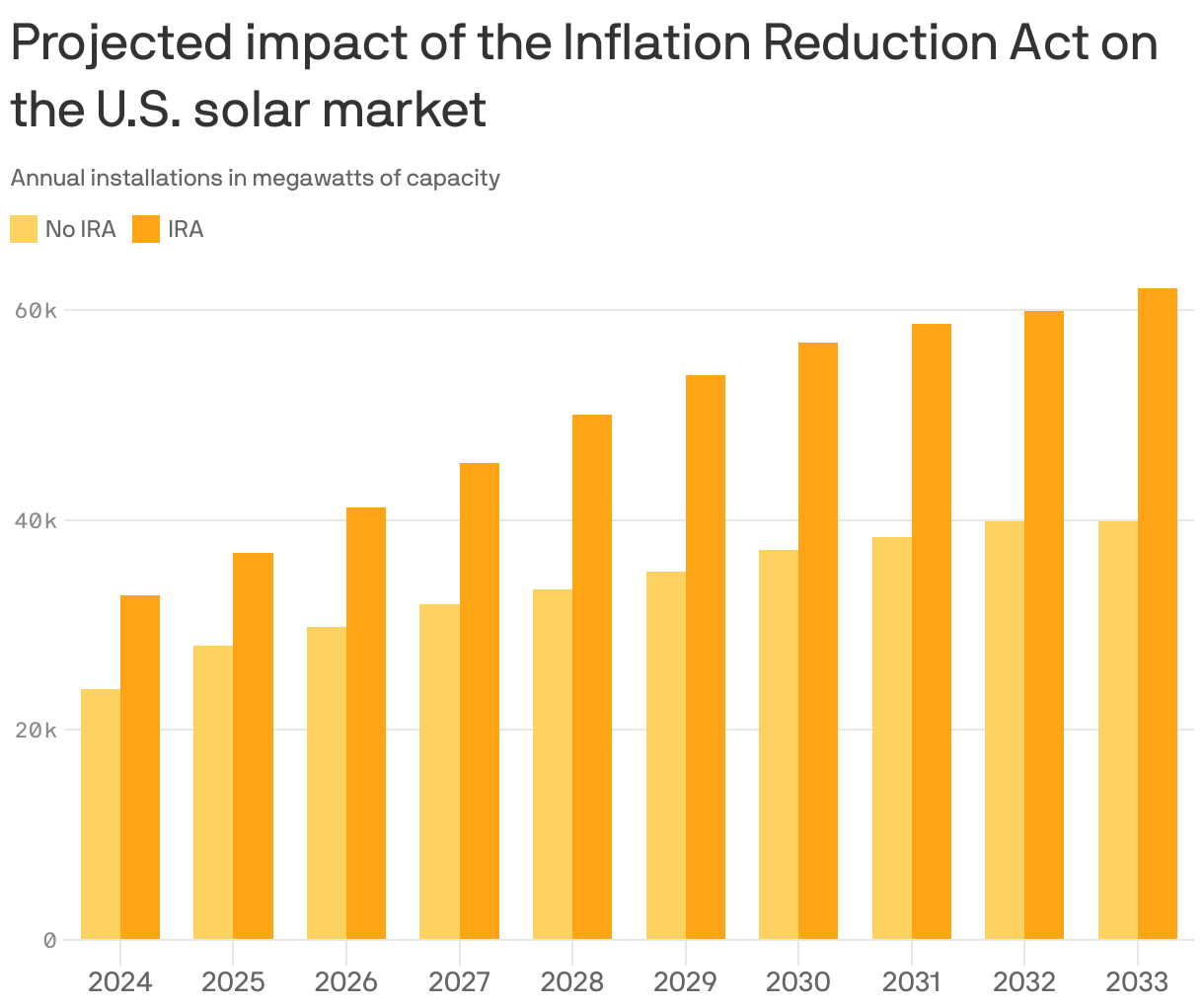
The year since passage of the big climate law has brought over $100 billion in U.S. solar and storage company investments, Ben writes.
Why it matters: New data from the Solar Energy Industries Association (a major industry trade group) on private investment suggests the law's subsidies for manufacturing and generation are significantly boosting industry activity levels.
- The chart above shows how SEIA and the consultancy Wood Mackenzie see the law boosting power projects.
The big picture: On the manufacturing side, the last year has seen billions worth of project announcements from companies like First Solar, Maxeon and Qcells.
- Overall, in the year since passage, there have been 51 new or expanded manufacturing projects announced, SEIA said.
- "By 2026, the U.S. will have over 17 times its current manufacturing capacity across modules, cells, wafers, ingots, and inverters when these announced factories are in operation."
The bottom line: Counterfactuals are hard because the industry was growing already, but it seems safe to say the new federal subsidies are accelerating activity — a lot.
4. Heat wave builds across the Pacific Northwest

Forecast temperature departures from average across northern California, Oregon and parts of Washington State on August 14. Image: Weatherbell.com.
It's the Pacific Northwest's turn to see scorchingly high temperatures as a heat dome builds across the region, Andrew writes.
Threat level: The National Weather Service has issued excessive heat warnings and heat advisories from California's Central Valley to all of Oregon and Washington State through mid-to-late this week.
- High temperatures are forecast to soar into the low 90s°F in and around Puget Sound, including Seattle, and as high as the 110s°F in parts of Oregon, per the National Weather Service.
- "These temperatures combined with the duration of heat, expected to continue through this week, will increasingly pose a heightened health risk, especially for those without adequate air conditioning," the NWS warns.
Context: Studies show that human-caused climate change is driving heat waves such as this one to be hotter, more likely to occur and longer-lasting.
By the numbers: Portland, Oregon could see three days in a row with highs in the triple digits, beginning today (Axios Seattle has more).
- Salem, Oregon could see its highest temperature on record during August if the temperature exceeds 108°F, which may occur Monday or Tuesday.
- Seattle is forecast to see highs near 90°F through late this week.
5. Hydrogen-powered trucks seek their lane

Illustration: Sarah Grillo/Axios
Hydrogen-powered semitrucks are finally coming to market, alongside new efforts to boost hydrogen fuel, Axios' Joann Muller reports.
Why it matters: Zero-emissions trucks — powered by electric batteries or hydrogen fuel cells — could help fight climate change and improve health outcomes for millions of people.
- Transportation is the largest contributor to U.S. greenhouse gas emissions.
- Diesel truck noise and pollution is especially harmful to low-income people of color living close to major trucking corridors.
State of play: Hydrogen is having a moment.
- It has long failed to take off for a host of practical reasons: It's costly and difficult to produce clean hydrogen, for instance, and there's no nationwide distribution network.
- But the Biden administration hopes to change that with new incentives for U.S. hydrogen production, which could help bolster sales of hydrogen-powered trucks now being introduced by a handful of manufacturers, including Toyota, Hyundai, Nikola and Cummins.
The intrigue: While it's clear that trucking needs to clean up its act, there's debate over whether that's best achieved with hydrogen or battery-electric trucks.
📬 Did a friend send you this newsletter? Welcome, please sign up.
🙏 Thanks to Chris Speckhard and Javier E. David for edits to today's edition, along with the talented Axios Visuals team.
Sign up for Axios Generate

Untangle the energy industry’s biggest news stories


