How smokejumpers fight Oregon wildfires: A day in the life

Add Axios as your preferred source to
see more of our stories on Google.
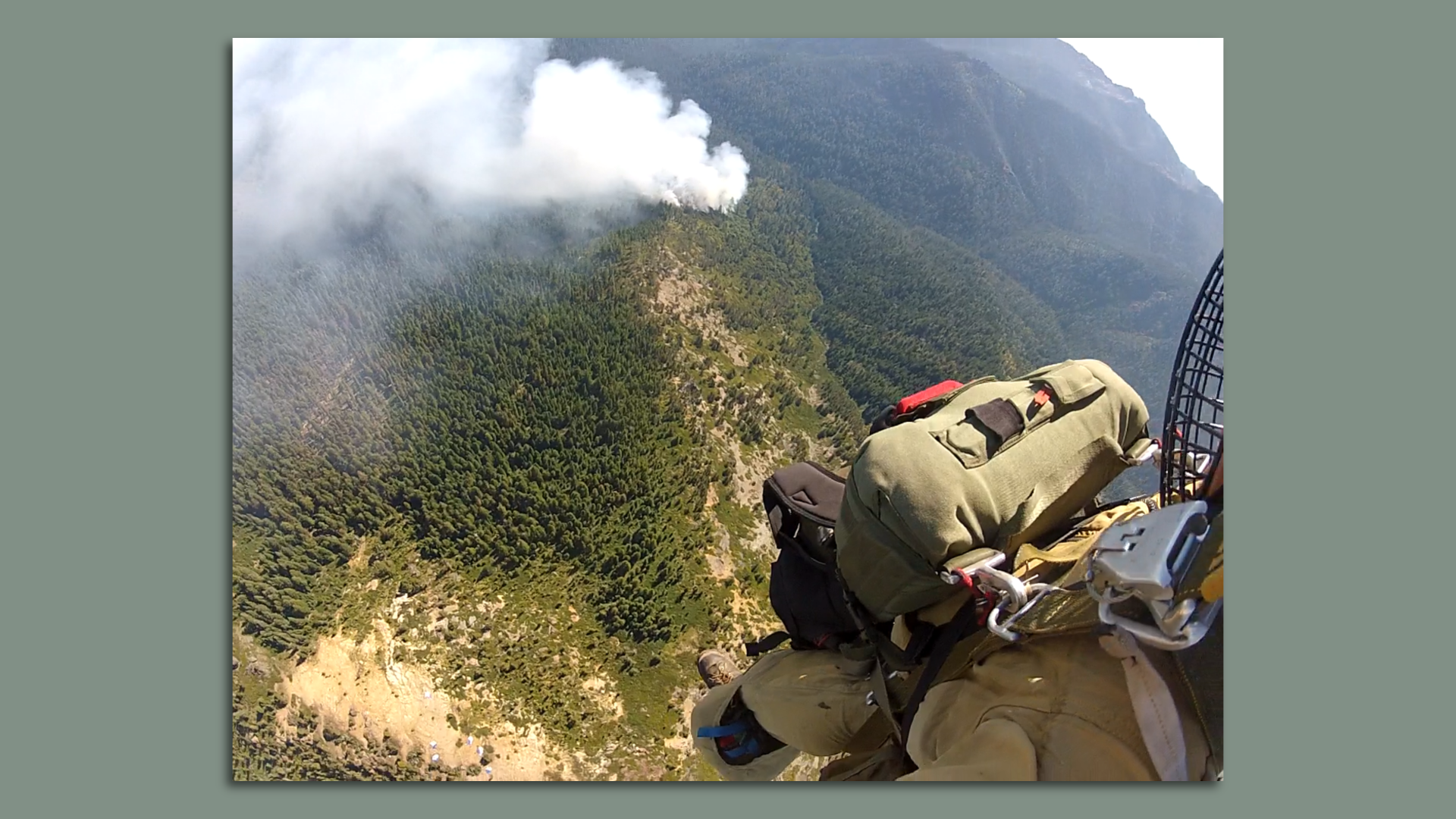
A smokejumper descends into a wildfire. Photo courtesy of the US Forest Service.
When the siren goes off inside Redmond Air Center, initial attack firefighters — also known as smokejumpers — pack on a parachute, load into a Short C-23 Sherpa plane and get ready to descend into the throes of an active wildfire, often in hard-to-reach, rugged terrain.
What's happening: By the time wildfire season settles down across the West Coast in mid-October, many of the 50 smokejumpers headquartered on the Redmond Smokejumper Base in central Oregon — the only team in the state — have clocked nearly 1,500 hours in overtime.
- "You're really talking about 21 months of work in a 12-month period," Josh Cantrell, a smokejumper and Redmond base manager with the US Forest Service, tells Axios.
- "It can be a highly labor intensive, time consuming, life consuming endeavor to be a wildland firefighter."
Why it matters: Smokejumpers are the first line of defense against wildland fires, not only here in the Pacific Northwest but across the country.
- Their mission is to capture a wildfire fast, while it's still small and shortly after it's identified by an aerial lookout or smoke-detection cameras positioned in state and national forests, Cantrell said.
How it works: After the siren goes off, up to 10 smokejumpers load onto a cargo aircraft already packed with the necessary equipment — sleeping bags, chainsaws, hoses, hand tools, gasoline, parachutes, food and water.
- With a bird's eye view, spotters locate the wildfire and nearby fuels (old-growth trees, shrubs, dead leaves and pine needles) as well as analyze the fire's activity — whether it's smoldering or creeping — and its size.
- Once a jump spot is identified, the smokejumpers leap from the plane, land on the ground and report to dispatch their latitude and longitude. Then the work begins.
Smokejumpers hike to the fire and perform suppression tactics — establishing the lowest point of the fire, creating a line of attack, and separating what is burning from what is not.
- This can mean cutting down trees, extinguishing smoldering areas or identifying a nearby water source to run a small pump through.
Meanwhile, if the fire's intensity continues to grow, smokejumpers then call in for additional resources, including fire retardant airplanes or helicopters equipped with water buckets.
Yes, but: The grunt work is exhausting, especially if that season's weather pattern predicts wind and dry lightning.
- The busiest seasons for smokejumpers are when there are tons of small fires — not the big ones, like the Golden Fire or Flat Fire that Oregon saw this summer, even though Cantrell's team does provide support for those, too.
- "We're busy regardless," he said.
The intrigue: Redmond's smokejumpers don't just fight fires in Oregon. They can be sent as far north as Alaska and Montana, and as far south as California or the Great Basin in Nevada.
- And for Cantrell, who's been on the job for 26 years, that's what makes the overtime worth it.
- "There's an allure to starting your day here and ending up someplace else," he said. "That sort of unknown is an experience that not everybody gets in their professional life."