How Trump's return-to-office order affects Chicago's federal employees

Add Axios as your preferred source to
see more of our stories on Google.
President Trump signed an executive order this week mandating that federal employees return to the office full-time.
Why it matters: The U.S. government is the biggest employer in Chicago, with nearly 50,000 workers.
- Return-to-office pushes can often be a way for companies (and governments) to do layoffs without technically having to fire anyone.
- For the Trump executive order, that appears to be the plan.
The big picture: Major companies have pushed employees to return to the office for years now, even though many workers have signaled they're not ready to be in an office full-time. Trump's decision could encourage even more private employers to follow suit.
What they're saying: "This directive turns back the clock to before 2010 when Congress required federal agencies to expand telework by law," said American Federation of Government Employees (AFGE) president Everett Kelley. "Congress took this action a full decade before the pandemic, recognizing telework as an important tool for agencies' operational efficiency."
Between the lines: Sen. Joni Ernst (R-Iowa) and Elon Musk have suggested that hardly any federal employees work in-person full-time, but the union says among those who are eligible for telework, more than 60% worked in-person.
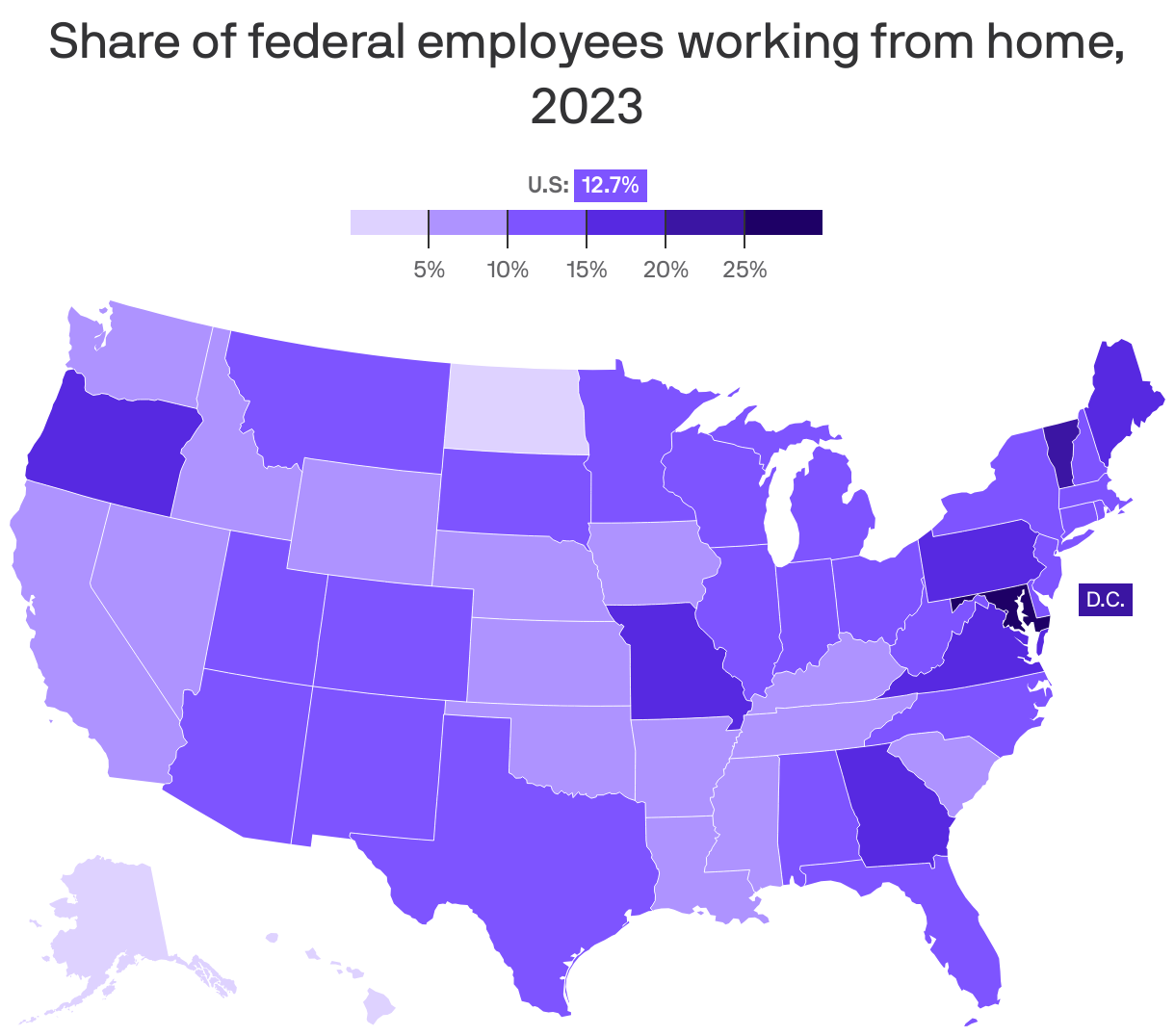
By the numbers: Of 149,000 federal employees in Illinois, including the military, 13.2% worked from home at least once the week before they were surveyed in 2023, according to the Census Bureau.
Zoom in: AFGE Local 704 represents 1,000 federal Environmental Protection Agency workers across the Midwest. Union president Nicole Cantello tells Axios their union agreement includes fully remote work and telework, which allows employees to be at home eight out of 10 days in a two-week pay period.
- "It's the union's position that the telework should continue under our collective bargaining agreement," Cantello says.
- "We believe that there will be a number of people who will decide that they do not want to stay because the administration has made it so unpalatable. But we are asking people to stand strong."
Zoom out: If more workers start commuting to downtown and regional federal office buildings, traffic could worsen and business in the loop, especially for restaurants, could pick up.
- "I think that that [return to office] is maybe having the biggest impact on our business. There are days when you see that the offices are full, that it's really rocking and rolling, and it feels great downtown," Lettuce Entertain You partner Jerrod Melman recently told Axios.
What's next: The Office of Personnel Management, in a memorandum dated Wednesday, recommended agencies set a target of having all workers back in the office full time within 30 days "subject to any exclusions granted by the agency and ... collective bargaining obligations."