President Biden's election-year budget lays out a possible second-term health care agenda focused on advancing policies that were scaled back or dropped fromthe defining legislative fights of his first term.
Why it matters: Presidential budgets are largely political messaging tools, and the fiscal year 2025 blueprint released Monday highlights Biden's preference to build on populist health reforms rather than push sweeping overhauls that tend to be divisive.
Some of America's bluest cities and states are abandoning progressive approaches to drug use and homelessness, instead embracing harder-line measures amid political backlash.
Why it matters: The worsening drug overdose, mental health and housing crises that are often intertwined and increasingly spill into U.S. streets are fueling the shift away from more compassionate approaches.
The big picture: The pharmacy giant neither admitted nor denied wrongdoing in the settlement, which included payment of $50,000 to cover costs including civil penalties, in news first reported by Reuters. But it did agree to not overcharge on such items.
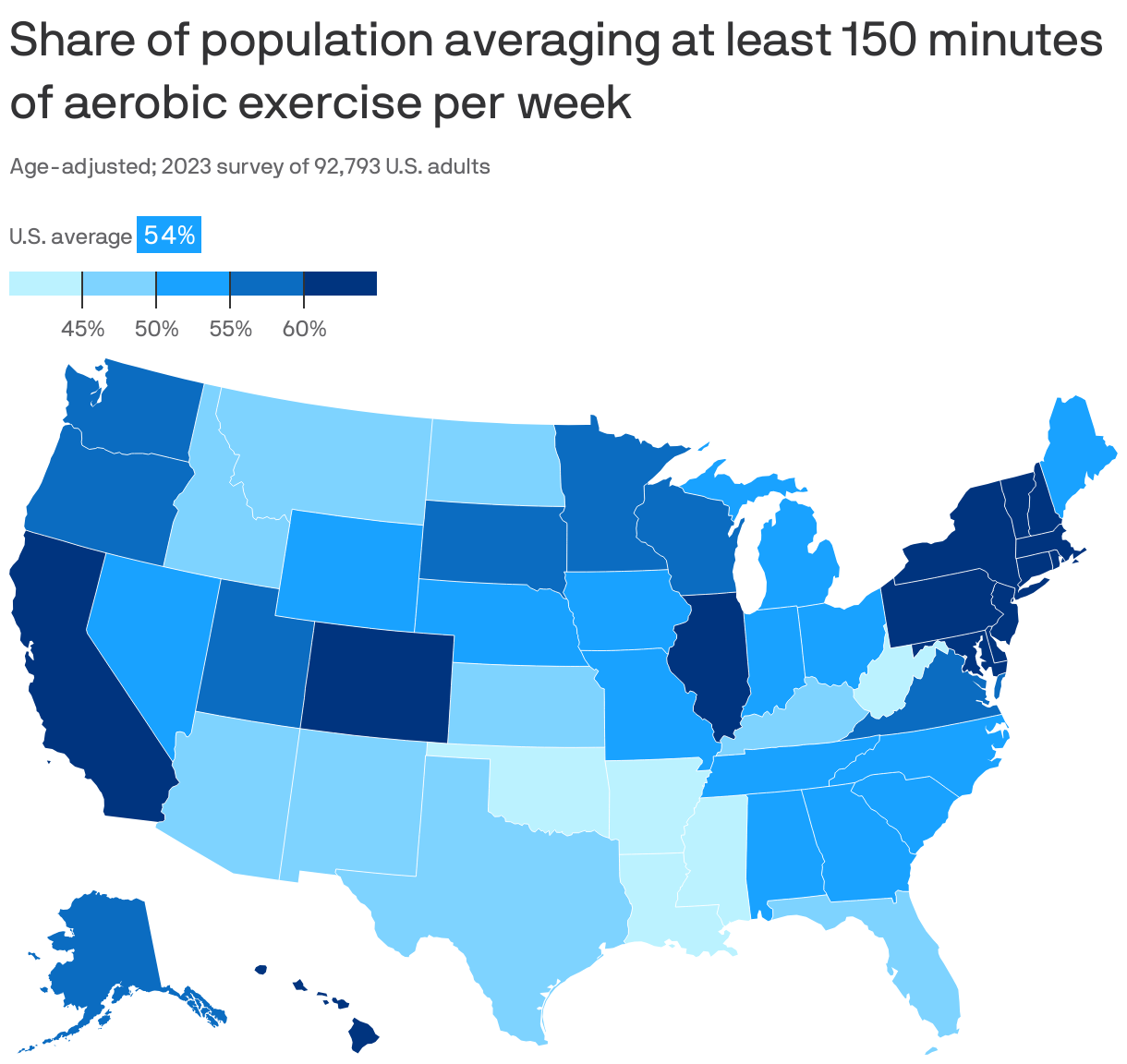
Massachusetts may be the U.S. state where residents get the most aerobic exercise, according to new Apple Watch data.
Why it matters: Many adults don't put in the recommended 150 minutes of weekly aerobic exercise, although they could hit that number with five 30-minute brisk walks weekly.
The Department of Veterans Affairs is expanding in vitro fertilization benefits regardless of marital status and will allow the use of donor eggs, sperm and embryos for the first time.
Why it matters: Veterans who are unmarried or in same-sex marriages will be able to access broader reproductive care, at a time when it faces post-Roe legal challenges in several states.
Teens are largely not worried about their technology and social media use, but at least some say they want to cut back, per newly released survey data.
Scientists are sounding new alarms about the health risks from microplastics after researchers in Italy found concentrations of polyethylene and polyvinyl chloride in plaques removed from patients with cardiovascular disease.
A pair of setbacks to drugs for Alzheimer's disease and ALS on Friday served as another reminder that widely touted treatments for desperate patients aren't necessarily a sure thing.
Why it matters: Drugs are increasingly judged on the probability they'll work instead of real-world clinical results — often with energetic lobbying by patient advocacy groups.
Health care organizations last year reported the most ransomware attacks of the 16 industries identified as critical U.S. infrastructure, according to a new FBI report on internet crime.
By the numbers: The Internet Crime Complaint Center, or IC3, received more than 2,800 complaints identified as ransomware that caused adjusted losses of nearly $60 million in 2023.
Disruptions from the Change Healthcare cyberattack are costing health providers as much as $1 billion a day and creating enough of a drag to depress first-quarter earnings, analysts and industry officials say.
Why it matters: Even though Change's parent, UnitedHealth Group, has a timeline for restoring the third-party payment systems that roughly half of U.S. health care relies on, it's not as simple as throwing a switch.