The Centers for Disease Control and Prevention raised COVID-19 travel advisories to their highest levels for a number of countries on Monday, including France and Portugal.
Vulnerable Democrats are urging President Biden and congressional leaders to act quickly to prevent the Medicare cuts that will take effect on the first day of the new year.
Why it matters: Congress has little time to act before the Medicare reimbursement cuts kick in on Jan. 1, 2022, and there’s currently no vehicle on the table to push the legislation through.
New York City Mayor Bill de Blasio (D) on Monday announced a new COVID vaccine mandate for all private companies.
Why it matters: De Blasio, speaking on MSNBC's "Morning Joe," said the "first-in-the-nation measure" will go into effect starting Dec. 27. It will apply to approximately 184,000 businesses.
The U.S. will invest an additional $400 million toward COVID-19 vaccination distribution efforts, such as bolstering cold chain infrastructure and supporting delivery, USAID administrator Samantha Power announced Monday.
Why it matters: While the problem of COVID-19 vaccine supply across the world is starting to ease in some places, the logistics of getting the vaccine in arms has emerged as a major bottleneck.
There were nearly 52.7 million fee-for-service telehealth visits by Medicare beneficiaries last year, up from only 840,000 in 2019, according to data released by the HHS Office of the Assistant Secretary for Planning and Evaluation. That is a 63-fold jump year over year.
Between the lines: Massachusetts, Vermont, Rhode Island, New Hampshire and Connecticut had the highest use of telehealth in 2020.
American businesses spend hundreds of billions of dollars a year on prescription drugs, and the bills keep getting bigger. But some of the companies promising to help rein in those costs prevent employers from looking under the hood.
Why it matters: Documents provided to Axios reveal a new layer of secrecy within the maze of American drug pricing — one in which firms that manage drug coverage for hundreds of employers, representing millions of workers, obscure the details of their work and make it difficult to figure out whether they're actually providing a good deal.
Louisiana health authorities said a suspected Omicron case was one of 17 confirmed COVID-19 infections among the passengers and crew of a Norwegian Cruise Lines ship that returned to New Orleans Sunday.
Driving the news: The Norwegian Breakaway departed New Orleans on Nov. 28 with more than 3,200 people on board, before making stops in Belize, Honduras and Mexico, according to a Louisiana Department of Health statement.
CDC director Dr. Rochelle Walensky on Sunday said that the number of Omicron coronavirus cases in the United States is "likely to rise."
Why it matters: The newly discovered variant has already been detected in at least 15 states, fueling concerns about the strain's ability to drive up a new wave of infections.
Vaccination rates are going up, people are going out to restaurants again — although the new COVID variant may get in the way — but they still aren't rushing back to the movies.
By the numbers: Some 49% of pre-pandemic moviegoers are no longer hitting theaters, according to a study from the film research company The Quorum, as reported by the New York Times.
European countries are doubling down on pressure campaigns to get people vaccinated just as Republicans continue to wage war — often successfully — against vaccine mandates in the U.S.
Why it matters: The starkly different approaches create a sharp contrast between the regions' approaches to vaccination, even as the Omicron variant rapidly spreads around the world.
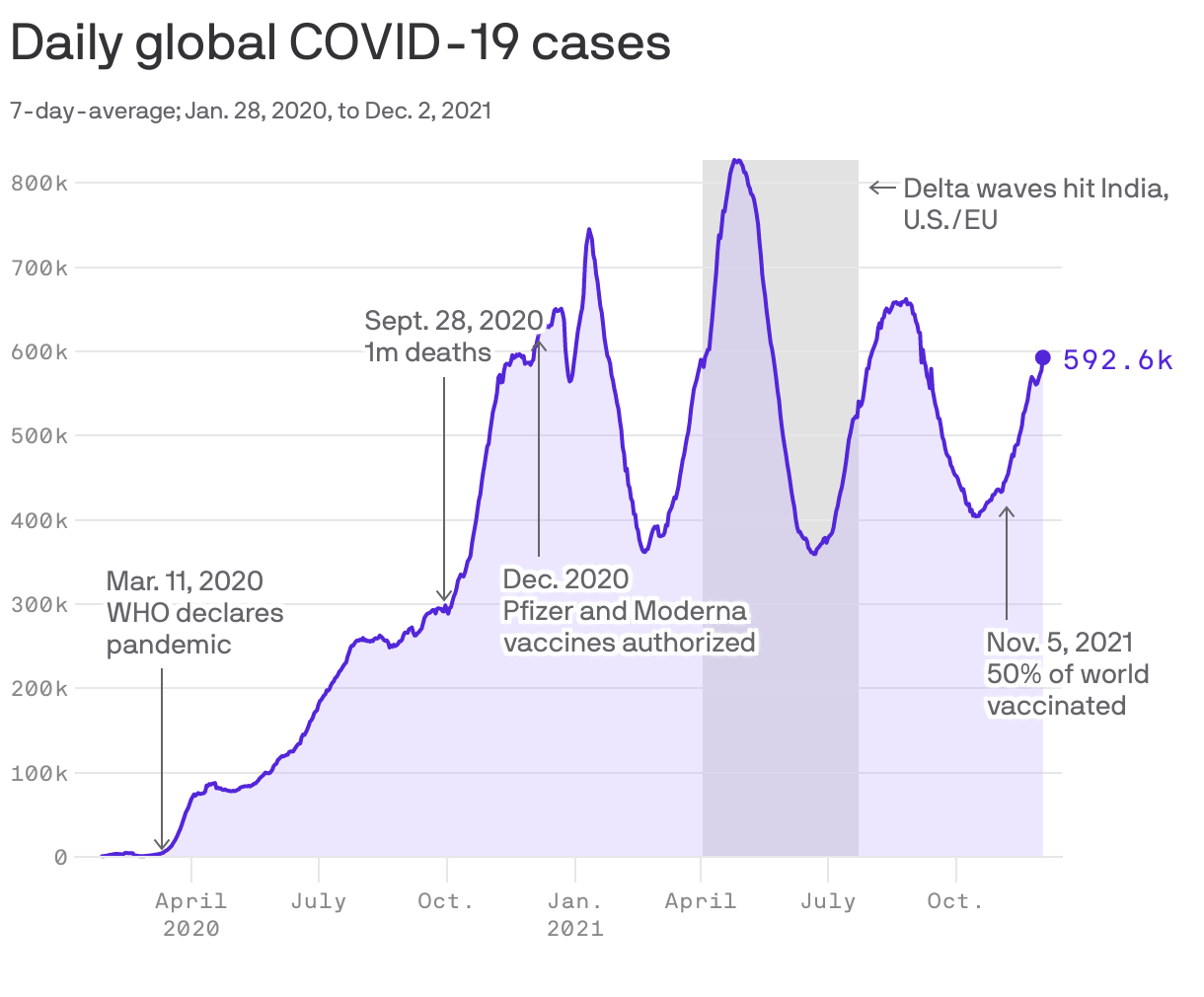
Two years ago Wednesday, the first case of a mysterious new respiratory disease was discovered in Wuhan, China. Now, the Omicron variant has deepened concerns about just how much longer the coronavirus pandemic will last.
The big picture: More than 5 million people have died since that first case. Most people on earth have lived through some form of lockdown. 54% of the global population has had at least one vaccination, though the shots have been distributed unevenly.